GATE 2024 EC Paper: Worked Solutions to All 65 Questions
All 65 questions of the GATE 2024 EC paper (IISc Bengaluru), in paper order. Try each one, then open its answer: the official answer from the answer key and a worked solution. Every answer matches the key, and every numerical answer was recomputed from the question's values.
Q.1
General Aptitude1 markMCQ
If → means increasing intensity, then [charm → enamor → bewitch] is analogous to [bored → ____ → weary]. Which word fills the blank?
Full question on page 1 of the official paper (PDF)
Show answerHide answer
Key idea: The missing word must be a stronger kind of boredom than bored, but milder than weary.
Official answer: A
Each step in the first group is a stronger version of the same feeling. Jaded means tired and dulled by too much of something, which sits between being bored and being weary of it.
Baffled is confusion, dead isn't a degree of boredom, and worsted means defeated. Option (A).
Q.2
General Aptitude1 markMCQ
P, Q, R, S and T share an office of three rooms. Two of them are siblings, and siblings must not share a room. S and Q are single children. Two acceptable allocations are: rooms {P, R}, {T, S}, {Q}; and rooms {P, Q}, {R, T}, {S}. Who are the siblings?
Full question on page 2 of the official paper (PDF)
Show answerHide answer
Key idea: Anyone who shares a room in an acceptable allocation can't be the sibling pair.
Official answer: A
S and Q have no siblings, so the pair is two of P, R and T. Pairs that share a room in an acceptable allocation are ruled out: P and R (first allocation) and R and T (second).
That leaves P and T. Option (A).
Q.3
General Aptitude1 markMCQ
Five years ago, the ratio of Aman's age to his father's was 1 : 4. Five years from now it will be 2 : 5. How old was his father when Aman was born?
Full question on page 3 of the official paper (PDF)
Show answerHide answer
Key idea: Write the two ratios as two linear equations in the present ages.
Official answer: B
With present ages a and f:
The first gives f = 4a - 15. Substituting, 5a + 25 = 8a - 20, so a = 15 and f = 45. The father was 45 - 15 = 30 when Aman was born. Option (B).
Learn the idea:
Q.4
General Aptitude1 markMCQ
For a real number , . What is ?
Full question on page 3 of the official paper (PDF)
Show answerHide answer
Key idea: 1/\log_b x = \log_x b, which turns the sum into a single logarithm.
Official answer: C
So x = 24. Option (C).
Learn the idea:
Q.5
General Aptitude1 markMCQ
What is the greatest prime factor of ?
Full question on page 4 of the official paper (PDF)
Show answerHide answer
Key idea: Take out the common power of 3 first.
Official answer: A
The prime factors are 2, 3 and 13, so the greatest is 13. Option (A).
Learn the idea:
Q.6
General Aptitude2 marksMCQ
Order the sentences into a coherent passage. P: Shifu's student exclaimed, "Why do you run since the bull is an illusion?" Q: Shifu said, "Surely my running away from the bull is also an illusion." R: Shifu once proclaimed that all life is illusion. S: One day, when a bull gave him chase, Shifu began running for his life.
Full question on page 5 of the official paper (PDF)
Show answerHide answer
Key idea: Set up the claim before the incident that tests it, and end on the reply to the question.
Official answer: C
R states Shifu's belief, so it comes first. S is the incident, P is the student's challenge, which needs both R and S before it, and Q is Shifu's reply to P. The order is R, S, P, Q. Option (C).
Q.7
General Aptitude2 marksMCQ
Four identical cylindrical chalk sticks, each of radius cm and length cm, are bound tightly in a 2 × 2 bundle with duct tape as wide as the sticks are long, as in the figure. What area of tape, in cm², wraps the bundle once?
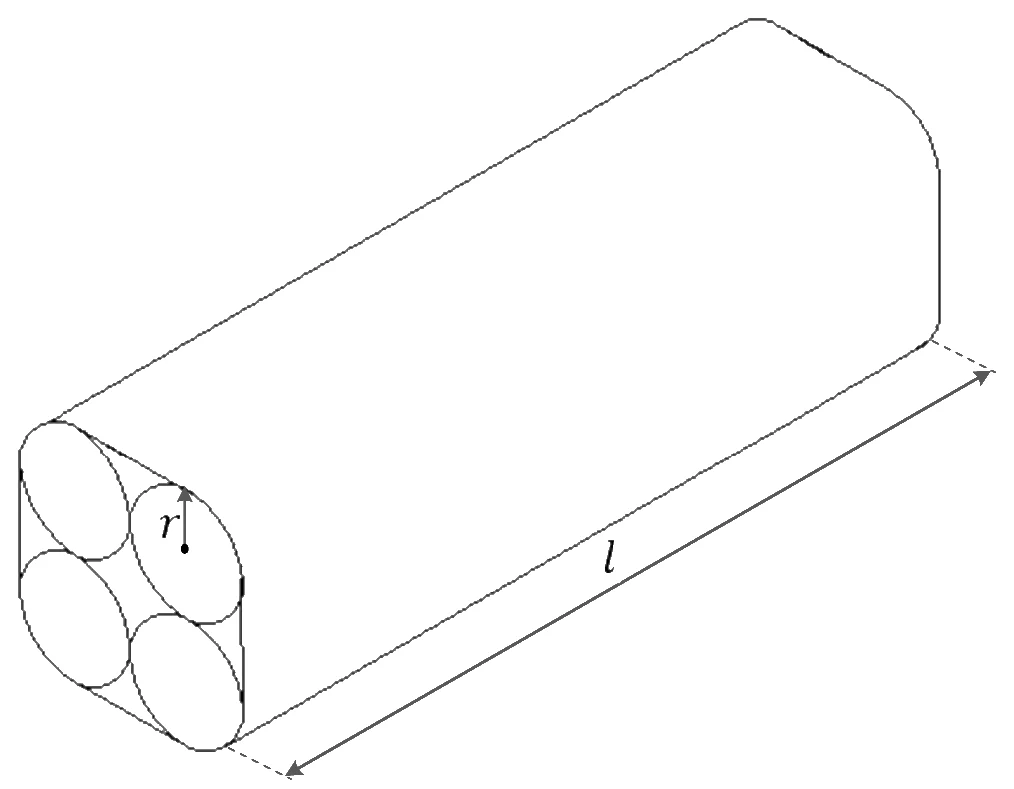
Full question on page 6 of the official paper (PDF)
Show answerHide answer
Key idea: A tight band round circles in a square is four straight runs plus one full circle's worth of arcs.
Official answer: D
Around the bundle, the tape runs straight along each side for one diameter, 2r = 1 cm, between the outer sticks, and curves round each corner stick through a quarter turn. The four quarter turns make one full circle:
The tape is 10 cm wide, so its area is 10(4 + \pi) cm². Option (D).
Learn the idea:
Q.8
General Aptitude2 marksMCQ
The bar chart in the figure shows the percentage of the population in each BMI category in 2003 and 2023. Which statement is INCORRECT?
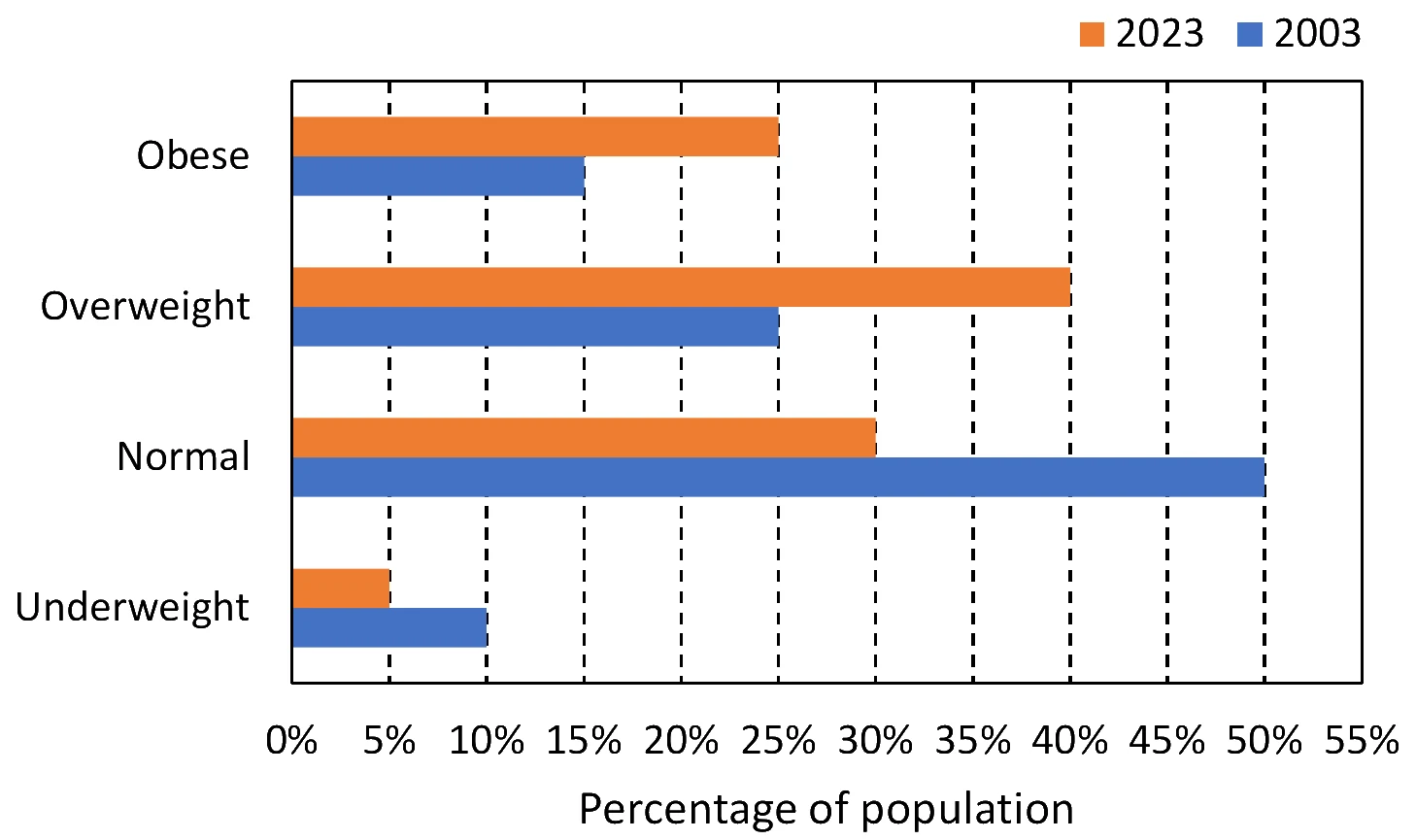
Full question on page 7 of the official paper (PDF)
Show answerHide answer
Key idea: Read the eight values off the chart once, then compare each ratio across the two years.
Official answer: C
From the chart, 2003 has obese 15%, overweight 25%, normal 50% and underweight 10%; 2023 has 25%, 40%, 30% and 5%.
- (A) Overweight to normal: 0.5 in 2003, 1.33 in 2023. Increased: correct.
- (B) Underweight to normal: 0.2, then 0.17. Decreased: correct.
- (C) Obese to normal: 0.3, then 0.83. It increased, so this statement is INCORRECT.
- (D) Normal: 50%, then 30%. Decreased: correct.
Option (C).
Learn the idea:
Q.9
General Aptitude2 marksMCQ
The figure shows examples of a mirror reflection and a water reflection. An object, reflected first in a mirror and then in water, appears as the seven-segment image 5:24. Which option is the original object?
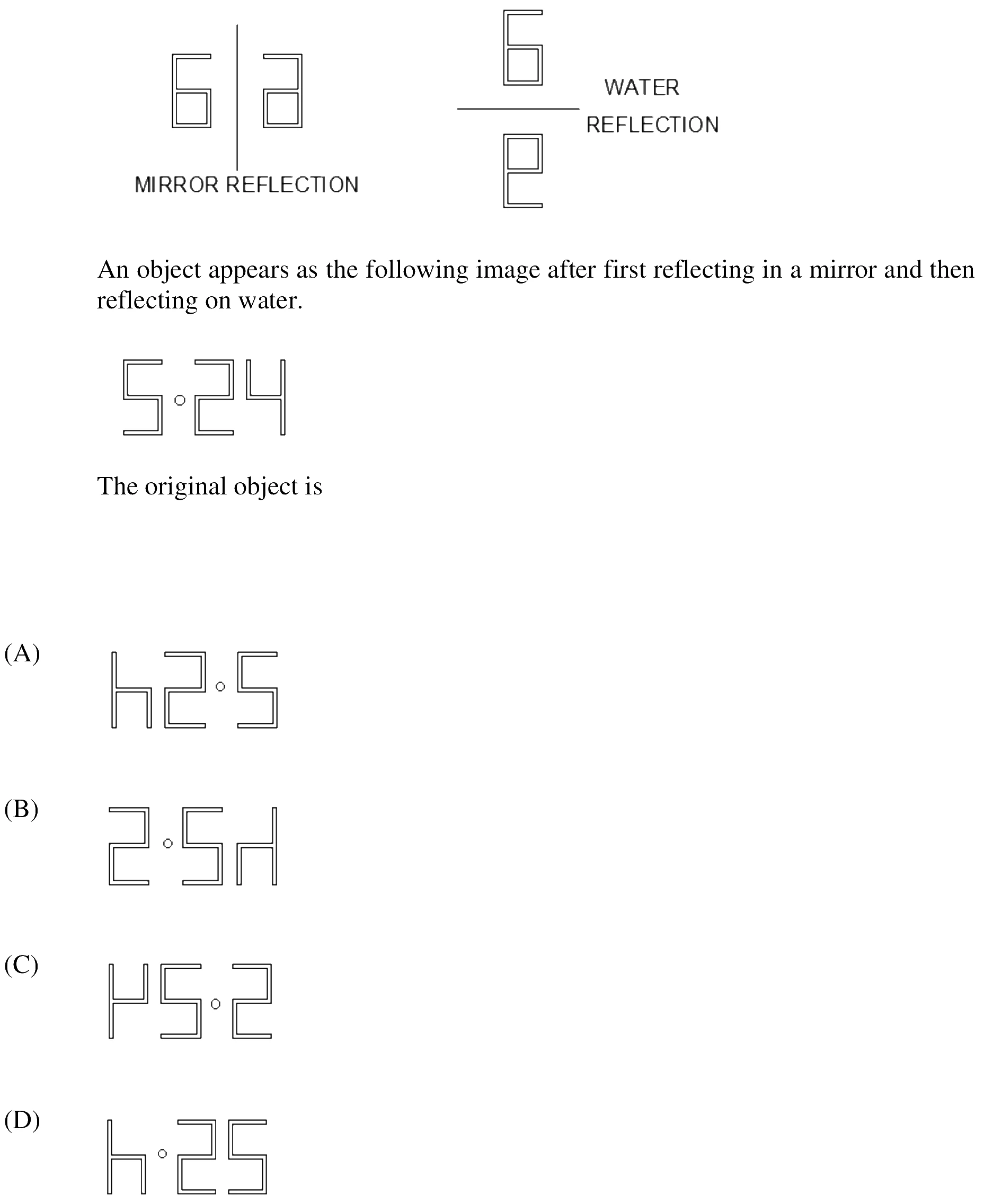
Full question on page 8 of the official paper (PDF)
Show answerHide answer
Key idea: A mirror flips left to right and water flips top to bottom; together they turn the image through 180 degrees.
Official answer: A
Undoing both reflections means rotating the image 5:24 through 180°. The order of the characters reverses, and each turns upside down: 4 becomes an h, while 2 and 5 look the same rotated.
So the original reads h, 2, a colon, then 5, which is option (A).
Q.10
General Aptitude2 marksMCQ
Sheets A and B are each 24 cm × 16 cm. Fold FO1 halves a sheet with the fold parallel to the original long edge; FO2 halves it with the fold parallel to the original short edge. Sheet A is folded twice by FO1 and sheet B twice by FO2. What is the ratio of the perimeters of A and B?
Full question on page 9 of the official paper (PDF)
Show answerHide answer
Key idea: Each fold halves only the side perpendicular to the fold line.
Official answer: A
FO1 folds parallel to the 24 cm edge, so it halves the 16 cm side: after two folds A is 24 × 4 cm, perimeter 56 cm. FO2 halves the 24 cm side: B is 6 × 16 cm, perimeter 44 cm.
56 : 44 = 14 : 11Option (A).
Learn the idea:
Q.11
Engineering Mathematics1 markMCQ
The general form of the complementary function of a differential equation is , where and are real constants set by the initial conditions. Which is the differential equation?
Full question on page 10 of the official paper (PDF)
Show answerHide answer
Key idea: A factor of t in front of an exponential means a repeated root of the characteristic equation.
Official answer: A
(At + B)e^{-2t} is what a double root at m = -2 produces, so the characteristic polynomial is
(m + 2)^2 = m^2 + 4m + 4That is option (A). Options (C) and (D) have distinct roots (-1, -2 and -2, -3), and (B) has roots \pm 2j.
Learn the idea:
Q.12
Control Systems1 markMCQ
In a Bode magnitude plot, a slope of 40 dB/decade is the same as
Full question on page 10 of the official paper (PDF)
Show answerHide answer
Key idea: A decade multiplies frequency by 10 and an octave by 2, so scale the slope by \log_{10} 2.
Official answer: A
Option (A). It is the familiar 20 dB/decade, or 6 dB/octave, of one pole, doubled.
Learn the idea:
Q.13
Control Systems1 markMCQ
In the unity negative-feedback loop in the figure, . If is a unit step, what happens to the error ?
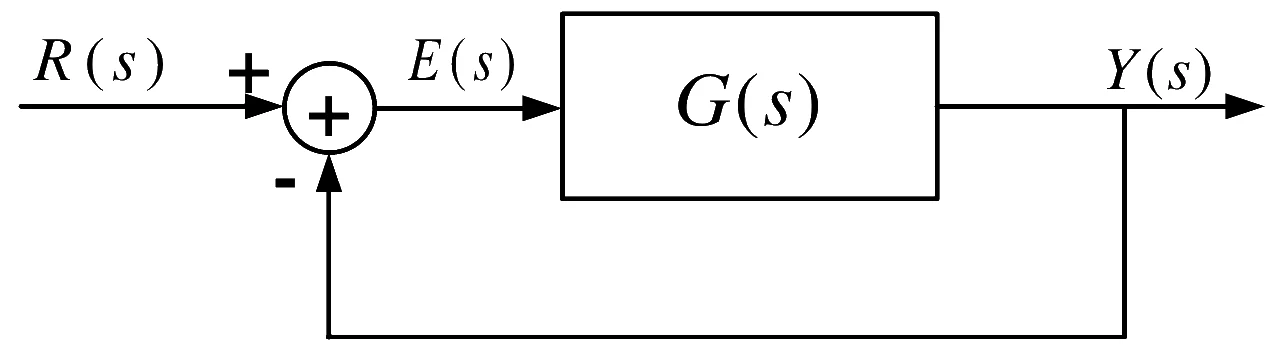
Full question on page 11 of the official paper (PDF)
Show answerHide answer
Key idea: The final value theorem only applies to a stable loop, so check the closed-loop poles before using it.
Official answer: D
The closed-loop characteristic equation is 1 + G(s) = 0:
Two poles sit on the imaginary axis at \pm j\sqrt{2}, so the loop is marginally stable and e(t) keeps oscillating. The limit doesn't exist. Option (D).
The final value theorem would give 0 for this type 1 system, option (A), but it doesn't apply when there are poles on the imaginary axis.
Learn the idea:
Q.14
Communications1 markMCQ
A digital system sends symbols through a noiseless channel band-limited to . The received signal is , where is the overall response to one symbol and has Fourier transform , and it is sampled at . Which Nyquist condition must satisfy for zero intersymbol interference?
Full question on page 12 of the official paper (PDF)
Show answerHide answer
Key idea: A question given marks to all scores full marks for every candidate, whatever they answered.
Official answer: Marks to all
The final key awards marks to all for this question and doesn't say why, so we don't pick an option.
The idea behind it: zero ISI means x(nT) is zero for every n \neq 0. Sampling at 1/T repeats X(f) every 1/T in frequency, so the condition is that the shifted copies add to a constant, \sum_m X(f + m/T) = T\,x(0). One likely reason for the ruling is that the question doesn't say what x(0) is, so the constant on the right isn't fixed.
Ruling in the key: The final key gives marks to all (MTA) for this question: every candidate received its 1 mark.
Q.15
Electromagnetics1 markMCQ
A lossless line is short-circuited at , as in the figure. Moving towards the generator, the points A, B, C and D are , , and from the load. What are the normalised input impedances , , and ?
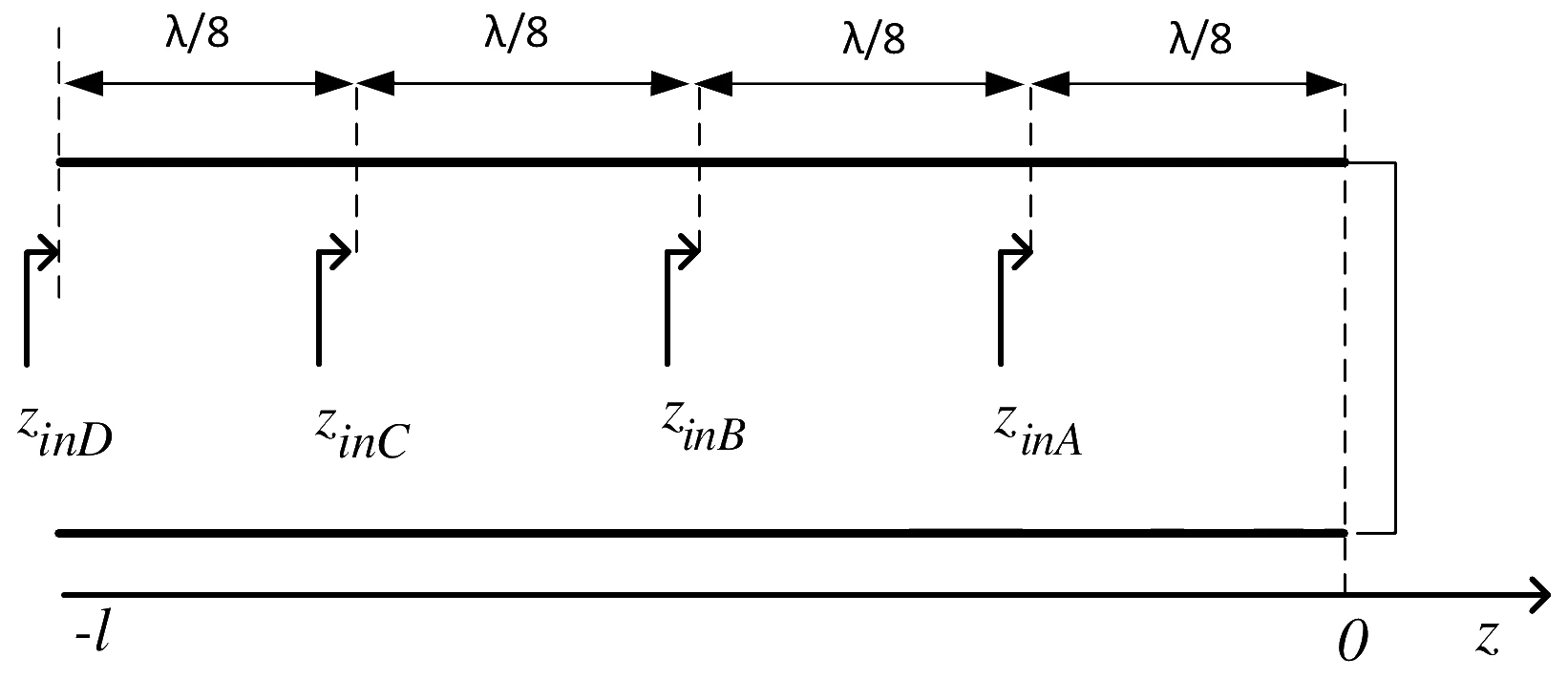
Full question on page 13 of the official paper (PDF)
Show answerHide answer
Key idea: A shorted lossless line of length l has normalised input impedance j\tan\beta l.
Official answer: A
With \beta = 2\pi/\lambda, each \lambda/8 step adds 45° to \beta l:
- A, \lambda/8: j\tan 45° = +j1
- B, \lambda/4: j\tan 90° = \infty (an open circuit)
- C, 3\lambda/8: j\tan 135° = -j1
- D, \lambda/2: j\tan 180° = 0 (a short again)
Option (A).
Learn the idea:
Q.16
Electromagnetics1 markMCQ
With and the unit vectors along and and a positive constant, which statement is true of and ?
Full question on page 14 of the official paper (PDF)
Show answerHide answer
Key idea: An electrostatic field is the gradient of a potential, so its curl must be zero.
Official answer: B
Only \mathbf{F}_1 is curl-free; it is -\nabla V for V = -Axy. Option (B).
Learn the idea:
Q.17
Analog Circuits1 markMCQ
In the circuit in the figure, the long-channel NMOS is in saturation with transconductance ; its drain is at AC ground, joins gate and source, and joins source and ground. Neglecting body effect, channel-length modulation and device capacitances, what is the input impedance at the gate?
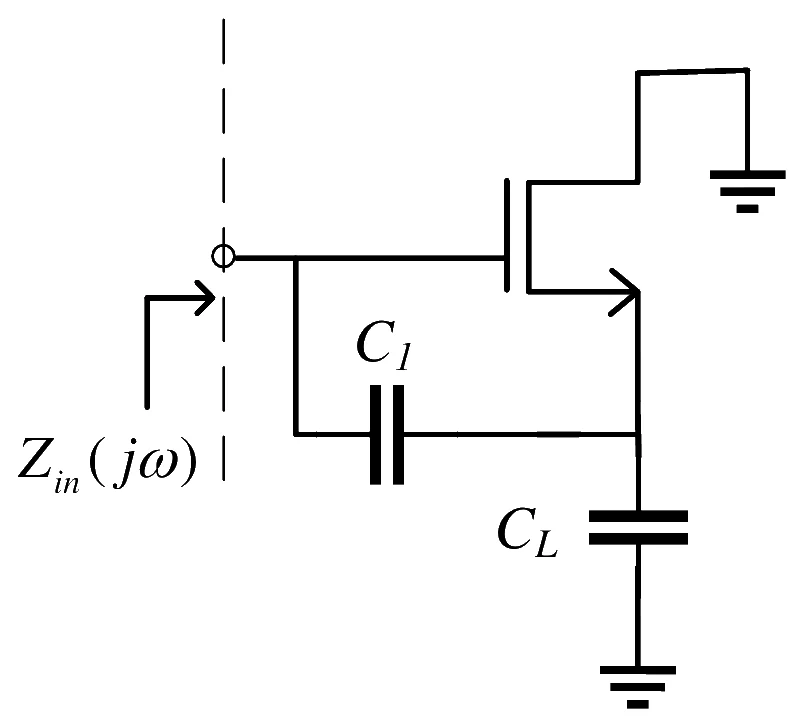
Full question on page 15 of the official paper (PDF)
Show answerHide answer
Key idea: Drive a test current into the gate and follow it through C_1 into the source node, where the transistor adds g_m v_{gs}.
Official answer: A
A test current i into the gate flows through C_1, so v_{gs} = i / (j\omega C_1). At the source, i and the drain current g_m v_{gs} both flow into C_L:
Option (A). The real part is negative: this is the negative resistance that sustains a Colpitts oscillator.
Q.18
Analog Circuits1 markMCQ
In the closed-loop amplifier in the figure, a MOSFET differential pair with a current-mirror load has its output tied back to the second input, and the magnitude of its open-loop low-frequency gain is 40. With all transistors in saturation, an ideal , and body effect, channel-length modulation and device capacitances neglected, what is the closed-loop gain , to three decimal places?
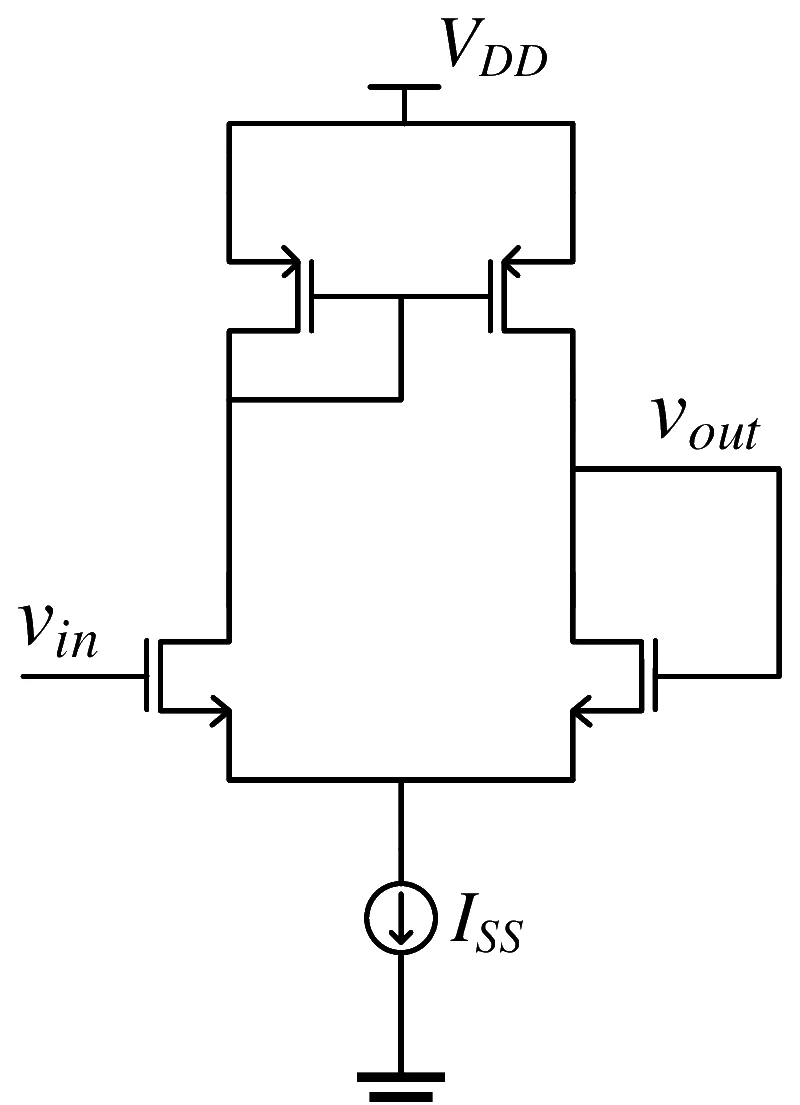
Full question on page 16 of the official paper (PDF)
Show answerHide answer
Key idea: Feeding the whole output back to the inverting input makes a buffer whose gain is A/(1 + A).
Official answer: A
The output is fed back in full (\beta = 1) to the input that subtracts, so
Option (A). An ideal op-amp would give 1.000, option (B); the finite gain of 40 leaves about a 2.4% shortfall.
Learn the idea:
Q.19
Digital Circuits1 markMCQ
What are the essential prime implicants of ?
Full question on page 17 of the official paper (PDF)
Show answerHide answer
Key idea: A prime implicant is essential only if it covers some minterm that no other prime implicant covers.
Official answer: A
The prime implicants are \overline{B}\,\overline{D} (0, 2, 8, 10), BD (5, 7, 13, 15), AB (12, 13, 14, 15) and A\overline{D} (8, 10, 12, 14).
- \overline{B}\,\overline{D} is the only one covering 0 and 2: essential.
- BD is the only one covering 5 and 7: essential.
- AB's minterms 12 and 14 are also covered by A\overline{D}, and 13 and 15 by BD, so it is not essential (nor is A\overline{D}).
The essential prime implicants are BD and \overline{B}\,\overline{D}. Option (A).
Learn the idea:
Q.20
Communications1 markMCQ
Zero-mean white Gaussian noise with power spectral density passes through a first-order RC low-pass filter, giving . What is the variance of at any time ?
Full question on page 17 of the official paper (PDF)
Show answerHide answer
Key idea: The output variance is the input PSD integrated against |H(f)|^2 over all frequencies.
Official answer: A
|H(f)|^2 = \frac{1}{1 + (2\pi f RC)^2}The output is stationary, so this holds at every t_k. Option (A).
Learn the idea:
Q.21
Networks, Signals and Systems1 markMCQ
A causal, stable LTI system with impulse response gives output for input . The input is applied to another causal, stable LTI system with impulse response . What is the output?
Full question on page 18 of the official paper (PDF)
Show answerHide answer
Key idea: Stretching both signals in a convolution stretches the result by the same factor and scales its area.
Official answer: A
\int_{-\infty}^{\infty} x(0.5\tau)\,h\big(0.5(t - \tau)\big)\,d\tauSubstitute u = 0.5\tau, so d\tau = 2\,du:
Option (A).
Q.22
Electronic Devices1 markMCQ
For non-degenerately doped n-type silicon, which plot in the figure shows how the free electron concentration depends on temperature ? Each plots against .
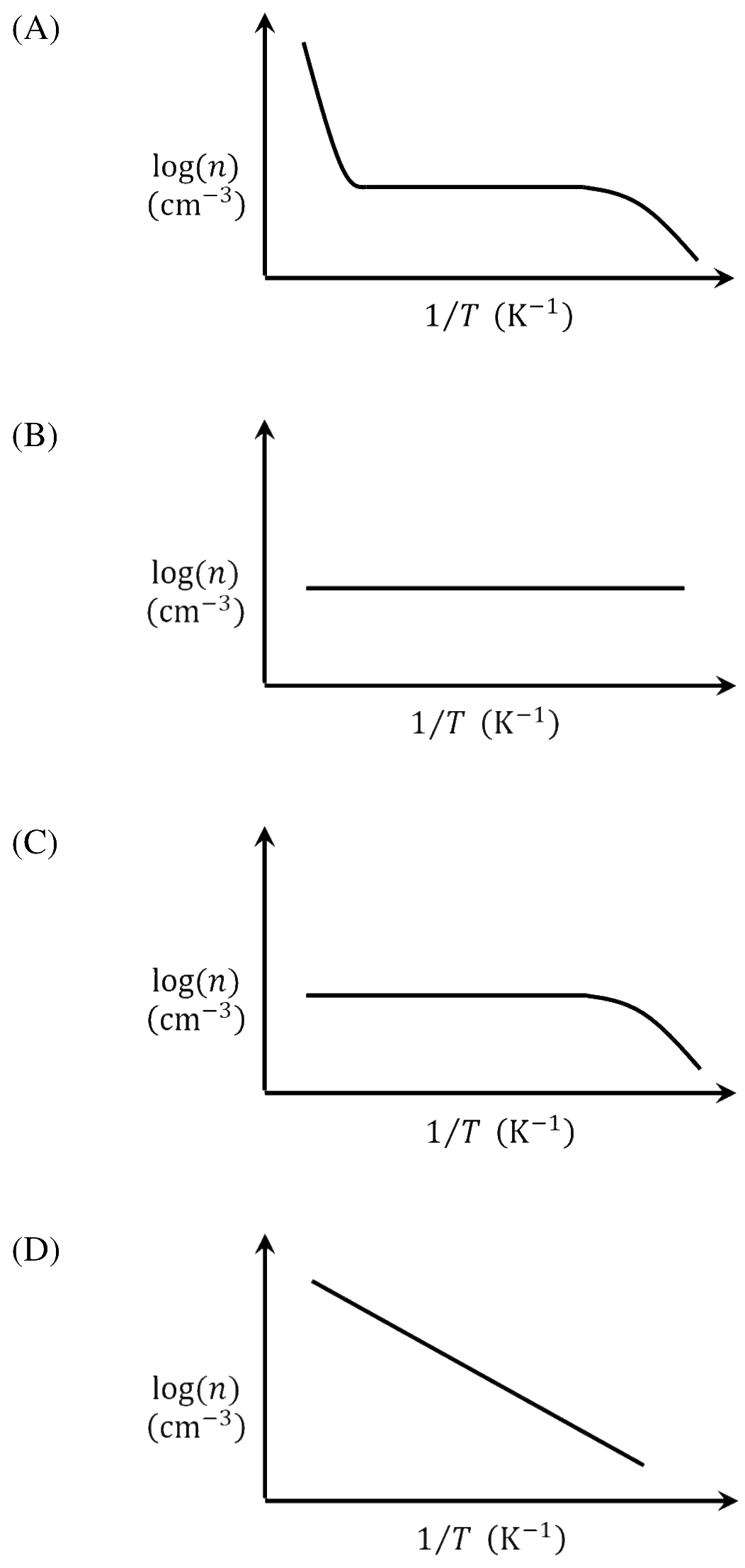
Full question on page 19 of the official paper (PDF)
Show answerHide answer
Key idea: Read the axis backwards: small 1/T is high temperature, so the plot runs from the intrinsic region on the left to freeze-out on the right.
Official answer: A
Going from high to low temperature, left to right along 1/T:
- High T (small 1/T): intrinsic carriers outnumber the donors, and n \approx n_i rises steeply with T.
- Middle range: every donor is ionised, so n \approx N_D, a flat plateau.
- Low T (large 1/T): freeze-out, as electrons drop back onto the donors, so n falls.
Only plot (A) has all three regions. Plot (C) misses the intrinsic rise, (B) has only the plateau, and (D) only a single slope. Option (A).
Learn the idea:
Q.23
Analog Circuits1 markMCQ
In the circuit in the figure, an ideal step-down transformer with a centre-tapped secondary feeds the load through two ideal diodes and with no forward drop. If V and the average load voltage is V, what is ?
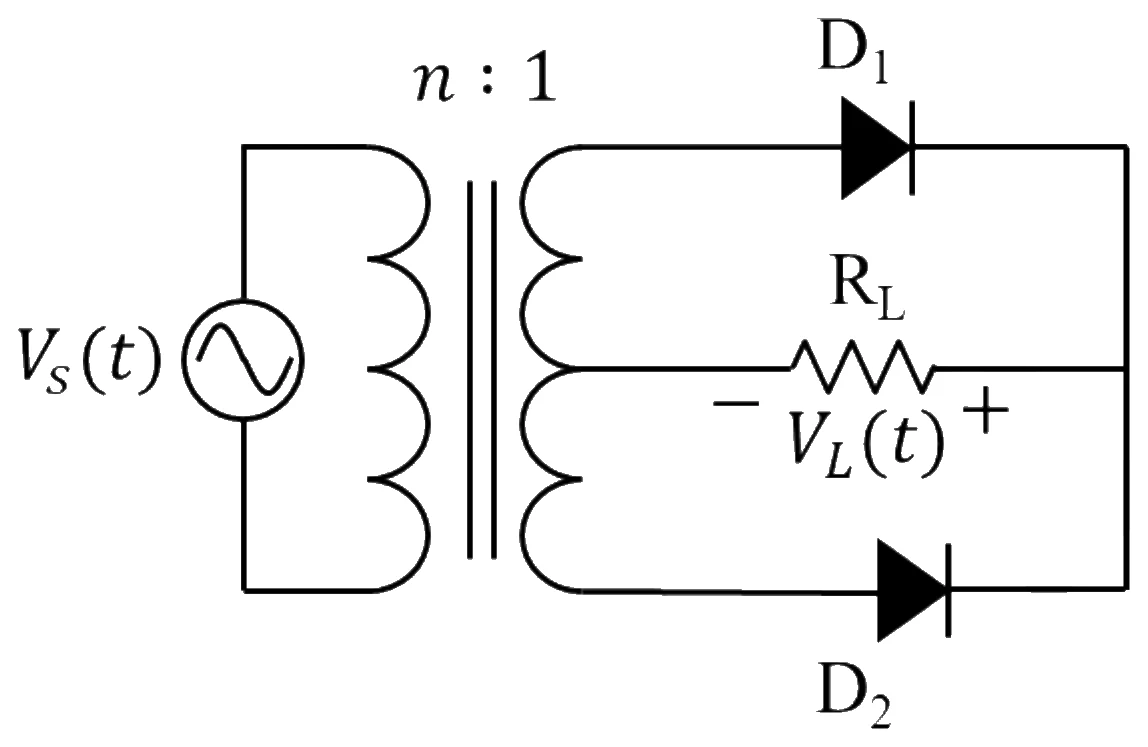
Full question on page 20 of the official paper (PDF)
Show answerHide answer
Key idea: In a centre-tapped full-wave rectifier, each diode sees half the secondary, and the load sees both half-cycles.
Official answer: A
The secondary has a peak of 10/n V, so each half has 5/n V. Full-wave rectification of a peak V_m averages 2V_m/\pi:
Option (A). Taking the whole secondary as each diode's voltage gives 8, option (B).
Learn the idea:
Q.24
Networks, Signals and Systems1 markMSQ
A causal discrete-time LTI system has . Which statements are true?
One or more options are correct.
Full question on page 21 of the official paper (PDF)
Show answerHide answer
Key idea: For a causal system, the poles decide stability, the zeros decide minimum phase, and h[0] = \lim_{z\to\infty} H(z).
Official answer: A, C and D
- (A) The poles \pm\frac{1}{3} are inside the unit circle, so the causal system is stable: true.
- (B) The zeros satisfy z^2 = -\frac{3}{2}, so |z| = \sqrt{1.5} \approx 1.22 > 1. Zeros outside the unit circle mean it isn't minimum phase: false.
- (C) h[0] = \lim_{z\to\infty} H(z) = 2: true.
- (D) Stable means h[n] \to 0: true.
Options (A), (C) and (D).
Learn the idea:
Q.25
Engineering Mathematics1 markMSQ
and are density and velocity, with continuous. is any volume with closed surface and outward unit normal . Which equations are equivalent to ?
One or more options are correct.
Full question on page 22 of the official paper (PDF)
Show answerHide answer
Key idea: Integrate the equation over any volume, then use the divergence theorem to turn the volume integral of the divergence into a flux.
Official answer: A and C
Integrating over V gives (C) directly. The divergence theorem, \int_V \nabla\cdot(\rho\mathbf{u})\,dv = \oint_S \rho\,\mathbf{u}\cdot\hat{n}\,ds, turns it into (A): mass inside falls at the rate it flows out.
Because V is arbitrary and the integrands are continuous, either integral form also gives back the differential equation. (B) and (D) have the wrong sign. Options (A) and (C).
Learn the idea:
Q.26
Electronic Devices1 markMSQ
The figure shows the equilibrium free-electron concentration in a doped semiconductor, rising from A to a maximum at B and falling to C. Which statements are true?
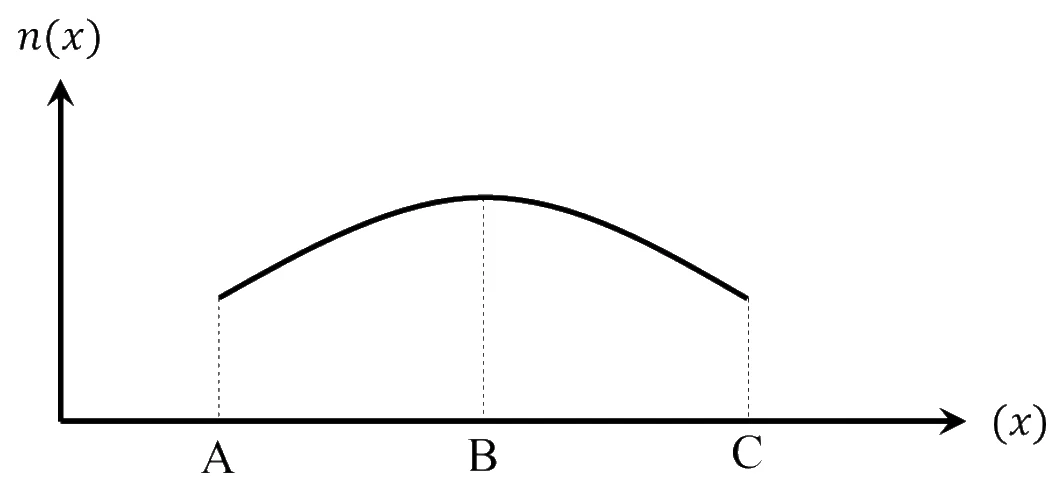
One or more options are correct.
Full question on page 23 of the official paper (PDF)
Show answerHide answer
Key idea: At equilibrium the drift and diffusion currents cancel everywhere, and electron current flows opposite to electron motion.
Official answer: A, B and C
- Between B and C, electrons diffuse from B (high n) towards C. Electrons carry negative charge, so the diffusion current points from C to B: (A) true.
- Between A and B, electrons diffuse from B towards A, so the diffusion current points from A to B. At equilibrium drift cancels it, so the drift current points from B to A: (B) true.
- Between B and C, the drift current must point from B to C to cancel diffusion. Electron drift current is along the field, so the field points from B to C: (C) true.
- The same reasoning between A and B puts the field from B to A, so (D) is false.
Options (A), (B) and (C).
Learn the idea:
Q.27
Digital Circuits1 markNAT
A machine has a 32-bit architecture with one-word instructions, 24 registers and 40 instructions. Each instruction has five fields: opcode, two source registers, one destination register and an unsigned immediate value. What is the immediate's maximum value?
Answer format: An integer
Full question on page 23 of the official paper (PDF)
Show answerHide answer
Key idea: Give each field the fewest bits that can name all its values, and the immediate gets whatever is left.
Official answer: 2047
- Opcode: 40 instructions need \lceil\log_2 40\rceil = 6 bits.
- Registers: 24 need \lceil\log_2 24\rceil = 5 bits each, so 15 bits for three.
- Immediate: 32 - 6 - 15 = 11 bits.
The largest unsigned 11-bit value is 2^{11} - 1 = 2047.
Q.28
Communications1 markNAT
An amplitude modulator's output is V. The carrier power, normalised to 1 Ω, is 50 W, and the total sideband power is of the total power. What is , in volts?
Answer format: Volts, rounded off to two decimal places
Full question on page 24 of the official paper (PDF)
Show answerHide answer
Key idea: Each cosine of amplitude a carries a^2/2 into 1 Ω, so carrier and sidebands can be added as separate powers.
Official answer: 2.49 to 2.51
The carrier power is A^2/2 = 50 W. The two sidebands carry B^2/2 each, B^2 together:
Learn the idea:
Q.29
Digital Circuits1 markNAT
In a number system of base , the equation has as one of its solutions. What is ?
Answer format: An integer
Full question on page 24 of the official paper (PDF)
Show answerHide answer
Key idea: Rewrite the coefficients 12 and 37 as base-r numerals, then substitute the root.
Official answer: 11
In base r, the numeral 12 means r + 2 and 37 means 3r + 7. Substituting x = 8:
The digits 7 and 8 need a base above 8, which r = 11 is. The other root is 13 - 8 = 5 in decimal, since the roots add to r + 2 = 13.
Q.30
Engineering Mathematics1 markNAT
For which do the vectors , and fail to form a basis of ?
Answer format: A number
Full question on page 24 of the official paper (PDF)
Show answerHide answer
Key idea: Three vectors in three dimensions form a basis exactly when the determinant of the matrix they make is non-zero.
Official answer: 5
It is zero at \alpha = 5, so then the vectors are dependent and not a basis.
Learn the idea:
Q.31
Networks, Signals and Systems1 markNAT
In the circuit in the figure, a 5 mA source and a 1 kΩ resistor carrying sit on the left node. A current-controlled voltage source of (positive on the right) joins it to the right node, which has a 1 kΩ resistor in series with a 2 mA source, and a 1 kΩ resistor carrying , all to the common bottom rail. What is , in mA?
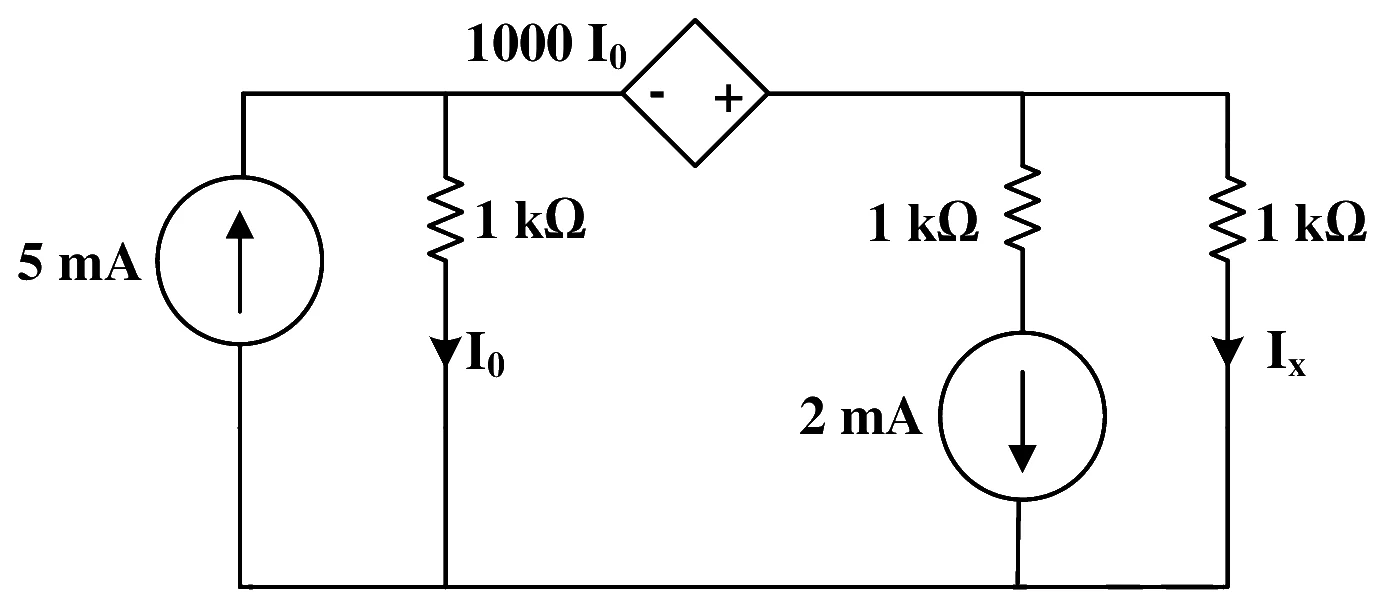
Answer format: mA, an integer
Full question on page 25 of the official paper (PDF)
Show answerHide answer
Key idea: The dependent source fixes the right node at the left node's voltage plus 1000\,I_0, so both node voltages are multiples of I_0.
Official answer: 2
With currents in mA and resistances in kΩ, the left node is at V_1 = I_0 volts, and the dependent source adds 1000\,I_0 A = I_0 (mA) volts, so the right node is at V_2 = 2I_0 and I_x = V_2 / 1 = 2I_0.
Current into the right node is what the left node doesn't send through its 1 kΩ, and it leaves through the 2 mA branch and I_x:
Learn the idea:
Q.32
Networks, Signals and Systems1 markNAT
In the circuit in the figure, a 5 A source with 2 Ω across it feeds a 3 H inductor into a node with 4 Ω to ground. The switch S, open for a long time, closes at and puts a second 4 Ω across that node. What is the time constant for , in seconds?
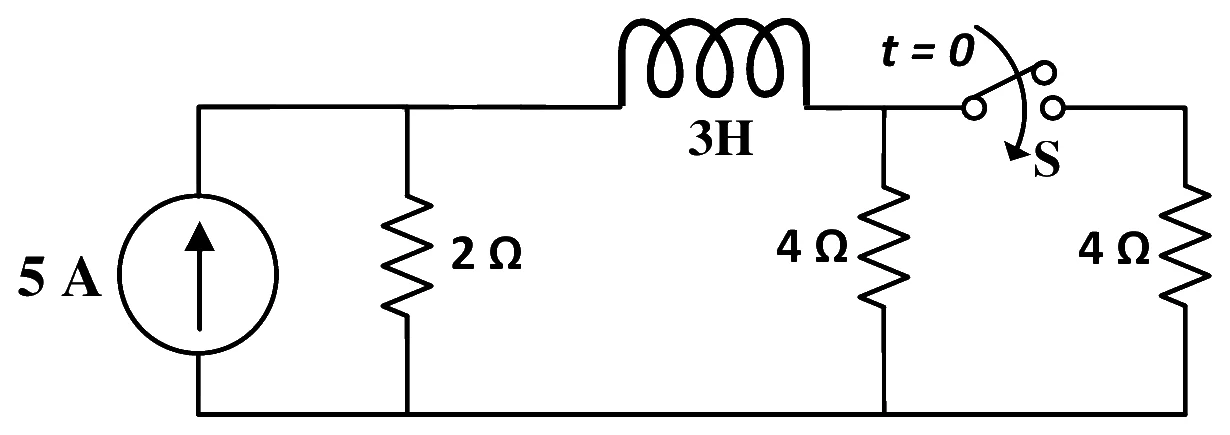
Answer format: Seconds
Full question on page 25 of the official paper (PDF)
Show answerHide answer
Key idea: The time constant is L over the resistance the inductor sees with the independent source turned off.
Official answer: 0.75
With the 5 A source open-circuited, the inductor sees the 2 Ω on one side and the two 4 Ω resistors in parallel on the other, all in series:
Learn the idea:
Q.33
Engineering Mathematics1 markNAT
and are independent and identically distributed, uniform on . What is ?
Answer format: Rounded off to two decimal places
Full question on page 25 of the official paper (PDF)
Show answerHide answer
Key idea: By symmetry P(X \ge Y) = P(Y \ge X), and X = Y has probability zero.
Official answer: 0.5
The two events X \ge Y and Y \ge X are mirror images and together cover everything, overlapping only on the line X = Y, which has zero probability. So each has probability \tfrac{1}{2}: the area of the triangle below the diagonal of the unit square.
Learn the idea:
Q.34
Communications1 markNAT
A source sends symbols from an alphabet of 16. What is the maximum achievable entropy, in bits?
Answer format: Bits
Full question on page 26 of the official paper (PDF)
Show answerHide answer
Key idea: Entropy is largest when every symbol is equally likely.
Official answer: 4
H_{max} = \log_2 16 = 4\ \text{bits}Learn the idea:
Q.35
Analog Circuits1 markNAT
In the circuit in the figure, a 10 µF capacitor starts at 10 V. At a switch closes and it discharges through 10 kΩ and an ideal Zener diode with V, reverse biased by the capacitor. What total energy is dissipated in the Zener, in mJ?
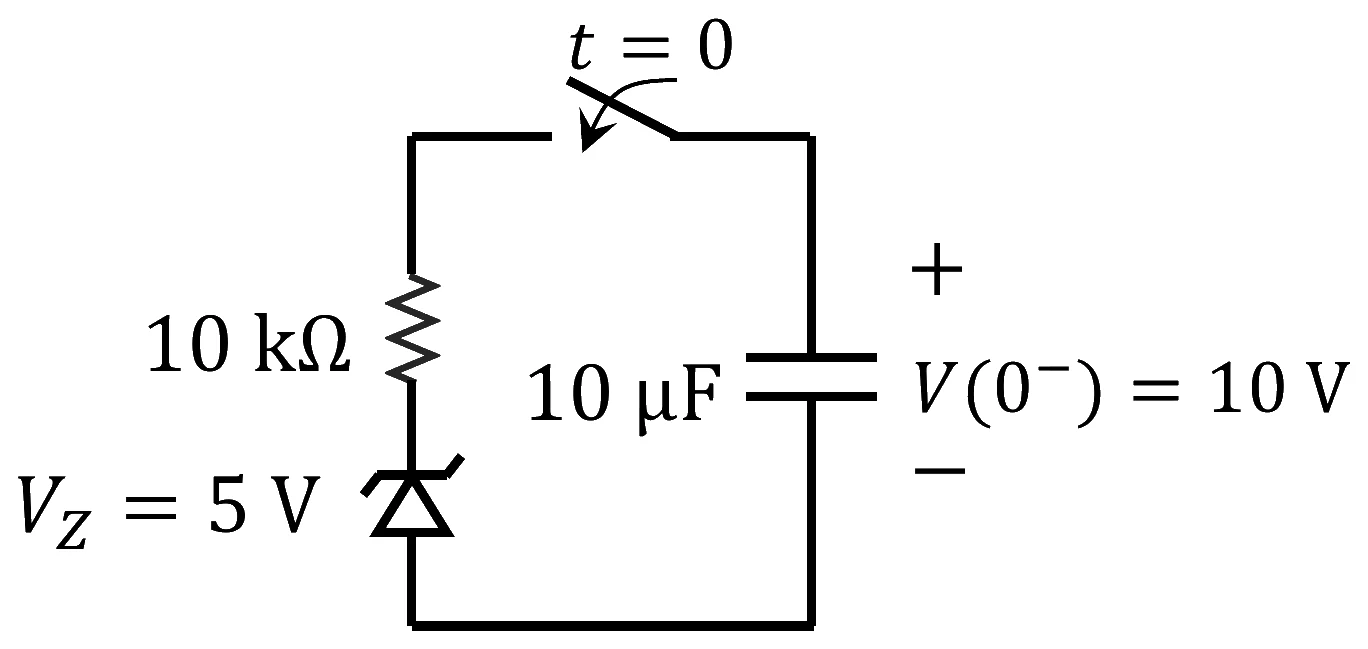
Answer format: mJ, rounded off to three decimal places
Full question on page 26 of the official paper (PDF)
Show answerHide answer
Key idea: An ideal Zener holds exactly V_Z while it conducts, so its energy is V_Z times the charge that passes through it.
Official answer: 0.25
The Zener conducts in breakdown while the capacitor is above 5 V, so the capacitor falls from 10 V to 5 V and then the current stops. The charge that flows is
The capacitor gives up \tfrac{1}{2}C(10^2 - 5^2) = 0.375 mJ; the other 0.125 mJ heats the resistor.
Learn the idea:
Q.36
Engineering Mathematics2 marksMCQ
Taking the Earth as a sphere of radius , what is the surface area of the region inside the 60°N latitude circle that contains the north pole?
Full question on page 27 of the official paper (PDF)
Show answerHide answer
Key idea: A spherical cap of height h has area 2\pi R h, the same as the band of a cylinder round it.
Official answer: A
The 60°N circle sits at height R\sin 60° = \tfrac{\sqrt{3}}{2}R above the equator, so the cap above it has height h = R(1 - \tfrac{\sqrt{3}}{2}):
Option (A). About 6.7% of the sphere.
Learn the idea:
Q.37
Control Systems2 marksMCQ
A unity negative-feedback system has forward gain . The closed-loop impulse response decays faster than if
Full question on page 28 of the official paper (PDF)
Show answerHide answer
Key idea: Decaying faster than e^{-t} means every closed-loop pole is left of s = -1; shift the axis there and apply Routh.
Official answer: A
The closed-loop poles solve (s+1)(s+2)(s+3) + K = 0. Put s = p - 1, so that p in the left half-plane means s left of -1:
For a cubic p^3 + a p^2 + b p + c, Routh needs every coefficient positive and ab > c: here K > 0 and 3 \times 2 > K. So 0 < K < 6, and only the range 1 < K < 5 lies inside it. Option (A).
Learn the idea:
Q.38
Control Systems2 marksMCQ
A satellite attitude loop has plant in cascade with a compensator , , under unity negative feedback. For closed-loop poles at , what must be?
Full question on page 29 of the official paper (PDF)
Show answerHide answer
Key idea: Match the closed-loop cubic to the required quadratic factor times an unknown real pole.
Official answer: B
Poles at -1 \pm j\sqrt{3} mean a factor s^2 + 2s + 4. With a third pole at -c:
Matching gives c = 2, then K = 8 and K\alpha = 8, so \alpha = 1. Option (B).
Q.39
Electromagnetics2 marksMCQ
A uniform plane wave V/m travels in air in the direction and is incident normally on a perfect electric conductor at . Where is the first null of the total magnetic field in the air, measured from , in metres?
Full question on page 30 of the official paper (PDF)
Show answerHide answer
Key idea: At a perfect conductor the electric field has a null and the magnetic field a maximum, so the magnetic nulls are a quarter wavelength away.
Official answer: A
From the exponent, \beta = 2\pi/3 rad/m, so \lambda = 2\pi/\beta = 3 m. The reflected wave makes a standing wave with
E \propto \sin\beta x, \qquad H \propto \cos\beta xH is largest at the conductor and first vanishes where \beta x = -\pi/2, at x = -\lambda/4 = -0.75 m. Option (A). The electric field's first null in the air is at -\lambda/2 = -1.5 m, option (B).
Learn the idea:
Q.40
Digital Circuits2 marksMCQ
A 4-bit priority encoder has inputs , , , in descending priority, and outputs for , , , respectively. What is the expression for ?
Full question on page 30 of the official paper (PDF)
Show answerHide answer
Key idea: B is 1 for the codes 01 and 11, that is when D_2 wins or when D_0 wins.
Official answer: B
D_2 wins when D_3 = 0 and D_2 = 1. D_0 wins when D_3 = D_2 = D_1 = 0 (with at least one input active, D_0 must then be 1). So
Option (B).
Learn the idea:
Q.41
Digital Circuits2 marksMCQ
In the circuit in the figure, a 2 × 1 MUX with a propagation delay of 10 ns has its output fed back to input 0 directly and to input 1 through an inverter with zero delay. If , what is ?
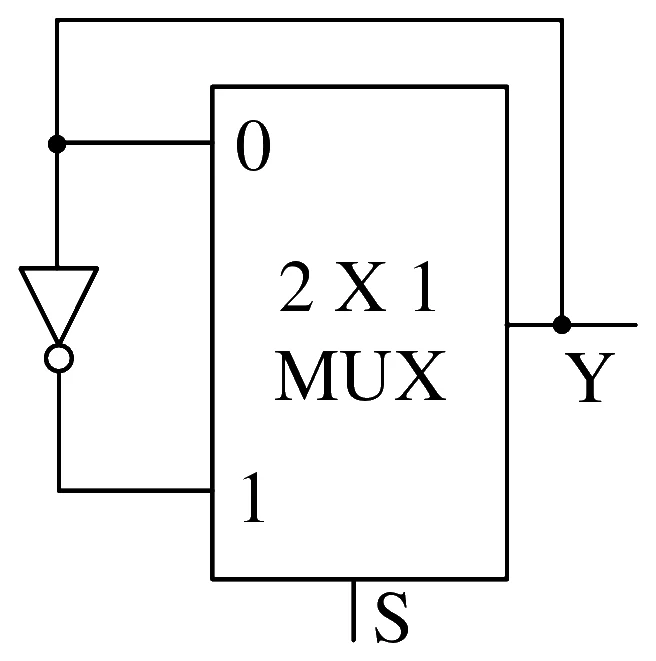
Full question on page 31 of the official paper (PDF)
Show answerHide answer
Key idea: With S = 1 the MUX passes its own inverted output, so Y flips once per propagation delay.
Official answer: B
With S = 1, Y(t) = \overline{Y(t - 10\ \text{ns})}: every 10 ns the output takes the opposite of its value 10 ns earlier. So it flips every 10 ns, a square wave of period 20 ns.
f = \frac{1}{20\ \text{ns}} = 50\ \text{MHz}Option (B). One half-period is one delay, which is why it isn't 100 MHz.
Learn the idea:
Q.42
Digital Circuits2 marksMCQ
In the synchronous circuit in the figure, and , each formed by an OR gate. What is the sequence of states ?
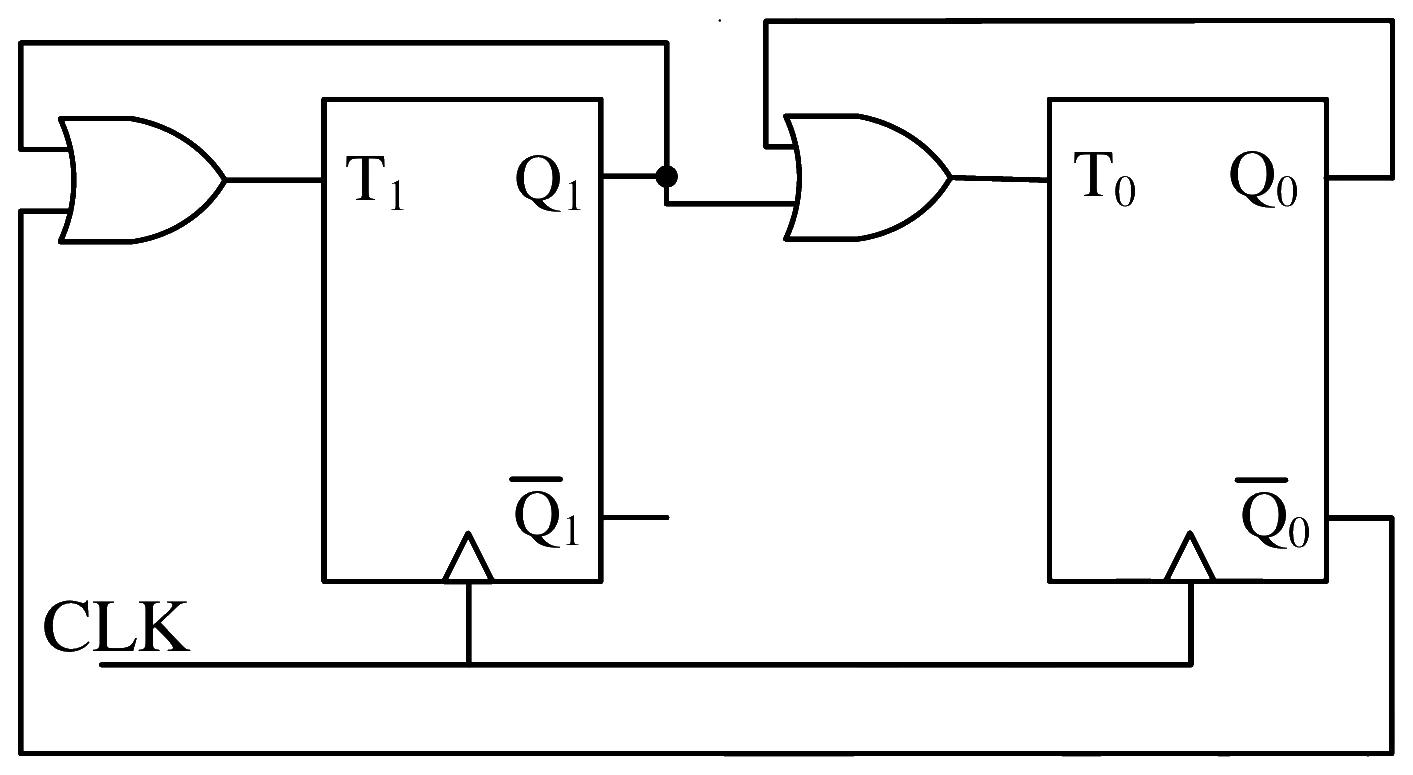
Full question on page 32 of the official paper (PDF)
Show answerHide answer
Key idea: A T flip-flop toggles when T = 1 and holds when T = 0, so work out both T inputs from the present state.
Official answer: B
- 11: T_1 = 1, T_0 = 1, both toggle: 00.
- 00: T_1 = 0 + 1 = 1, T_0 = 0: 10.
- 10: T_1 = 1, T_0 = 1: 01.
- 01: T_1 = 0 + 0 = 0, T_0 = 1: 00.
From 11 the circuit runs 11 → 00 → 10 → 01 → 00 and then repeats 00 → 10 → 01. Option (B).
Learn the idea:
Q.43
Engineering Mathematics2 marksMCQ
For and the circle , what is ?
Full question on page 33 of the official paper (PDF)
Show answerHide answer
Key idea: Both singularities, z = 0 and z = 2, are inside the circle; add their residues.
Official answer: D
Near z = 0, \sin(\pi z) \approx \pi z, so the double pole is really simple: f(z) \approx \dfrac{\pi}{z(z - 2)}, with residue \dfrac{\pi}{-2}. At z = 2 the residue is \dfrac{\sin 2\pi}{4} = 0.
Option (D).
Learn the idea:
Q.44
Networks, Signals and Systems2 marksMCQ
The figure shows , a downward triangle between and with minimum , and , an upward triangle between and with peak 1. If is the Fourier transform of , which is the Fourier transform of ?
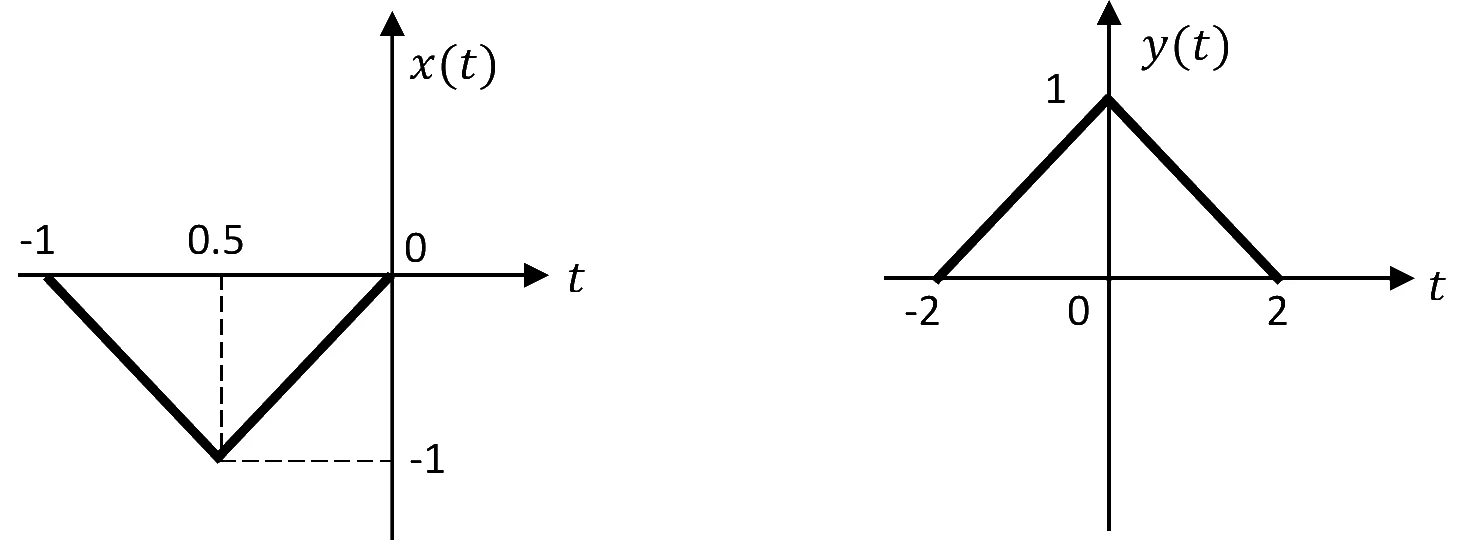
Full question on page 34 of the official paper (PDF)
Show answerHide answer
Key idea: A question given marks to all scores full marks for every candidate, whatever they answered.
Official answer: Marks to all
The final key awards marks to all for this question and doesn't say why, so we don't pick an option.
The method it tests: write y as a flipped, stretched and shifted copy of x, then apply the scaling and shift properties, x(at - b) \leftrightarrow \frac{1}{|a|}X\!\left(\frac{f}{a}\right)e^{-j2\pi f b/a}. One likely reason for the ruling is the figure: the tick under the minimum of x(t) is labelled 0.5, though the minimum sits between -1 and 0.
Ruling in the key: The final key gives marks to all (MTA) for this question: every candidate received its 2 marks.
Learn the idea:
Q.45
Communications2 marksMCQ
A source sends from with equal probability over an AWGN channel: , with zero-mean, variance 4 and independent of . With , what is the optimum symbol error probability?
Full question on page 35 of the official paper (PDF)
Show answerHide answer
Key idea: With equal priors the optimum thresholds are midway between symbols, and the middle symbol can be pushed out on either side.
Official answer: B
The thresholds are at \pm 2, a distance 2 from each symbol, and \sigma = 2, so each one-sided error has probability Q(2/2) = Q(1):
- s = -4: Q(1)
- s = 0: 2Q(1)
- s = 4: Q(1)
Option (B). Dividing the distance 2 by the variance 4 instead of \sigma gives Q(0.5), and forgetting the standard deviation altogether gives Q(2).
Learn the idea:
Q.46
Digital Circuits2 marksMCQ
A full-scale sine is applied to a 10-bit ADC. The fundamental at the output has a normalised power of 1 W, and the total noise and distortion is 10 µW. What is the effective number of bits, to the nearest integer?
Full question on page 35 of the official paper (PDF)
Show answerHide answer
Key idea: Measure SINAD in dB and invert the ideal-ADC formula 6.02N + 1.76.
Official answer: B
To the nearest integer, 8. Option (B). The noise and distortion cost the converter about two of its ten bits.
Q.47
Communications2 marksMCQ
The bits 1 1 1 0 1 0 1 0 1 are encoded with CRC-4, generator . What is the encoded sequence?
Full question on page 36 of the official paper (PDF)
Show answerHide answer
Key idea: Append four zeros, divide by the generator in modulo-2 arithmetic, and append the 4-bit remainder.
Official answer: A
The generator is 10011. Dividing 1110101010000 by it, with XOR in place of subtraction at each step, leaves the remainder 1100.
So the codeword is the message followed by 1100: 1 1 1 0 1 0 1 0 1 1 1 0 0. Option (A). A check: the codeword itself divides by 10011 with no remainder.
Learn the idea:
Q.48
Networks, Signals and Systems2 marksMCQ
is sampled at 15 Hz. The sampled signal passes through an LTI system with , giving . What is ?
Full question on page 36 of the official paper (PDF)
Show answerHide answer
Key idea: A question given marks to all scores full marks for every candidate, whatever they answered.
Official answer: Marks to all
The final key awards marks to all for this question and doesn't say why, so we don't pick an option.
The method it tests: sampling at 15 Hz copies the 4 Hz tone to 15k \pm 4 Hz, the filter passes a narrow band round 19 Hz with its own phase shift, and the output is the 19 Hz copy. One likely reason for the ruling is that the answer's amplitude and phase depend on how the impulse sampling and the filter's gain are normalised, which the question leaves open.
Ruling in the key: The final key gives marks to all (MTA) for this question: every candidate received its 2 marks.
Learn the idea:
Q.49
Analog Circuits2 marksMCQ
In the circuit in the figure, the ideal op-amps saturate at ±10 V and the inductor current starts at 0. OPA1 is a non-inverting Schmitt trigger with 10 kΩ from and 100 kΩ of positive feedback; its output drives OPA2 through a 1 mH inductor, with 1 kΩ of feedback. is a triangle of ±2 V peak and 8 µs period. Which statement is true?
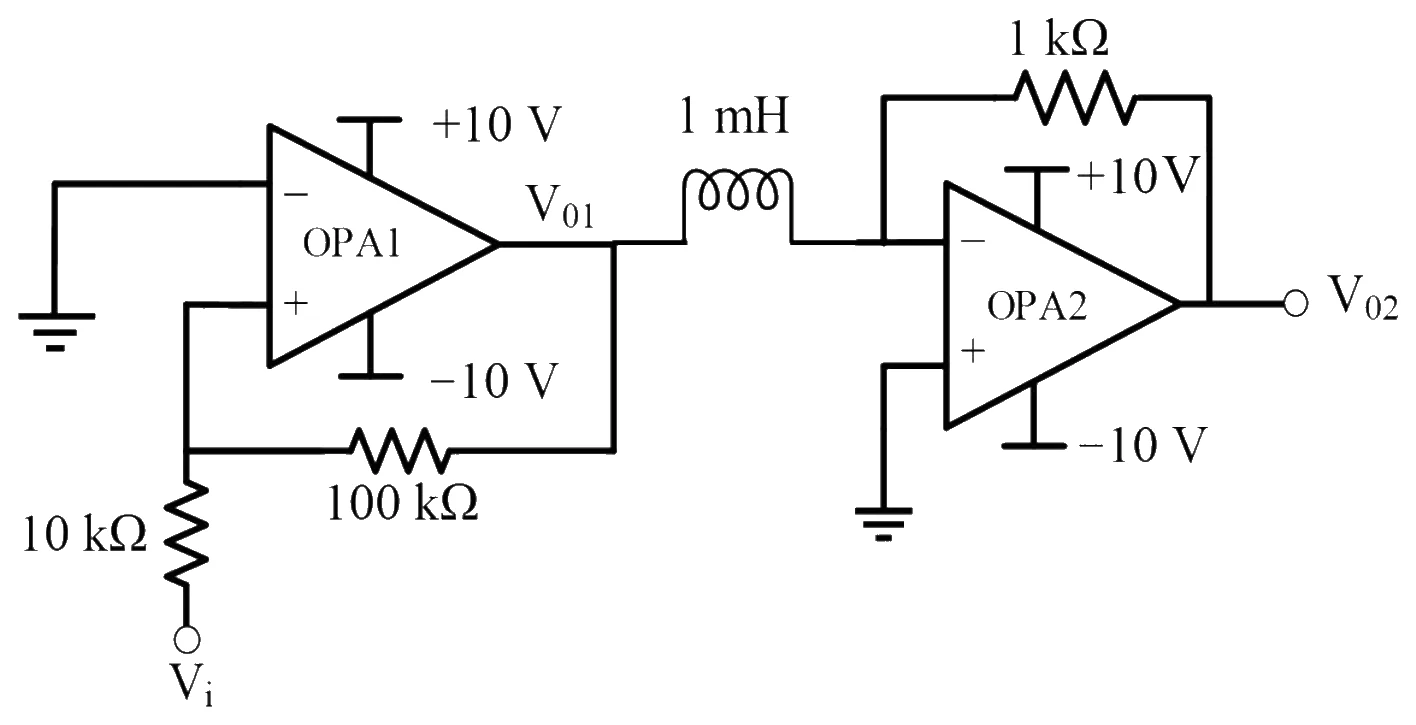
Full question on page 37 of the official paper (PDF)
Show answerHide answer
Key idea: Hysteresis delays each switch until the input reaches a threshold, and an integrator that reaches the rail clips its ramp.
Official answer: D
OPA1 switches when its + input crosses 0, which happens at V_i = \pm 10 \times \frac{10}{100} = \pm 1 V. The triangle changes by 4 V in 4 µs, 1 V/µs, so it reaches 1 V 1 µs after its zero crossing: V_{01} is a ±10 V square wave delayed by 1 µs.
OPA2 with an inductor in and a resistor in feedback is an integrator: V_{02} = -\frac{R}{L}\int V_{01}\,dt. Its ramp rate is \frac{1000}{10^{-3}} \times 10 = 10^7 V/s, so it reaches the 10 V rail in 1 µs, well inside each 4 µs half-period, and stays there:
V_{02} is a trapezoid. Option (D).
Learn the idea:
Q.50
Analog Circuits2 marksMCQ
In the circuit in the figure, an ideal op-amp is a non-inverting amplifier ( to ground, in feedback), and its output returns to the + input through a network of series , shunt , series and shunt . For sustained oscillation, what are and the frequency?
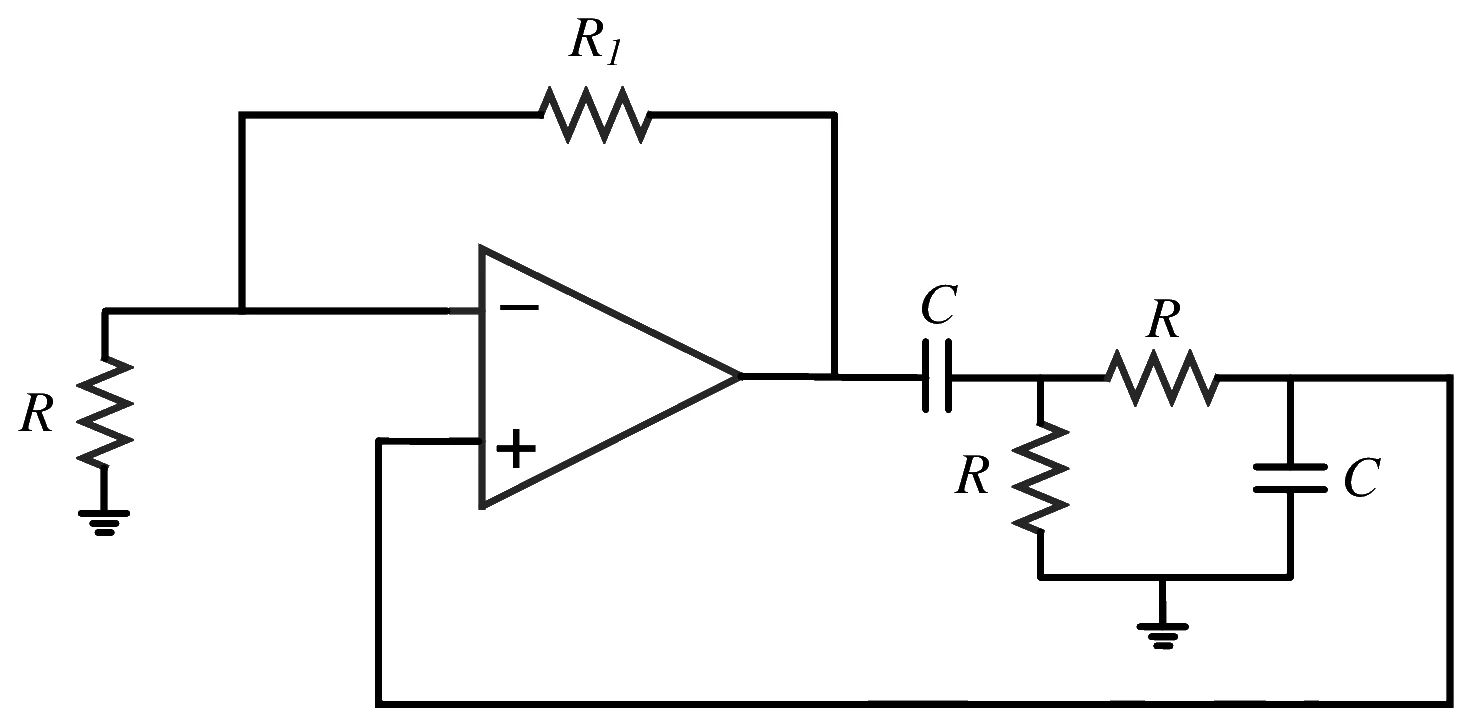
Full question on page 38 of the official paper (PDF)
Show answerHide answer
Key idea: Oscillation needs the loop gain to be exactly 1 at the frequency where the network's phase shift is zero.
Official answer: B
Solving the two-node network with \omega normalised to 1/RC, its transfer is real at \omega = 1/RC, where
\frac{V_{fb}}{V_{out}} = \frac{1}{3}So the amplifier must give exactly 3: 1 + R_1/R = 3, R_1 = 2R, and the frequency is 1/(2\pi RC). Option (B). The 29 and \sqrt{6} in the other options belong to the three-section RC phase-shift oscillator.
Learn the idea:
Q.51
Analog Circuits2 marksMCQ
In the circuit in the figure, and are in saturation with transconductances and . is diode-connected under , and joins its gate to the gate of , which drives . The input reaches 's gate through and . Neglecting body effect, channel-length modulation and device capacitances, with a short for AC, what is the exact ?
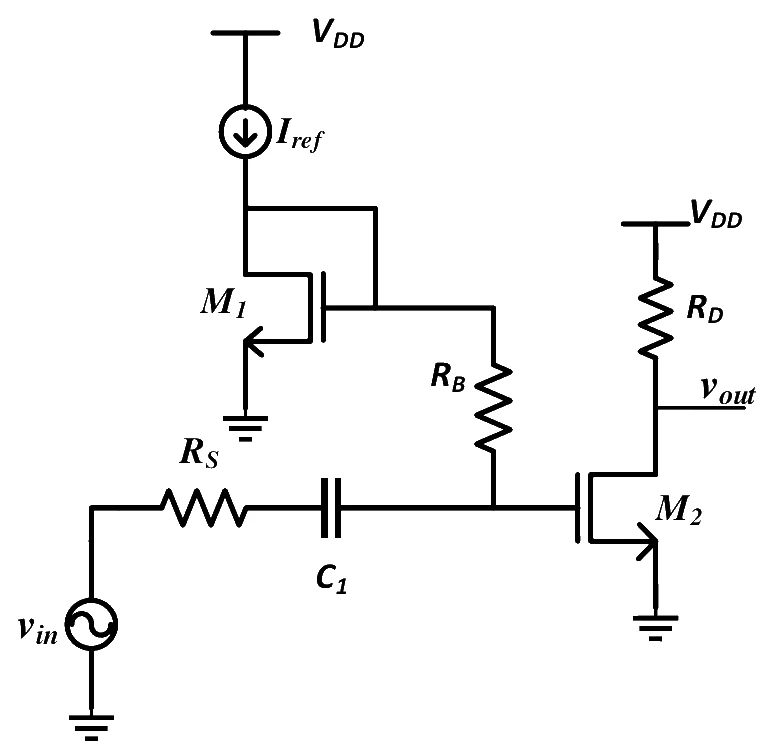
Full question on page 39 of the official paper (PDF)
Show answerHide answer
Key idea: A diode-connected MOSFET looks like a resistance of 1/g_m to AC, and the ideal current source above it is an open circuit.
Official answer: B
For AC, I_{ref} is open and the diode-connected M_1 is 1/g_{m1} to ground. So M_2's gate sees R_B + 1/g_{m1} to ground, which forms a divider with R_S:
Option (B). Leaving out R_B gives (D), and forgetting the divider altogether gives (A).
Q.52
Electronic Devices2 marksMSQ
Which statements about a BJT's DC current gain are true?
One or more options are correct.
Full question on page 40 of the official paper (PDF)
Show answerHide answer
Key idea: \beta peaks at moderate current: it is pulled down by recombination at low current and by high injection at high current.
Official answer: A, C and D
- (A) True: at high injection the base's majority carriers are no longer negligible, emitter efficiency drops, and \beta falls as I_C rises.
- (B) False: when recombination current in the emitter-base junction dominates the base current, it grows more slowly than I_C, so \beta rises with I_C in this region.
- (C) True: in saturation the base current exceeds I_C/\beta_F, so the ratio I_C/I_B is below the active-region \beta.
- (D) True: avalanche multiplication is amplified by the transistor's gain, so BV_{CEO} \approx BV_{CBO}/\beta^{1/n} falls as \beta rises.
Options (A), (C) and (D).
Learn the idea:
Q.53
Control Systems2 marksMSQ
System S is , . Which of these have the same transfer function?
One or more options are correct.
Full question on page 41 of the official paper (PDF)
Show answerHide answer
Key idea: Compute C(sI - A)^{-1}B for each; different realisations of one system share it.
Official answer: A and C
- (A) is the controllable canonical form of \frac{2s + 1}{s^2 + 3s + 2}: the same.
- (B) gives \frac{-4}{s^2 + 3s + 2}: different.
- (C) gives \frac{-1}{s + 1} + \frac{3}{s + 2} = \frac{2s + 1}{(s + 1)(s + 2)}: the same.
- (D) gives \frac{1}{s + 1} + \frac{2}{s + 2} = \frac{3s + 4}{(s + 1)(s + 2)}: different.
Options (A) and (C).
Q.54
Engineering Mathematics2 marksMSQ
, and are functions of , and for every pair of points and the line integral is the same along any path from to . Which statements are true?
One or more options are correct.
Full question on page 42 of the official paper (PDF)
Show answerHide answer
Key idea: Path independence, zero circulation, being a gradient and having zero curl are four faces of the same property; zero divergence is a different one.
Official answer: A, B and D
- (A) True: going out along one path and back along another gives the difference of two equal integrals.
- (B) True: define f as the integral from a fixed point; path independence makes it well defined, and \nabla f = \mathbf{F}.
- (D) True: \mathbf{F} = \nabla f has zero curl, and these are its three components.
- (C) False: that is zero divergence. \mathbf{F} = (x, 0, 0) = \nabla(x^2/2) is path independent but has divergence 1.
Options (A), (B) and (D).
Learn the idea:
Q.55
Engineering Mathematics2 marksMSQ
For the matrix , with a positive real number, which vectors are eigenvectors?
One or more options are correct.
Full question on page 43 of the official paper (PDF)
Show answerHide answer
Key idea: Find the eigenvalues, then read the ratio of components off one row of A - \lambda I.
Official answer: A and B
The first row of A - \lambda I gives \mp\sqrt{2k}\,v_1 + k\,v_2 = 0, so v_2 = \pm\frac{\sqrt{2k}}{k}v_1 = \pm\sqrt{2/k}\,v_1. Taking v_1 = 1 gives (A) and (B).
(C) and (D) have v_2/v_1 = \pm 1/\sqrt{2k}, which equals \pm\sqrt{2/k} for no positive k. Options (A) and (B).
Learn the idea:
Q.56
Networks, Signals and Systems2 marksMSQ
For which radian frequencies does have a period of 40?
One or more options are correct.
Full question on page 43 of the official paper (PDF)
Show answerHide answer
Key idea: \cos(\Omega n) repeats after N samples when \Omega N is a whole number of turns, 2\pi m.
Official answer: A and D, or A, C and D
Write \Omega = 2\pi m/N in lowest terms; the fundamental period is then N:
- 0.15\pi = 2\pi \cdot \frac{3}{40}: fundamental period 40.
- 0.225\pi = 2\pi \cdot \frac{9}{80}: period 80, and 40 is not a period.
- 0.3\pi = 2\pi \cdot \frac{3}{20}: fundamental period 20, so 40 is a period but not the fundamental one.
- 0.45\pi = 2\pi \cdot \frac{9}{40}: fundamental period 40.
If "a period of 40" means the fundamental period, the answer is (A) and (D); if it means any period, (C) qualifies too. The key accepts both: A and D, or A, C and D.
Q.57
Communications2 marksNAT
, with uniform on and uniform on , independent. It feeds an 8-bit uniform mid-rise quantiser, and its autocorrelation is . What is the signal-to-quantisation-noise ratio at the output, in dB?
Answer format: dB, rounded off to two decimal places
Full question on page 44 of the official paper (PDF)
Show answerHide answer
Key idea: Signal power is R_X(0), and a uniform quantiser's noise power is \Delta^2/12 with \Delta the full range over 2^n.
Official answer: 45.00 to 45.30
The signal swings over [-2, 2], so with 8 bits \Delta = 4/256 = 1/64 and the noise power is \Delta^2/12 = 1/49152. The signal power is R_X(0) = 2/3:
Learn the idea:
Q.58
Electromagnetics2 marksNAT
A lossless line with Ω has an unknown load with . Moving towards the generator, what is the maximum magnitude of the input impedance looking towards the load, in ohms?
Answer format: Ohms
Full question on page 44 of the official paper (PDF)
Show answerHide answer
Key idea: At a voltage maximum the input impedance is purely real and equal to Z_0 times the VSWR.
Official answer: 200
Learn the idea:
Q.59
Networks, Signals and Systems2 marksNAT
For an -point sequence, is its -point DFT. Let . For , what is ?
Answer format: An integer
Full question on page 44 of the official paper (PDF)
Show answerHide answer
Key idea: Applying the DFT twice gives N times the time-reversed sequence, so four times gives N^2 times the original.
Official answer: 112
So y[n] = 16\,x[n], and Y[0] = \sum_n y[n] = 16(1 + 2 + 1 + 3) = 112.
Q.60
Networks, Signals and Systems2 marksNAT
In the two-port in the figure, port 1 connects through 2 Ω to a node that is wired straight to port 2. From that node a shunt branch runs through 4 Ω and a dependent voltage source (negative at the top, positive at the bottom) to the common rail. What is , in siemens?
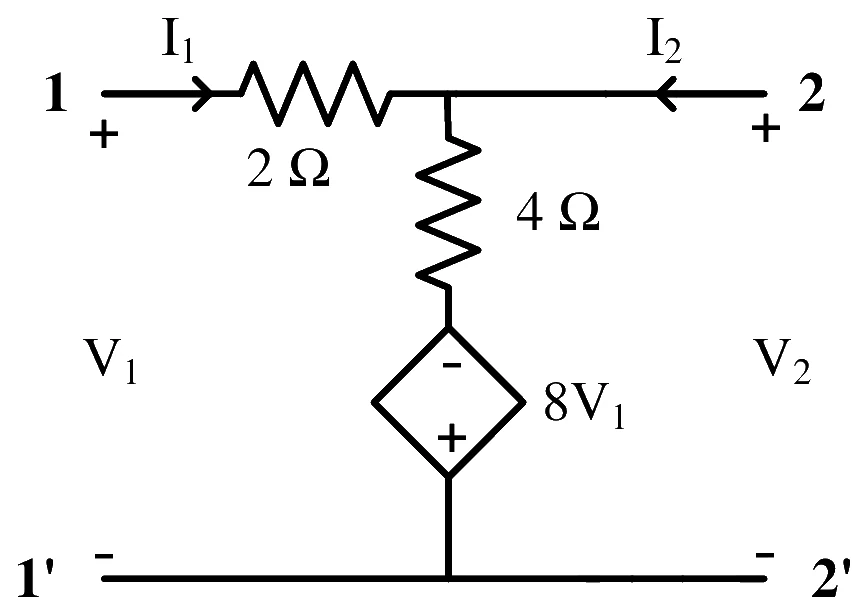
Answer format: Siemens
Full question on page 45 of the official paper (PDF)
Show answerHide answer
Key idea: Y_{21} = I_2/V_1 with port 2 short-circuited.
Official answer: 1.5
With port 2 shorted the node is at 0 V, so I_1 = V_1/2. The source holds the bottom of the 4 Ω at -8V_1, so the shunt branch draws \frac{0 - (-8V_1)}{4} = 2V_1 from the node. KCL at the node:
Learn the idea:
Q.61
Electronic Devices2 marksNAT
A MOS capacitor on p-type silicon has a 100 nm oxide of relative permittivity 4, a fixed positive oxide charge of C/cm² at the oxide-silicon interface, and a metal work function of 4.6 eV, with F/cm. If the flatband voltage is 0 V, what is the work function of the silicon, in eV?
Answer format: eV, rounded off to two decimal places
Full question on page 45 of the official paper (PDF)
Show answerHide answer
Key idea: The flatband voltage is the work-function difference minus the oxide charge's voltage, V_{FB} = \phi_{ms} - Q_{ox}/C_{ox}.
Official answer: 4.10 to 4.50
With V_{FB} = 0, \phi_m - \phi_s = 0.283 V, so
Within the key's range of 4.10 to 4.50.
Q.62
Networks, Signals and Systems2 marksNAT
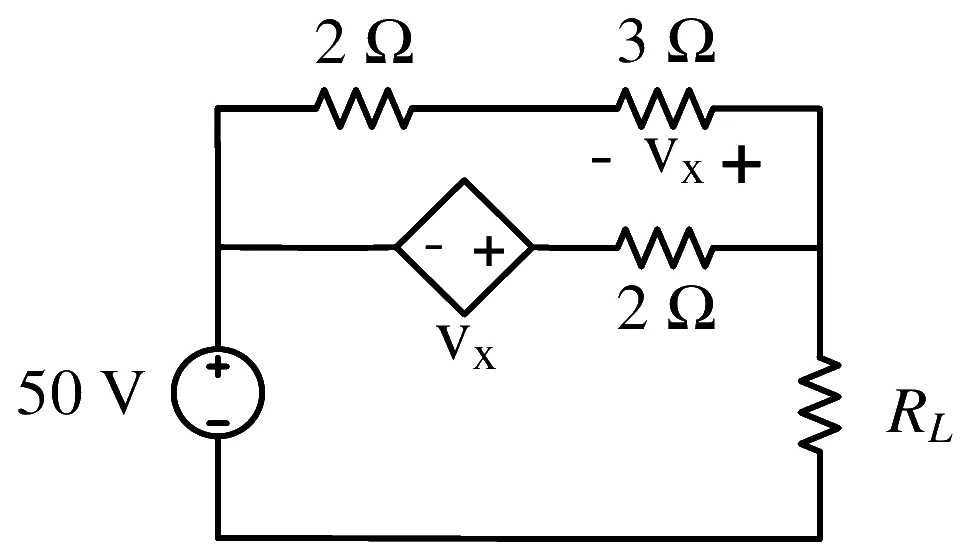
In the network in the figure, a 50 V source feeds the load through two parallel paths: 2 Ω then 3 Ω, with across the 3 Ω (positive at the load end); and a dependent voltage source (positive towards the load) then 2 Ω. What value of , in ohms, receives maximum power?
Answer format: Ohms
Full question on page 45 of the official paper (PDF)
Show answerHide answer
Key idea: With a dependent source, find the Thevenin resistance by turning off the independent source and driving the terminals with a test voltage.
Official answer: 2.5
Short the 50 V source and apply a test voltage V across the load terminals. The top path is 5 Ω, carrying V/5, and its 3 Ω takes v_x = \tfrac{3}{5}V.
In the lower path the dependent source lifts its right end to v_x = 0.6V, so its 2 Ω carries (V - 0.6V)/2 = 0.2V. The total test current is 0.2V + 0.2V = 0.4V:
Learn the idea:
Q.63
Electronic Devices2 marksNAT
In a non-degenerate n-type semiconductor, 5% of the dopant atoms are neutral. The Fermi level is 0.25 eV below , the donor level has degeneracy 2, and the thermal voltage is 20 mV. What is , in eV?
Answer format: eV, rounded off to two decimal places
Full question on page 46 of the official paper (PDF)
Show answerHide answer
Key idea: The fraction of donors still holding their electron follows a Fermi function with the degeneracy factor in front of the exponential.
Official answer: 0.17 to 0.19
Learn the idea:
Q.64
Electronic Devices2 marksNAT
An NMOS in the linear region carries µA at V. Keeping fixed, is raised to 1.5 V. With µA/V², what is the transconductance at the new operating point, in µA/V?
Answer format: µA/V, rounded off to two decimal places
Full question on page 46 of the official paper (PDF)
Show answerHide answer
Key idea: Use the first point to find the overdrive voltage, then check which region the new V_{DS} puts the device in.
Official answer: 52.40 to 52.60
In the linear region I_{DS} = k\left[V_{ov}V_{DS} - V_{DS}^2/2\right]:
At V_{DS} = 1.5 V > V_{ov}, the transistor is in saturation, where g_m = k V_{ov}:
Using the linear-region expression g_m = kV_{DS} instead would give 75, the usual slip.
Q.65
Electronic Devices2 marksNAT
A PN-junction solar cell has a photocurrent of 1 mA, and its maximum power point is at 0.3 V. With a thermal voltage of 30 mV, what is the diode's reverse saturation current, in nA?
Answer format: nA, rounded off to two decimal places
Full question on page 46 of the official paper (PDF)
Show answerHide answer
Key idea: At the maximum power point, the derivative of P = VI with respect to V is zero.
Official answer: 4.00 to 4.26
Learn the idea:
Sources
- GATE 2024 EC question paper (PDF), published by IISc Bengaluru. The questions are theirs: we paraphrase each question and its options, and link to the original.
- GATE 2024 EC answer key (PDF). It was published after the challenge window closed. The provisional key is no longer available, so we can't tell which answers, if any, changed between the two. The key gives marks to all for Q14, Q44 and Q48.