GATE EC Engineering Mathematics Previous Year Questions with Solutions
32 Engineering Mathematics questions from the GATE EC 2026 and 2025 and 2024 and 2023 papers, newest first. Try each one, then open its answer: the official answer from that year's key and a worked solution. Each question links to its place in the full paper.
GATE 2026, Q.11
Engineering Mathematics1 markMCQ
The solution of with is . Which matrix is ?
Full question on page 11 of the official paper (PDF)
Show answerHide answer
Key idea: Each component evolves on its own, so A is diagonal with the exponents on its diagonal.
Official answer: A
Differentiate each component and compare it with the component itself:
Option (A).
Learn the idea:
GATE 2026, Q.12
Engineering Mathematics1 markMCQ
and are the unit normals to the surface at the point . Which vector can be?
Full question on page 12 of the official paper (PDF)
Show answerHide answer
Key idea: The gradient of the surface function is normal to the surface.
Official answer: D
Write the surface as f = 2x^2 - y^2 - z^2 = 0 and take its gradient at (1, 0, \sqrt{2}):
This is a multiple of (\sqrt{2}, 0, -1), whose length is \sqrt{3}, so a unit normal is
\vec{n} = \frac{\sqrt{2}\,\hat{i} - \hat{k}}{\sqrt{3}}Option (D). Options (A) and (C) aren't unit vectors, and (B) points the wrong way.
Learn the idea:
GATE 2026, Q.26
Engineering Mathematics1 markMSQ
For , which values of and make ?
One or more options are correct.
Full question on page 26 of the official paper (PDF)
Show answerHide answer
Key idea: Write \det M in terms of a and b, then keep the options where it isn't zero.
Official answer: B and D
Expand along the first row:
- (A) a = b = -\tfrac{1}{2}: -\tfrac{1}{2} - \tfrac{5}{2} + 3 = 0.
- (B) a = b = \tfrac{1}{2}: 6 \neq 0.
- (C) a = -3, b = 0: 0.
- (D) a = \tfrac{1}{2}, b = -3: -11.5 \neq 0.
Options (B) and (D).
Learn the idea:
GATE 2026, Q.36
Engineering Mathematics2 marksMCQ
Do and converge?
Full question on page 33 of the official paper (PDF)
Show answerHide answer
Key idea: Ratio test for the first; compare the second with a geometric series.
Official answer: A
For S_A, use the ratio test:
So S_A converges (its sum is in fact 6).
Every term of S_B is a different power of \tfrac{1}{2} (the exponents run 0, 1, 3, 4, 6, 7, 9, and so on). Its partial sums are therefore bounded by the full geometric series:
S_B \le \sum_{k=0}^{\infty} \left(\tfrac{1}{2}\right)^k = 2A series of positive terms with bounded partial sums converges (its sum is 12/7). Both converge. Option (A).
GATE 2026, Q.38
Engineering Mathematics2 marksMCQ
is uniform on and is an independent standard normal. With and , find the correlations and .
Full question on page 35 of the official paper (PDF)
Show answerHide answer
Key idea: Independence and E[N] = 0 remove the noise terms, leaving E[X^2] and E[X^3].
Official answer: A
Here correlation means E[XY] (the correlation coefficient of X and Y is 1/2, which isn't an option). Independence and E[N] = 0 remove the noise terms:
The second is zero because x^3 is odd and X is symmetric about 0. Option (A).
Learn the idea:
GATE 2026, Q.61
Engineering Mathematics2 marksNAT
Evaluate over the square with corners , , and .
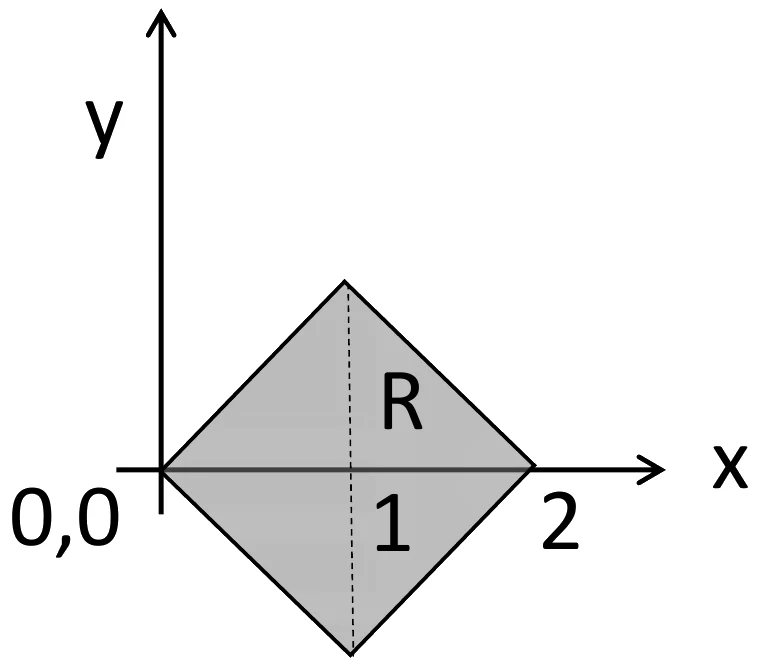
Answer format: A number, rounded off to two decimal places
Full question on page 57 of the official paper (PDF)
Show answerHide answer
Key idea: Use the square's polar moment about its centre, then shift the centre to (1, 0).
Official answer: 0.60 to 0.70
The square has diagonals of length 2, so its area is 2 and its side is \sqrt{2}. Its centre is (1, 0).
For a square of area A and side s, \iint (u^2 + v^2) about its centre is A s^2/6, whatever its orientation. Shifting the centre to (1, 0) adds A \times 1^2:
Learn the idea:
GATE 2025, Q.11
Engineering Mathematics1 markMCQ
. For which of these is the rank of at least three? (i) and ; (ii) ; (iii) and ; (iv) .
Full question on page 10 of the official paper (PDF)
Show answerHide answer
Key idea: The first two rows are always independent, so the rank is at least three as soon as the last two rows are not both zero.
Official answer: A
Rows 1 and 2 have pivots 2 and 6 in columns 1 and 2, so they give rank 2 whatever \alpha, \beta and \gamma are. Rows 3 and 4 have zeros in those columns, so any non-zero one of them adds to the rank.
- (i) Row 3 is (0, 0, 0, \beta), non-zero: rank 3.
- (ii) Rows 3 and 4 are both zero: rank 2.
- (iii) Row 3 is (0, 0, \alpha, 0), non-zero: rank 3.
- (iv) All four pivots are non-zero: rank 4.
So (i), (iii) and (iv) work. Option (A).
Learn the idea:
GATE 2025, Q.12
Engineering Mathematics1 markMCQ
Which of these series converge? (i) , (ii) , (iii)
Full question on page 11 of the official paper (PDF)
Show answerHide answer
Key idea: Compare each series with one whose behaviour you know: a p-series, a telescoping sum, or the series for e.
Official answer: B
- (i) is a p-series with p = \tfrac{1}{2} \le 1, so it diverges: its partial sums grow like 2\sqrt{N}.
- (ii) telescopes, since \frac{1}{n(n+1)} = \frac{1}{n} - \frac{1}{n+1}, and its sum is 1.
- (iii) is the series for e without its first term, so it converges to e - 1.
Only (ii) and (iii) converge. Option (B).
GATE 2025, Q.13
Engineering Mathematics1 markMCQ
A pot holds two red balls and two blue balls. Two balls are drawn at random without replacement. What is the probability that they are different colours?
Full question on page 12 of the official paper (PDF)
Show answerHide answer
Key idea: Count unordered pairs: every pair of the four balls is equally likely.
Official answer: A
There are \binom{4}{2} = 6 pairs. A mixed pair takes one of 2 red and one of 2 blue: 2 \times 2 = 4 pairs.
Option (A). The same comes from the second draw: whatever the first ball, 2 of the 3 left are the other colour.
Learn the idea:
GATE 2025, Q.25
Engineering Mathematics1 markMSQ
For on all real , which statements are correct?
One or more options are correct.
Full question on page 24 of the official paper (PDF)
Show answerHide answer
Key idea: A cubic is unbounded both ways, and the sign of f'' says which stationary point is which.
Official answer: A and B
As x \to \infty, f \to \infty, and as x \to -\infty, f \to -\infty. So f has neither a global maximum nor a global minimum: (A) and (B) are correct.
f''(-1) = -18 < 0, so x = -1 is a local maximizer, and f''(2) = 18 > 0, so x = 2 is a local minimizer. Both (C) and (D) have them the wrong way round. Options (A) and (B).
Learn the idea:
GATE 2025, Q.32
Engineering Mathematics1 markNAT
satisfies , with and . What is the maximum value of on ?
Answer format: Rounded off to two decimal places
Full question on page 29 of the official paper (PDF)
Show answerHide answer
Key idea: An equation whose coefficients are powers of t matching the order of each derivative has solutions of the form t^m.
Official answer: 0.25
Try y = t^m. Substituting gives
So y = c_1 t + c_2 t^2 and y' = c_1 + 2c_2 t. Then y'(0) = c_1 = 1 and y'(1) = 1 + 2c_2 = -1, so c_2 = -1:
y(t) = t - t^2Its maximum on [0, 1] is at t = \tfrac{1}{2}, where y = \tfrac{1}{4} = 0.25.
Learn the idea:
GATE 2025, Q.51
Engineering Mathematics2 marksMSQ
is non-negative, continuous and bounded on , with maximum and minimum there. For which pairs is guaranteed?
One or more options are correct.
Full question on page 45 of the official paper (PDF)
Show answerHide answer
Key idea: The integral lies between the interval length times the minimum and the interval length times the maximum.
Official answer: A
The interval has length 6, so
6m \le \int_2^8 f(x)\,dx \le 6MA pair is guaranteed to work if \beta \le 6m and \alpha \ge 6M for every such f. Since m, M \ge 0:
- (A) 5m \le 6m and 7M \ge 6M: always holds.
- (B) \alpha = 5M fails for a constant f = 1, whose integral is 6 > 5.
- (C) and (D): \beta = 7m fails for the same constant, since 7 > 6.
Option (A) only.
Learn the idea:
GATE 2025, Q.52
Engineering Mathematics2 marksMSQ
Which of these statements about contour integrals, taken counter-clockwise round the unit circle , are TRUE?
One or more options are correct.
Full question on page 46 of the official paper (PDF)
Show answerHide answer
Key idea: By Cauchy's theorem the integral is zero unless the function has a singularity inside the circle with a non-zero residue.
Official answer: A and B
- (A) e^z is analytic everywhere, so the integral is 0: TRUE.
- (B) For n \ge 0, z^n is analytic. For negative even n there is a pole at 0, but \oint_C z^n\,dz is 2\pi j only for n = -1 and 0 for every other integer. TRUE.
- (C) \cos z is analytic, so the integral is 0, and the statement is FALSE.
- (D) \sec z = 1/\cos z has poles at \pm\pi/2, \pm 3\pi/2, \dots, all outside the unit circle, so this integral is 0 too: FALSE.
Options (A) and (B).
Learn the idea:
GATE 2025, Q.58
Engineering Mathematics2 marksNAT
Two fair six-sided dice are rolled, and is the sum of the outcomes. What is the expectation of ?
Answer format: Rounded off to two decimal places
Full question on page 50 of the official paper (PDF)
Show answerHide answer
Key idea: Expectation is linear: the expected sum is the sum of the expected values.
Official answer: 6.95 to 7.05
So E[X] = 7.00. Listing all 36 outcomes gives the same answer.
Learn the idea:
GATE 2025, Q.59
Engineering Mathematics2 marksNAT
With and , what is over real , where is the Euclidean norm?
Answer format: Rounded off to two decimal places
Full question on page 50 of the official paper (PDF)
Show answerHide answer
Key idea: The minimum is the distance from \mathbf{b} to the line through \mathbf{a}: the part of \mathbf{b} perpendicular to \mathbf{a}.
Official answer: 2.95 to 3.05
The best x projects \mathbf{b} onto \mathbf{a}:
The minimum is 3.00.
Learn the idea:
GATE 2024, Q.11
Engineering Mathematics1 markMCQ
The general form of the complementary function of a differential equation is , where and are real constants set by the initial conditions. Which is the differential equation?
Full question on page 10 of the official paper (PDF)
Show answerHide answer
Key idea: A factor of t in front of an exponential means a repeated root of the characteristic equation.
Official answer: A
(At + B)e^{-2t} is what a double root at m = -2 produces, so the characteristic polynomial is
(m + 2)^2 = m^2 + 4m + 4That is option (A). Options (C) and (D) have distinct roots (-1, -2 and -2, -3), and (B) has roots \pm 2j.
Learn the idea:
GATE 2024, Q.25
Engineering Mathematics1 markMSQ
and are density and velocity, with continuous. is any volume with closed surface and outward unit normal . Which equations are equivalent to ?
One or more options are correct.
Full question on page 22 of the official paper (PDF)
Show answerHide answer
Key idea: Integrate the equation over any volume, then use the divergence theorem to turn the volume integral of the divergence into a flux.
Official answer: A and C
Integrating over V gives (C) directly. The divergence theorem, \int_V \nabla\cdot(\rho\mathbf{u})\,dv = \oint_S \rho\,\mathbf{u}\cdot\hat{n}\,ds, turns it into (A): mass inside falls at the rate it flows out.
Because V is arbitrary and the integrands are continuous, either integral form also gives back the differential equation. (B) and (D) have the wrong sign. Options (A) and (C).
Learn the idea:
GATE 2024, Q.30
Engineering Mathematics1 markNAT
For which do the vectors , and fail to form a basis of ?
Answer format: A number
Full question on page 24 of the official paper (PDF)
Show answerHide answer
Key idea: Three vectors in three dimensions form a basis exactly when the determinant of the matrix they make is non-zero.
Official answer: 5
It is zero at \alpha = 5, so then the vectors are dependent and not a basis.
Learn the idea:
GATE 2024, Q.33
Engineering Mathematics1 markNAT
and are independent and identically distributed, uniform on . What is ?
Answer format: Rounded off to two decimal places
Full question on page 25 of the official paper (PDF)
Show answerHide answer
Key idea: By symmetry P(X \ge Y) = P(Y \ge X), and X = Y has probability zero.
Official answer: 0.5
The two events X \ge Y and Y \ge X are mirror images and together cover everything, overlapping only on the line X = Y, which has zero probability. So each has probability \tfrac{1}{2}: the area of the triangle below the diagonal of the unit square.
Learn the idea:
GATE 2024, Q.36
Engineering Mathematics2 marksMCQ
Taking the Earth as a sphere of radius , what is the surface area of the region inside the 60°N latitude circle that contains the north pole?
Full question on page 27 of the official paper (PDF)
Show answerHide answer
Key idea: A spherical cap of height h has area 2\pi R h, the same as the band of a cylinder round it.
Official answer: A
The 60°N circle sits at height R\sin 60° = \tfrac{\sqrt{3}}{2}R above the equator, so the cap above it has height h = R(1 - \tfrac{\sqrt{3}}{2}):
Option (A). About 6.7% of the sphere.
Learn the idea:
GATE 2024, Q.43
Engineering Mathematics2 marksMCQ
For and the circle , what is ?
Full question on page 33 of the official paper (PDF)
Show answerHide answer
Key idea: Both singularities, z = 0 and z = 2, are inside the circle; add their residues.
Official answer: D
Near z = 0, \sin(\pi z) \approx \pi z, so the double pole is really simple: f(z) \approx \dfrac{\pi}{z(z - 2)}, with residue \dfrac{\pi}{-2}. At z = 2 the residue is \dfrac{\sin 2\pi}{4} = 0.
Option (D).
Learn the idea:
GATE 2024, Q.54
Engineering Mathematics2 marksMSQ
, and are functions of , and for every pair of points and the line integral is the same along any path from to . Which statements are true?
One or more options are correct.
Full question on page 42 of the official paper (PDF)
Show answerHide answer
Key idea: Path independence, zero circulation, being a gradient and having zero curl are four faces of the same property; zero divergence is a different one.
Official answer: A, B and D
- (A) True: going out along one path and back along another gives the difference of two equal integrals.
- (B) True: define f as the integral from a fixed point; path independence makes it well defined, and \nabla f = \mathbf{F}.
- (D) True: \mathbf{F} = \nabla f has zero curl, and these are its three components.
- (C) False: that is zero divergence. \mathbf{F} = (x, 0, 0) = \nabla(x^2/2) is path independent but has divergence 1.
Options (A), (B) and (D).
Learn the idea:
GATE 2024, Q.55
Engineering Mathematics2 marksMSQ
For the matrix , with a positive real number, which vectors are eigenvectors?
One or more options are correct.
Full question on page 43 of the official paper (PDF)
Show answerHide answer
Key idea: Find the eigenvalues, then read the ratio of components off one row of A - \lambda I.
Official answer: A and B
The first row of A - \lambda I gives \mp\sqrt{2k}\,v_1 + k\,v_2 = 0, so v_2 = \pm\frac{\sqrt{2k}}{k}v_1 = \pm\sqrt{2/k}\,v_1. Taking v_1 = 1 gives (A) and (B).
(C) and (D) have v_2/v_1 = \pm 1/\sqrt{2k}, which equals \pm\sqrt{2/k} for no positive k. Options (A) and (B).
Learn the idea:
GATE 2023, Q.11
Engineering Mathematics1 markMCQ
Let and . What value of the coefficient in minimises the length of the error vector ?
Full question on page 9 of the official paper (PDF)
Show answerHide answer
Key idea: The error is shortest when it is perpendicular to \mathbf{v}_2, which makes \alpha \mathbf{v}_2 the projection of \mathbf{v}_1.
Official answer: C
Setting \mathbf{e} \cdot \mathbf{v}_2 = 0 gives the projection coefficient:
Option (C).
Learn the idea:
GATE 2023, Q.12
Engineering Mathematics1 markMCQ
What is the rate of increase of the scalar field in the direction at the point ?
Full question on page 9 of the official paper (PDF)
Show answerHide answer
Key idea: The rate of increase along a direction is the gradient dotted with the unit vector in that direction.
Official answer: B
Option (B). Forgetting to normalise \mathbf{v} gives 4, option (D).
Learn the idea:
GATE 2023, Q.13
Engineering Mathematics1 markMCQ
Let . Which of the following cannot be a value of ?
Full question on page 10 of the official paper (PDF)
Show answerHide answer
Key idea: Write 16j in polar form; its four fourth roots have modulus 2 and angles a quarter turn apart.
Official answer: A
The angles are \pi/8, 5\pi/8, 9\pi/8 and 13\pi/8. 2\pi/8 is not among them: (2e^{j\pi/4})^4 = 16e^{j\pi} = -16. Option (A).
Learn the idea:
GATE 2023, Q.14
Engineering Mathematics1 markMCQ
What is the value of the contour integral , where is the circle , taken counter-clockwise?
Full question on page 10 of the official paper (PDF)
Show answerHide answer
Key idea: Find which poles lie inside the circle, then use the residue theorem.
Official answer: B
The poles are the roots of z^2 + 2z + 2, z = -1 \pm j. The circle has centre -1 + 1.5j and radius 1, so -1 + j (distance 0.5) is inside and -1 - j (distance 2.5) is not.
Option (B).
Learn the idea:
GATE 2023, Q.15
Engineering Mathematics1 markMCQ
The eigenvalues and eigenvectors of a matrix are and . For any invertible matrix , what are the eigenvalues and eigenvectors of the matrix , where ?
Full question on page 11 of the official paper (PDF)
Show answerHide answer
Key idea: Similar matrices share eigenvalues; multiply B\mathbf{v}_k = \lambda_k \mathbf{v}_k by P to see the eigenvectors.
Official answer: C
So A has the same eigenvalues \lambda_k, with eigenvectors P\mathbf{v}_k. Option (C).
Learn the idea:
GATE 2023, Q.36
Engineering Mathematics2 marksMCQ
A random variable , distributed normally as , undergoes the transformation in the figure. What is the form of the probability density function of ? (In the options, , , are non-zero constants and is a piecewise continuous function.)
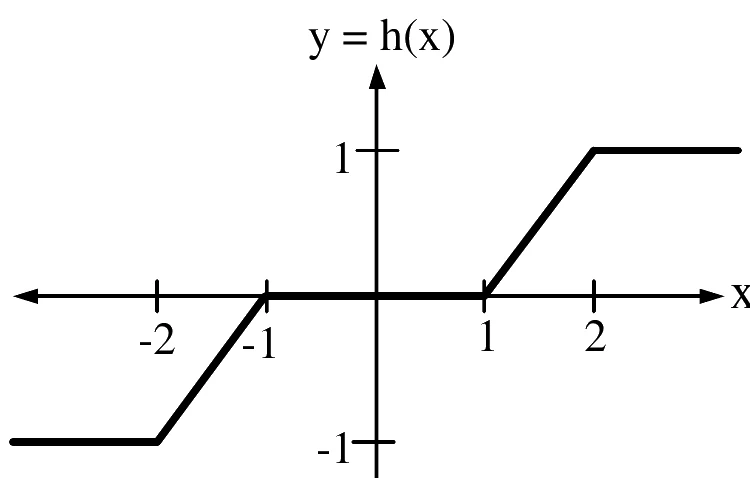
Full question on page 24 of the official paper (PDF)
Show answerHide answer
Key idea: Wherever h is flat over an interval of x, all that probability lands on one value of y: an impulse in the PDF.
Official answer: B
h is flat at three levels: y = -1 for x < -2, y = 0 for -1 < x < 1 and y = 1 for x > 2. Each of these ranges has non-zero probability under N(0, 1), so the PDF has impulses at y = -1, 0 and 1:
The sloped parts map 1 < |x| < 2 continuously onto 0 < |y| < 1, which gives g(y). Option (B).
Learn the idea:
GATE 2023, Q.37
Engineering Mathematics2 marksMCQ
What is the value of the line integral along the straight line joining and ?
Full question on page 25 of the official paper (PDF)
Show answerHide answer
Key idea: The integrand is an exact differential, so the integral depends only on the end points.
Official answer: B
Option (B). Parametrising the line as (1 + t, 1 + 2t, 2 - t) gives the same 24.
Learn the idea:
GATE 2023, Q.38
Engineering Mathematics2 marksMCQ
Let be an real column vector with length . What is the trace of the matrix ?
Full question on page 25 of the official paper (PDF)
Show answerHide answer
Key idea: The diagonal of \mathbf{x}\mathbf{x}^T holds the squares x_i^2.
Official answer: A
Option (A).
Learn the idea:
GATE 2023, Q.55
Engineering Mathematics2 marksNAT
What is the value of over the region in the figure, the square bounded by , , and ?
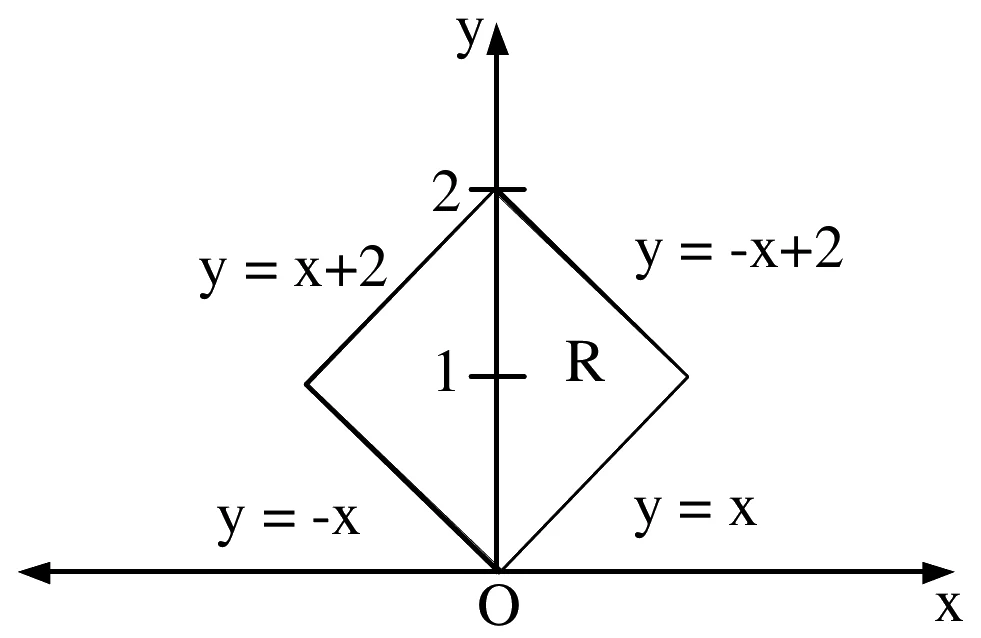
Answer format: rounded off to the nearest integer
Full question on page 41 of the official paper (PDF)
Show answerHide answer
Key idea: The region is symmetric about the y-axis and xy is odd in x.
Official answer: 0
Replacing x by -x maps R onto itself and changes the sign of xy, so the two halves cancel and the integral is 0.
Directly, for 0 \le y \le 1 the region spans -y \le x \le y, and for 1 \le y \le 2 it spans -(2 - y) \le x \le 2 - y; each inner integral \int x\, dx over a symmetric range is 0. Answer: 0.
Learn the idea: