GATE 2025 EC Paper: Worked Solutions to All 65 Questions
All 65 questions of the GATE 2025 EC paper (IIT Roorkee), in paper order. Try each one, then open its answer: the official answer from the answer key and a worked solution. Every answer matches the key, and every numerical answer was recomputed from the question's values.
Q.1
General Aptitude1 markMCQ
Group I lists words in decreasing order of intensity: Abuse, Insult, Ridicule. Group II follows the same pattern: ____, Praise, Appreciate. Which word fills the gap?
Full question on page 1 of the official paper (PDF)
Show answerHide answer
Key idea: The missing word has to be a stronger form of approval than the two after it.
Official answer: A
Group I goes from the harshest criticism to the mildest, so Group II must go from the warmest approval down to appreciation. To extol is to praise very highly, which fits before praise.
Prize means to value something, appropriate means to take or to be suitable, and espouse means to adopt a cause. None of them is a degree of praise. Option (A).
Q.2
General Aptitude1 markMCQ
Choose the best completion: "Had I learnt acting as a child, I ____ a famous film star."
Full question on page 1 of the official paper (PDF)
Show answerHide answer
Key idea: A condition about the past that didn't happen takes a result with a modal plus have and a past participle.
Official answer: D
Had I learnt is the inverted form of if I had learnt: the speaker didn't learn acting as a child. The result of an unreal past condition is written with would have, could have or might have and a past participle, so could have been is right.
The other three are present or future forms, which don't match a condition that is already over. Option (D).
Q.3
General Aptitude1 markMCQ
The 12 notes C, C#, D, D#, E, F, F#, G, G#, A, A# and B rise in frequency by a factor of from each note to the next. If C is at 130.8 Hz, what is the ratio of the frequencies of F# and C?
Full question on page 2 of the official paper (PDF)
Show answerHide answer
Key idea: A fixed ratio per step means the ratio over several steps is that factor raised to the number of steps.
Official answer: B
From C, the notes C#, D, D#, E, F and F# are six steps up. Six steps multiply the frequency by
The 130.8 Hz isn't needed, because a ratio doesn't depend on where the scale starts. Option (B).
Learn the idea:
Q.4
General Aptitude1 markMCQ
A curve is drawn by an iterative algorithm. Iteration 0 is a straight segment of length 1. The figure shows iterations 1 and 2, whose segments are each and long. What is the total length of the curve after iteration ?
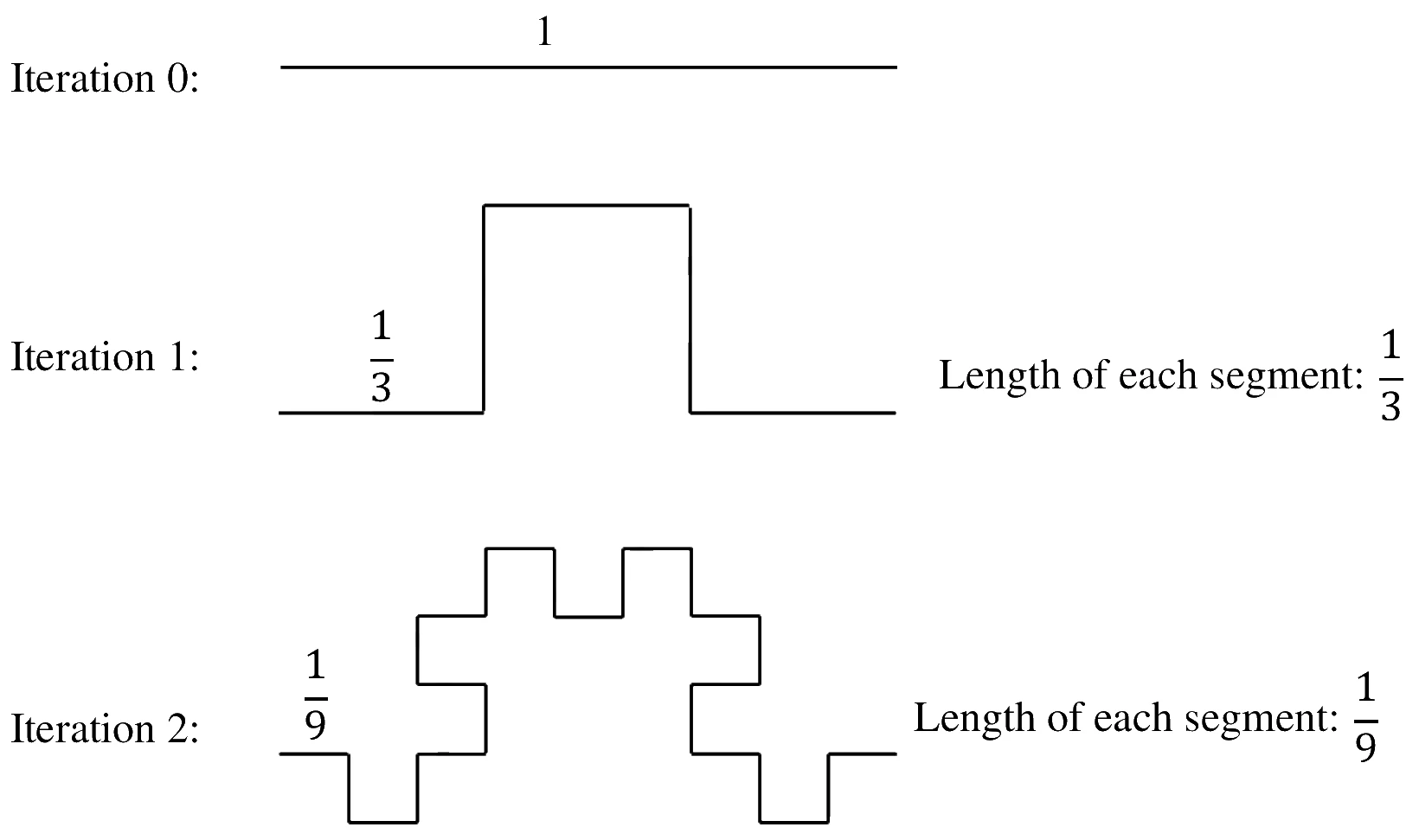
Full question on page 3 of the official paper (PDF)
Show answerHide answer
Key idea: Find what one iteration does to the total length; a constant factor per iteration gives a power of n.
Official answer: B
Count the segments in the figure. Iteration 1 has 5 segments of \tfrac{1}{3}, so its length is \tfrac{5}{3}. Iteration 2 replaces each of those by 5 segments a third as long: 25 segments of \tfrac{1}{9}, length \tfrac{25}{9}.
Every iteration multiplies the number of segments by 5 and divides their length by 3, so the length grows by \tfrac{5}{3} each time:
L_n = \left(\frac{5}{3}\right)^{n}Only (B) gives \tfrac{5}{3} at n = 1 and \tfrac{25}{9} at n = 2. Option (B).
Learn the idea:
Q.5
General Aptitude1 markMCQ
Which of the four plots in the figure represents , where is a non-zero real number?
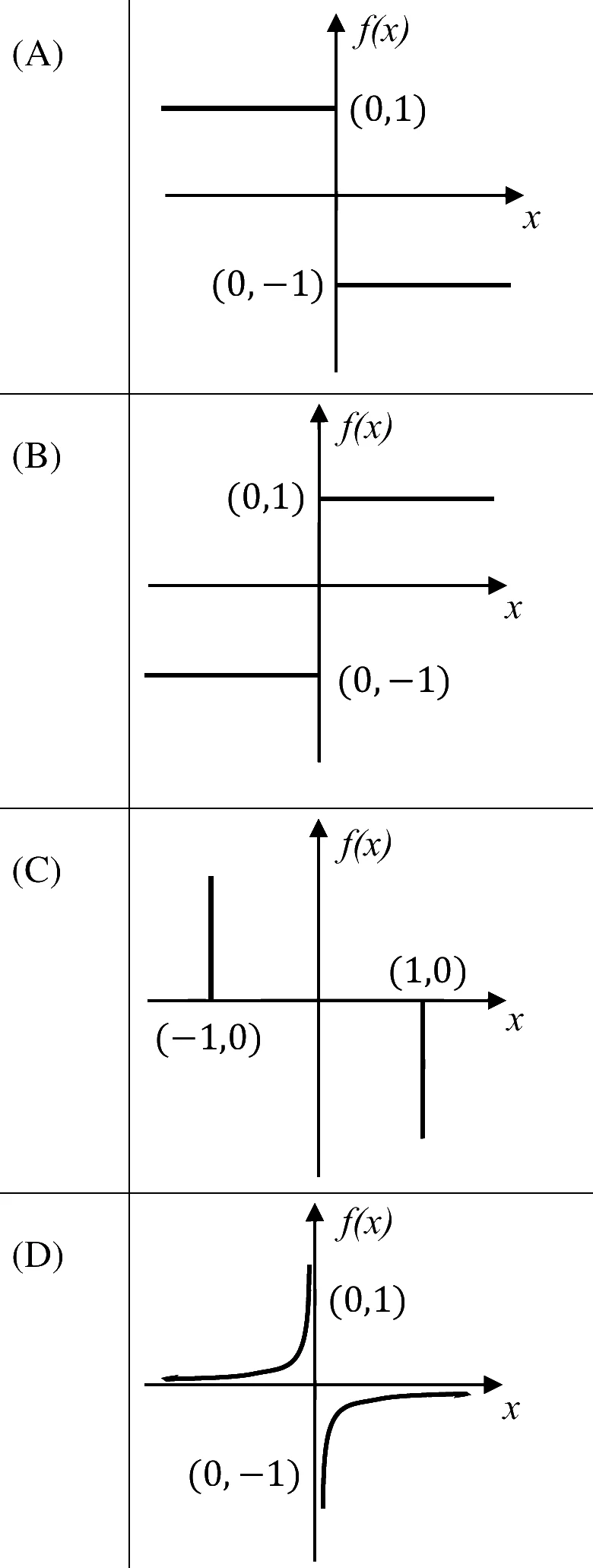
Full question on page 4 of the official paper (PDF)
Show answerHide answer
Key idea: Treat positive and negative x separately, since |x| is x for one and -x for the other.
Official answer: A
For x > 0, |x| = x and f(x) = -1. For x < 0, |x| = -x and f(x) = +1. So the graph is the constant 1 left of the axis and the constant -1 right of it, with no value at x = 0.
That is plot (A). Plot (B) is the reverse, +|x|/x, and (C) and (D) aren't constant on either side. Option (A).
Q.6
General Aptitude2 marksMCQ
Arrange the sentences into a coherent paragraph. P: Over time, such adaptations lead to large evolutionary changes that can shape new species. Q: In the natural world, organisms constantly adapt to their environments. R: This process of adaptation is driven by natural selection, in which favourable traits improve survival and reproduction. S: As environments change, organisms that can adapt their behaviour, structure and physiology are more likely to survive.
Full question on page 5 of the official paper (PDF)
Show answerHide answer
Key idea: Start with the sentence that refers back to nothing, then follow words such as this and such, which point to an earlier sentence.
Official answer: B
Q introduces the topic and leans on nothing before it, so it opens. S explains how adapting helps organisms survive as environments change.
R then names this process of adaptation as natural selection, and P, with such adaptations and over time, closes on the long-term result. The order Q, S, R, P is option (B).
The other orders put P or R, which both point back to something already said, ahead of Q.
Q.7
General Aptitude2 marksMCQ
A stick 1 m long is broken at distances and from one end, with . Which of these is NOT a necessary condition for the three pieces to form a triangle?
Full question on page 6 of the official paper (PDF)
Show answerHide answer
Key idea: Three lengths with a fixed total make a triangle exactly when each one is less than half the total.
Official answer: D
The pieces are b_1, b_2 - b_1 and 1 - b_2, which add up to 1. Each must be shorter than the other two together, that is, shorter than 0.5:
Those are (A), (C) and (B). Condition (D) isn't needed: b_1 = 0.4 and b_2 = 0.7 give pieces of 0.4, 0.3 and 0.3, a valid triangle, yet b_1 + b_2 = 1.1. Option (D).
Q.8
General Aptitude2 marksMCQ
Eight students start in a circle, clockwise P, R, T, Q, S, V, U, W, and move forward clockwise as they play musical chairs. After round 1 the 4th student behind P leaves; after round 2, the 5th behind Q; after round 3, the 3rd behind V; after round 4, the 4th behind U. Who is left after round 4?
Full question on page 7 of the official paper (PDF)
Show answerHide answer
Key idea: A question given marks to all scores full marks for every candidate, whatever they answered.
Official answer: Marks to all
The final key awards marks to all for this question, and doesn't say why. We don't give an answer: as printed, the question doesn't say how far the students move in a round, or which way round the circle counts as behind, and the student who leaves each round depends on both.
In the exam this meant there was nothing to lose by answering it. As practice, treat it as an exercise in reading a puzzle's rules carefully before starting.
Ruling in the key: The final key gives marks to all (MTA) for this question: every candidate received its 2 marks.
Q.9
General Aptitude2 marksMCQ
A table gives the gold, silver and bronze medals of the top five nations by golds: USA 40, 44, 41; Canada 39, 27, 24; Japan 20, 12, 13; Australia 17, 19, 16; France 16, 26, 22. Based only on these figures, which statement is INCORRECT?
Full question on page 8 of the official paper (PDF)
Show answerHide answer
Key idea: Every statement is about totals, so total each nation's medals first.
Official answer: C
Adding gold, silver and bronze:
- USA: 125
- Canada: 90
- France: 64
- Australia: 52
- Japan: 45
- All five: 376
(A) is true: France's 64 is third, ahead of Australia and Japan. (B) is true: the USA stays ahead of Canada. (D) is true: 90 is twice 45.
(C) is false: the USA and Canada have 215 of the 376 medals, about 57%, which is more than half. Option (C).
Learn the idea:
Q.10
General Aptitude2 marksMCQ
An organisation charges an overhead on a consulting fee: 20% of the fee for fees up to ₹5,00,000, and for higher fees ₹1,00,000 plus 10% of the amount above ₹5,00,000. GST of 18% is charged on the fee plus the overhead, and the client pays the fee, overhead and GST. If the client can pay at most ₹10,00,000, what is the largest fee the employee can charge?
Full question on page 9 of the official paper (PDF)
Show answerHide answer
Key idea: With a slab rule, decide which slab the answer is in, then solve the single linear equation for that slab.
Official answer: B
At a fee of ₹5,00,000 the client pays 1.18 \times 1.2 \times 5{,}00{,}000 = 7{,}08{,}000 rupees, well under the limit, so the fee is in the upper slab. There, with the fee F in rupees, the overhead and the client's total are
The largest fee is ₹7,24,961. Option (B).
Learn the idea:
Q.11
Engineering Mathematics1 markMCQ
. For which of these is the rank of at least three? (i) and ; (ii) ; (iii) and ; (iv) .
Full question on page 10 of the official paper (PDF)
Show answerHide answer
Key idea: The first two rows are always independent, so the rank is at least three as soon as the last two rows are not both zero.
Official answer: A
Rows 1 and 2 have pivots 2 and 6 in columns 1 and 2, so they give rank 2 whatever \alpha, \beta and \gamma are. Rows 3 and 4 have zeros in those columns, so any non-zero one of them adds to the rank.
- (i) Row 3 is (0, 0, 0, \beta), non-zero: rank 3.
- (ii) Rows 3 and 4 are both zero: rank 2.
- (iii) Row 3 is (0, 0, \alpha, 0), non-zero: rank 3.
- (iv) All four pivots are non-zero: rank 4.
So (i), (iii) and (iv) work. Option (A).
Learn the idea:
Q.12
Engineering Mathematics1 markMCQ
Which of these series converge? (i) , (ii) , (iii)
Full question on page 11 of the official paper (PDF)
Show answerHide answer
Key idea: Compare each series with one whose behaviour you know: a p-series, a telescoping sum, or the series for e.
Official answer: B
- (i) is a p-series with p = \tfrac{1}{2} \le 1, so it diverges: its partial sums grow like 2\sqrt{N}.
- (ii) telescopes, since \frac{1}{n(n+1)} = \frac{1}{n} - \frac{1}{n+1}, and its sum is 1.
- (iii) is the series for e without its first term, so it converges to e - 1.
Only (ii) and (iii) converge. Option (B).
Q.13
Engineering Mathematics1 markMCQ
A pot holds two red balls and two blue balls. Two balls are drawn at random without replacement. What is the probability that they are different colours?
Full question on page 12 of the official paper (PDF)
Show answerHide answer
Key idea: Count unordered pairs: every pair of the four balls is equally likely.
Official answer: A
There are \binom{4}{2} = 6 pairs. A mixed pair takes one of 2 red and one of 2 blue: 2 \times 2 = 4 pairs.
Option (A). The same comes from the second draw: whatever the first ball, 2 of the 3 left are the other colour.
Learn the idea:
Q.14
Communications1 markMCQ
An FM signal is , with . What is its peak frequency deviation in Hz?
Full question on page 13 of the official paper (PDF)
Show answerHide answer
Key idea: Frequency deviation is the time derivative of the phase deviation divided by 2\pi, not the sum of the modulation indices.
Official answer: A
The phase deviation is \phi(t) = 3\sin(2\pi f_1 t) + 4\sin(6\pi f_1 t). Differentiating and dividing by 2\pi:
Both cosines equal 1 at t = 0, so the peak is 3f_1 + 12f_1 = 15f_1. Option (A).
The tone at 3f_1 contributes four times its index, 12, because deviation scales with the modulating frequency. Adding the indices, 3 + 4, is the usual slip.
Q.15
Communications1 markMCQ
An AWGN channel has bandwidth , noise power spectral density and average power constraint . Which plot in the figure shows how the capacity depends on , with and fixed?
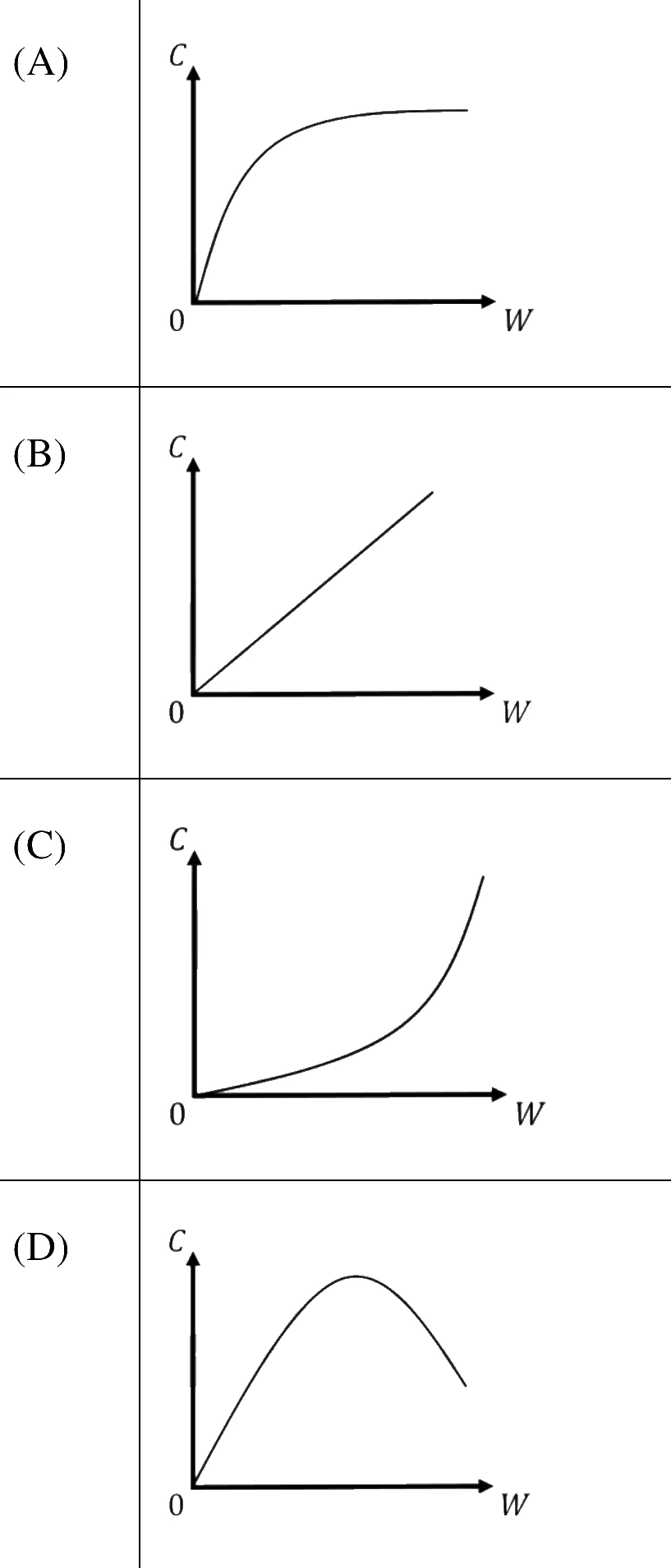
Full question on page 14 of the official paper (PDF)
Show answerHide answer
Key idea: More bandwidth also lets in more noise, so the signal-to-noise ratio falls as W grows.
Official answer: A
By the Shannon-Hartley formula,
C = W \log_2\!\left(1 + \frac{P_{av}}{N_0 W}\right)C is 0 at W = 0 and always increases with W, but ever more slowly. As W \to \infty, using \ln(1 + x) \approx x,
So the curve rises and flattens toward a finite limit: plot (A). It never falls, which rules out (D), and it doesn't grow without limit as (B) and (C) do.
Q.16
Control Systems1 markMCQ
The figure shows a Nyquist plot with the unit circle dashed. , , and are the positive frequencies at the points P, Q, R and S. Which statement is TRUE?
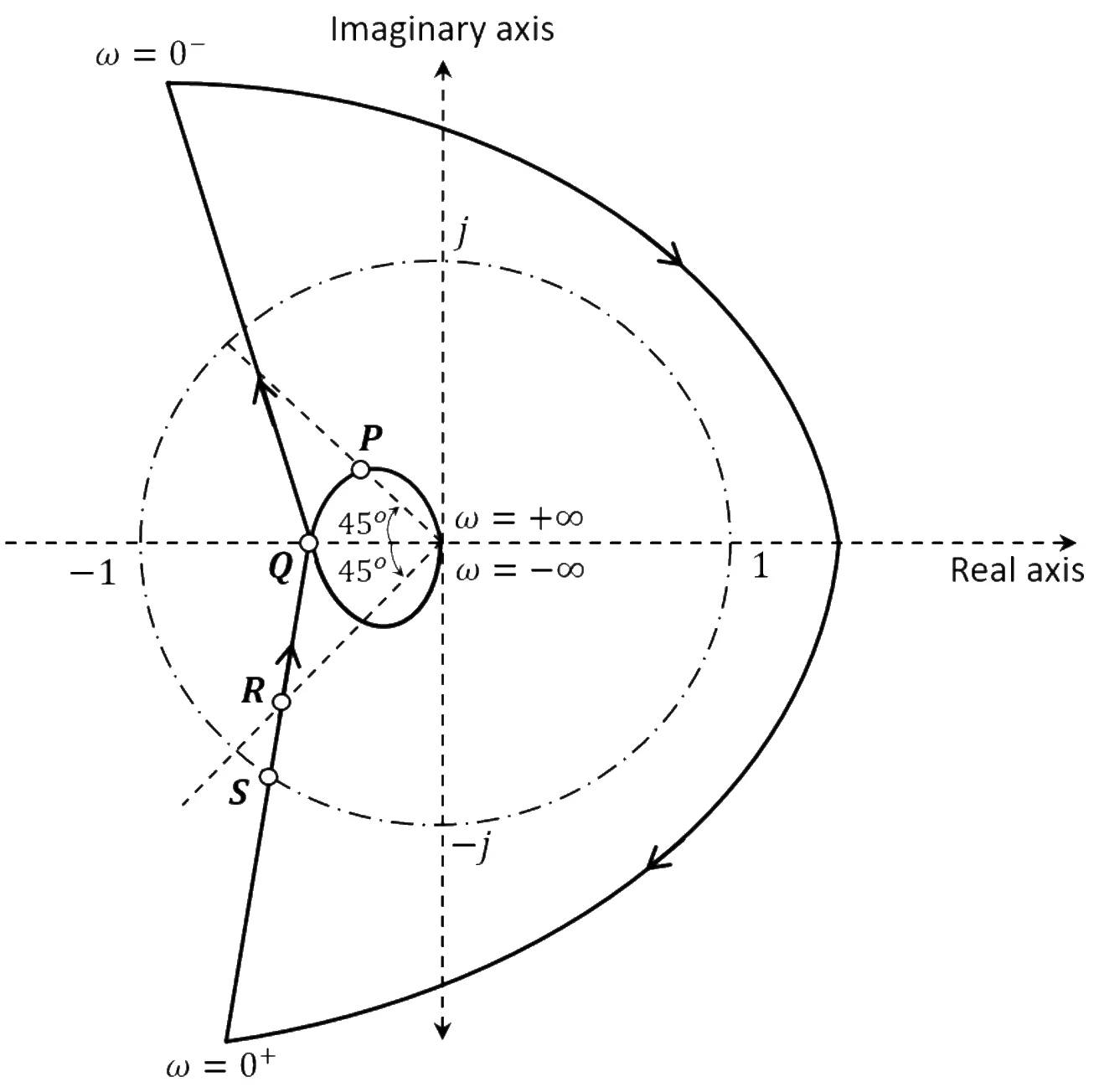
Full question on page 15 of the official paper (PDF)
Show answerHide answer
Key idea: Gain crossover is where the plot meets the unit circle; phase crossover is where it meets the negative real axis.
Official answer: D
At the gain crossover frequency |G(j\omega)H(j\omega)| = 1, so the plot is on the unit circle. Of the four points, only S lies on the dashed unit circle.
At the phase crossover frequency the phase is -180°, so the plot is on the negative real axis. That is Q, where the branch crosses the axis inside the circle.
P and R are marked where the plot meets the 45° lines through the origin; they are neither crossover. So \omega_S is the gain crossover and \omega_Q the phase crossover. Option (D).
Learn the idea:
Q.17
Networks, Signals and Systems1 markMCQ
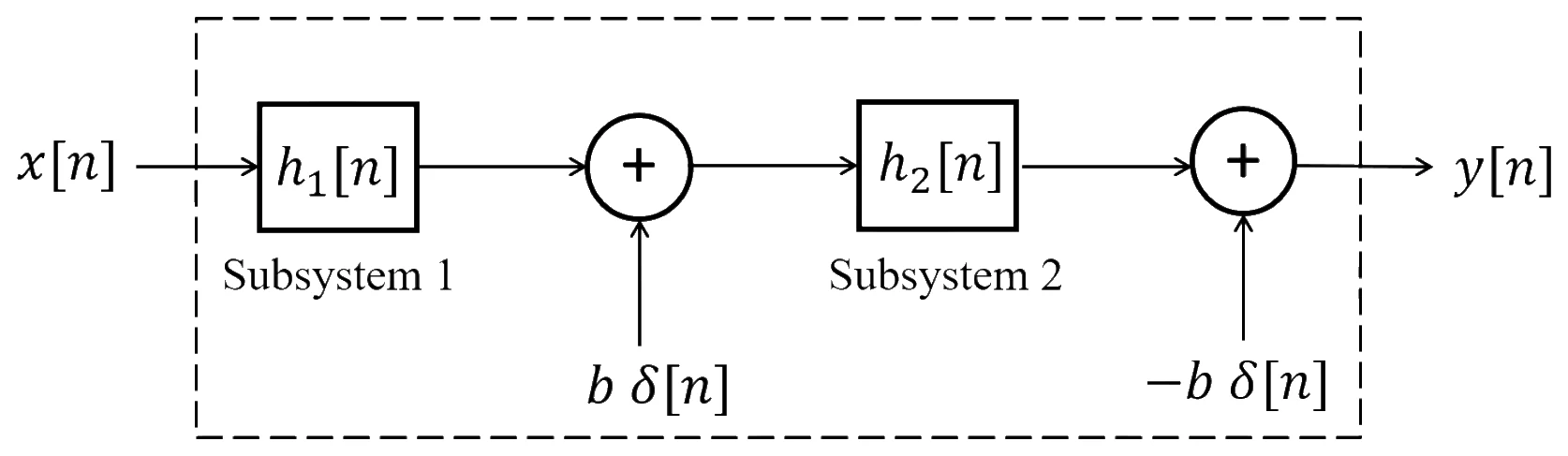
In the figure, passes through an LTI subsystem with impulse response , then is added, then it passes through an LTI subsystem , and is subtracted to give , with . If , the overall system is
Full question on page 16 of the official paper (PDF)
Show answerHide answer
Key idea: An output term that doesn't depend on the input breaks linearity, and one fixed at n = 0 breaks time invariance.
Official answer: D
Follow a signal through the box:
The second term is the same for every input, and it is not zero because h_2[n] \neq \delta[n]. A zero input therefore gives a non-zero output, so the system is not linear.
That term also stays put at n = 0 when the input is delayed, so a delayed input doesn't give a delayed output: the system is time variant. Option (D). (If h_2[n] = \delta[n], the two b\,\delta[n] terms would cancel and the system would be LTI.)
Q.18
Networks, Signals and Systems1 markMCQ
is a real continuous-time signal whose Fourier transform exists. Which statement is always TRUE?
Full question on page 17 of the official paper (PDF)
Show answerHide answer
Key idea: The magnitude of an integral is at most the integral of the magnitude.
Official answer: A
Since |e^{-j\omega t}| = 1,
So (A) holds for every f, and (B) never does. (C) and (D) compare with the signed integral, which can fail either way:
- (C) fails for f(t) = -1 on |t| < \tfrac{1}{2}: |F(0)| = 1 but \int f\,dt = -1.
- (D) fails for f(t) = 1 on |t| < \tfrac{1}{2}: at \omega = \pi, |F| = 2/\pi \approx 0.64 < 1.
Option (A).
Learn the idea:
Q.19
Networks, Signals and Systems1 markMCQ
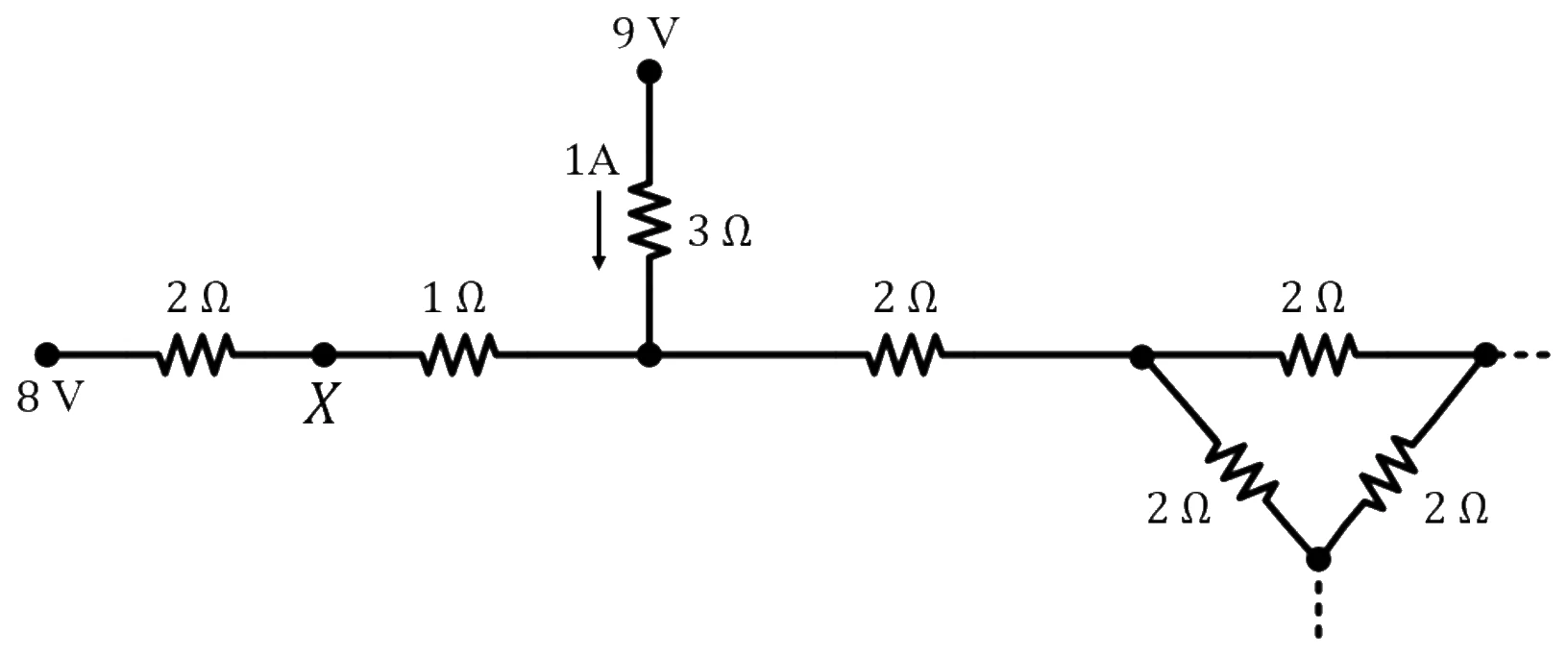
In the network in the figure, 1 A flows through the 3 Ω resistor from the 9 V node into the junction. Node X is joined to an 8 V node through 2 Ω and to that junction through 1 Ω. What is the voltage at X, in volts?
Full question on page 18 of the official paper (PDF)
Show answerHide answer
Key idea: The known current through the 3 Ω fixes the junction voltage, and then the rest of the network doesn't matter for node X.
Official answer: A
The 3 Ω resistor drops 1 \times 3 = 3 V, so the junction is at 9 - 3 = 6 V.
Node X has only two connections, so the current in from the 8 V node equals the current out to the junction:
Option (A). The resistors to the right of the junction only carry whatever current is left over there.
Learn the idea:
Q.20
Networks, Signals and Systems1 markMCQ
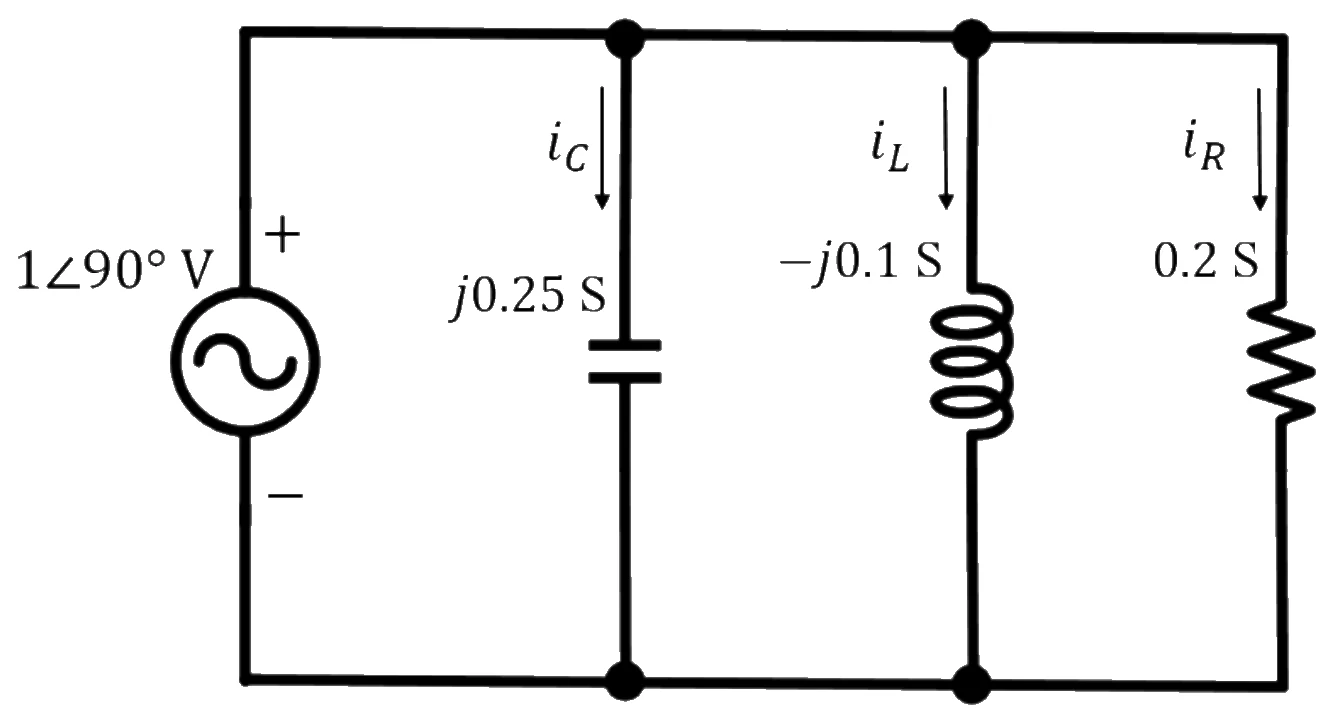
A source of V is connected across a capacitor of admittance S, an inductor of S and a resistor of S, all in parallel, as in the figure. Which set of branch currents is correct?
Full question on page 19 of the official paper (PDF)
Show answerHide answer
Key idea: With admittances, each branch current is I = YV: multiply, don't divide.
Official answer: A
Every branch has the full source voltage V = 1\angle 90° = j across it, so
Option (A). Option (B) divides by the admittances, as if they were impedances.
Learn the idea:
Q.21
Analog Circuits1 markMCQ
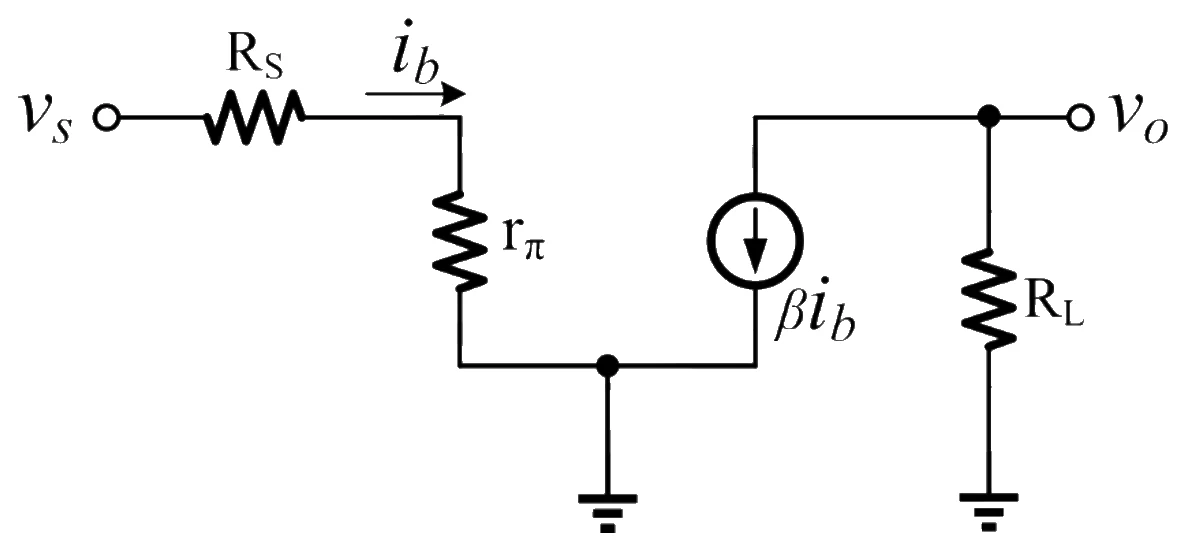
In the small-signal circuit in the figure, drives through , carrying , and a dependent source flows down from the output node, which has to ground. What is the voltage gain ?
Full question on page 20 of the official paper (PDF)
Show answerHide answer
Key idea: Find i_b from the input loop alone, then let the dependent source drive the load.
Official answer: A
The input side is R_S and r_\pi in series, so
i_b = \frac{v_s}{R_S + r_\pi}The source \beta i_b pulls current down out of the output node, so that current flows up through R_L and makes v_o negative:
Option (A). Dropping r_\pi gives (C), and missing the inversion gives (D).
Learn the idea:
Q.22
Analog Circuits1 markMCQ
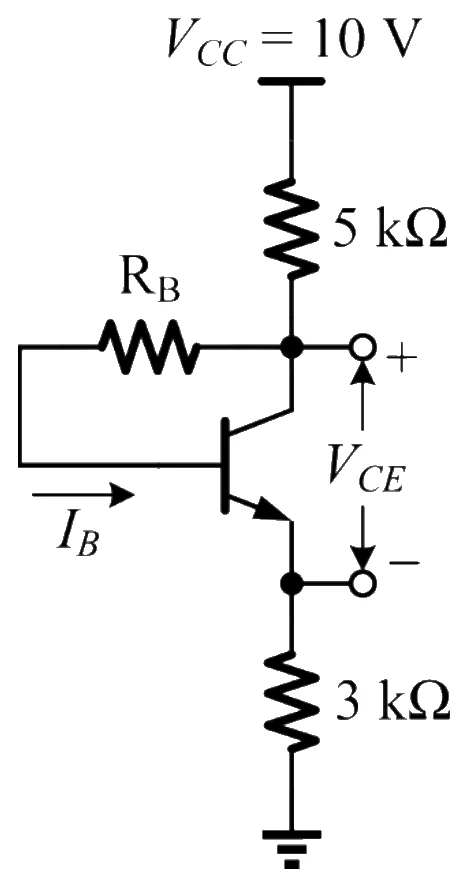
In the circuit in the figure, V feeds the collector through 5 kΩ, the emitter has 3 kΩ to ground, and connects the collector to the base. The ideal BJT is in the active region with . If µA, what is in volts, to two decimal places?
Full question on page 21 of the official paper (PDF)
Show answerHide answer
Key idea: With R_B taken from the collector, the collector resistor carries the base current as well as the collector current.
Official answer: C
With \beta = 100 and I_B = 10 µA, I_C = 1 mA and I_E = 1.01 mA.
The 5 kΩ carries I_C + I_B = 1.01 mA, because I_B leaves the collector node through R_B. So
Option (C). Options (A) and (B) are V_C and V_E on their own, and using only I_C in the 5 kΩ gives 1.97 V.
Learn the idea:
Q.23
Digital Circuits1 markMCQ
A 3-input majority gate with inputs , and outputs when two or more inputs are 1, and when two or more are 0. Which expression gives ?
Full question on page 22 of the official paper (PDF)
Show answerHide answer
Key idea: F is 1 exactly when some pair of inputs are both 1.
Official answer: A
Two or more inputs are 1 exactly when at least one of the pairs XY, YZ or ZX is 1, so F = XY + YZ + ZX. Option (A).
The others fail on one row each: X \oplus Y \oplus Z is 0 for X = Y = 1, Z = 0; X + Y + Z is 1 with a single 1; and XYZ is 0 with two 1s.
Learn the idea:
Q.24
Digital Circuits1 markMCQ
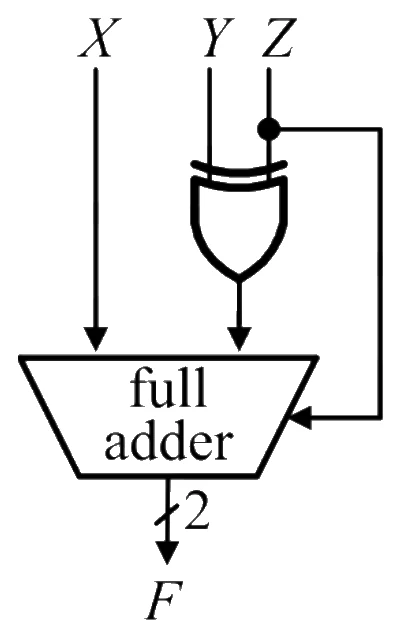
In the circuit in the figure, a full adder takes , and a carry-in of , and its 2-bit output is . With , the circuit works as which of these, with inputs and ?
Full question on page 23 of the official paper (PDF)
Show answerHide answer
Key idea: Adding the complement of Y plus 1 is subtracting Y in two's complement.
Official answer: B
With Z = 1, the XOR gives \overline{Y} and the carry-in is 1, so the full adder computes
X + \overline{Y} + 1That is X - Y in two's complement: the sum bit is the difference bit X \oplus Y, and the carry-out is 1 when no borrow is needed (X \ge Y). The circuit is a subtractor. Option (B). With Z = 0 it would add.
Learn the idea:
Q.25
Engineering Mathematics1 markMSQ
For on all real , which statements are correct?
One or more options are correct.
Full question on page 24 of the official paper (PDF)
Show answerHide answer
Key idea: A cubic is unbounded both ways, and the sign of f'' says which stationary point is which.
Official answer: A and B
As x \to \infty, f \to \infty, and as x \to -\infty, f \to -\infty. So f has neither a global maximum nor a global minimum: (A) and (B) are correct.
f''(-1) = -18 < 0, so x = -1 is a local maximizer, and f''(2) = 18 > 0, so x = 2 is a local minimizer. Both (C) and (D) have them the wrong way round. Options (A) and (B).
Learn the idea:
Q.26
Control Systems1 markMSQ
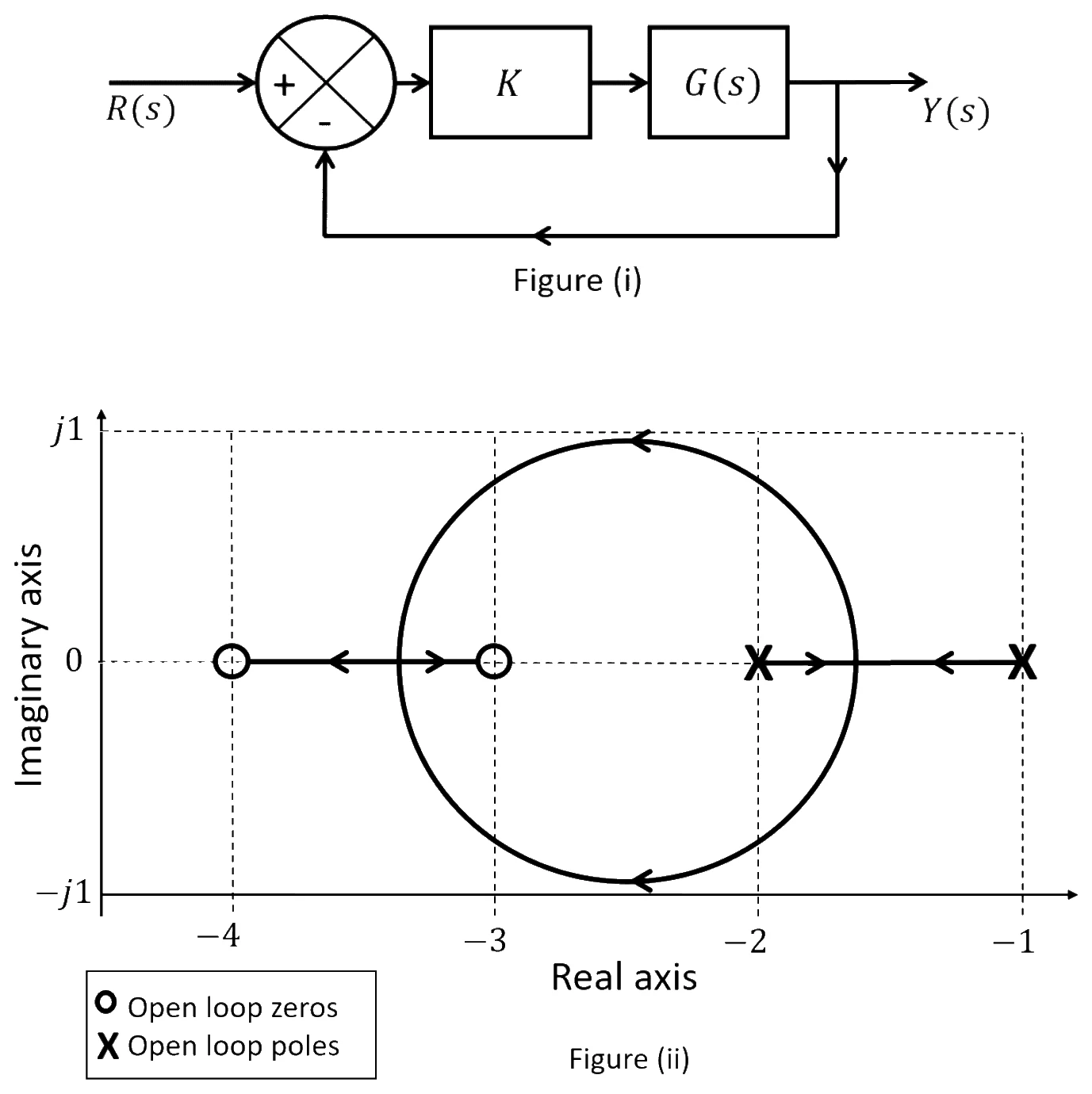
The unity negative-feedback system in the figure has gain in front of . Its root locus, also shown, has open-loop poles at and and zeros at and . For what value or values of does the closed loop have a pole at ?
One or more options are correct.
Full question on page 25 of the official paper (PDF)
Show answerHide answer
Key idea: A point is a closed-loop pole for some K > 0 only if it lies on the root locus, which the angle condition decides.
Official answer: C
From the figure, G(s) = \dfrac{(s+3)(s+4)}{(s+1)(s+2)} up to a positive constant. At s = -1 + j, the angle of G is
A point on the root locus needs \pm 180°, so -1 + j is not on it. Solving for K directly confirms it:
That isn't a real number, so no K works. The figure agrees: the circle only reaches about \pm j0.87. Option (C). Option (B) is the size of that complex value, 0.2, taken as if it were a gain.
Q.27
Networks, Signals and Systems1 markMSQ
has z-transform . Which statements are TRUE?
One or more options are correct.
Full question on page 26 of the official paper (PDF)
Show answerHide answer
Key idea: The DTFT is the z-transform on the unit circle, and the RoC can never contain a pole but may contain zeros.
Official answer: C and D
- (A) is false: x[n] = 2^n u[n] has X(z) = \frac{1}{1 - 2z^{-1}} for |z| > 2, but no DTFT.
- (B) is false: the RoC has no poles, but it can contain zeros. x[n] = \delta[n] - \delta[n-1] has X(z) = 1 - z^{-1}, with a zero at z = 1 inside its RoC.
- (C) is true: on the unit circle, X(e^{j\omega}) is the DTFT, and it converges there when the circle is in the RoC.
- (D) is true: X(z) = \alpha for every z, so the RoC is the whole plane.
Options (C) and (D).
Learn the idea:
Q.28
Communications1 markMSQ
is band-limited to Hz. DSB-SC is , and AM is with modulation index . (i) An envelope detector can demodulate DSB-SC if for all . (ii) An envelope detector can demodulate AM only if for all . Which are correct?
One or more options are correct.
Full question on page 27 of the official paper (PDF)
Show answerHide answer
Key idea: An envelope detector recovers whatever multiplies the carrier, provided that factor never goes negative.
Official answer: A and D
The envelope is |A_c\, m(t)| for DSB-SC and |A_c\,(1 + \mu\, m(t))| for AM.
- (i): if m(t) > 0 always, |A_c\, m(t)| = A_c\, m(t), so the envelope is the message. (i) is TRUE.
- (ii): AM needs 1 + \mu\, m(t) > 0, not m(t) > 0. A tone m(t) = \cos(2\pi W t) with \mu = 0.5 goes negative, yet 1 + 0.5\cos(2\pi W t) stays between 0.5 and 1.5, and the envelope detector recovers it. So the "only if" is FALSE.
Options (A) and (D).
Learn the idea:
Q.29
Analog Circuits1 markMSQ
Which statements about an ideal op-amp are TRUE?
One or more options are correct.
Full question on page 28 of the official paper (PDF)
Show answerHide answer
Key idea: An ideal op-amp amplifies only the difference between its inputs, draws no input current and drives any load.
Official answer: A and C
An ideal op-amp has infinite input resistance (A) and infinite differential gain (C). Its output resistance is zero, not infinite, so it can drive any load, and its common-mode gain is zero, since it ignores what the two inputs share (infinite CMRR). Options (A) and (C).
Learn the idea:
Q.30
Analog Circuits1 markMSQ
For ideal MOSFET single-stage DC-coupled amplifiers with finite load resistors, which statements are TRUE?
One or more options are correct.
Full question on page 28 of the official paper (PDF)
Show answerHide answer
Key idea: Whether the signal goes into the gate or the source decides the input resistance, and which terminal it comes out of decides the phase.
Official answer: B and D
- (A) is false: a common-gate stage takes its input at the source, where the input resistance is about 1/g_m.
- (B) is true: the common-source input is the gate, which draws no current.
- (C) is false: the common-source gain is -g_m R_D, so the output is inverted.
- (D) is true: the common-drain stage (source follower) has a positive gain just under 1.
Options (B) and (D).
Q.31
Electronic Devices1 markMSQ
Which of these can be used as an n-type dopant for silicon?
One or more options are correct.
Full question on page 29 of the official paper (PDF)
Show answerHide answer
Key idea: An n-type dopant has one more valence electron than silicon: it comes from group 15.
Official answer: A and D
Silicon has four valence electrons. Arsenic and phosphorus (group 15) have five, so each donates a free electron: they are donors, and make silicon n-type.
Boron and gallium (group 13) have three and accept an electron, making silicon p-type. Options (A) and (D).
Learn the idea:
Q.32
Engineering Mathematics1 markNAT
satisfies , with and . What is the maximum value of on ?
Answer format: Rounded off to two decimal places
Full question on page 29 of the official paper (PDF)
Show answerHide answer
Key idea: An equation whose coefficients are powers of t matching the order of each derivative has solutions of the form t^m.
Official answer: 0.25
Try y = t^m. Substituting gives
So y = c_1 t + c_2 t^2 and y' = c_1 + 2c_2 t. Then y'(0) = c_1 = 1 and y'(1) = 1 + 2c_2 = -1, so c_2 = -1:
y(t) = t - t^2Its maximum on [0, 1] is at t = \tfrac{1}{2}, where y = \tfrac{1}{4} = 0.25.
Learn the idea:
Q.33
Communications1 markNAT
A (6,3) binary linear block code has generator matrix . What is the minimum Hamming distance between codewords?
Answer format: An integer
Full question on page 29 of the official paper (PDF)
Show answerHide answer
Key idea: For a linear code, the minimum distance equals the smallest weight of a non-zero codeword.
Official answer: 3
List the 7 non-zero codewords, the sums of the rows of G in every combination, with their weights:
- Single rows: 100101, 010011, 001110 (weight 3 each)
- Two rows: 110110, 101011, 011101 (weight 4 each)
- All three: 111000 (weight 3)
The smallest weight is 3, so d_{min} = 3.
Learn the idea:
Q.34
Analog Circuits1 markNAT
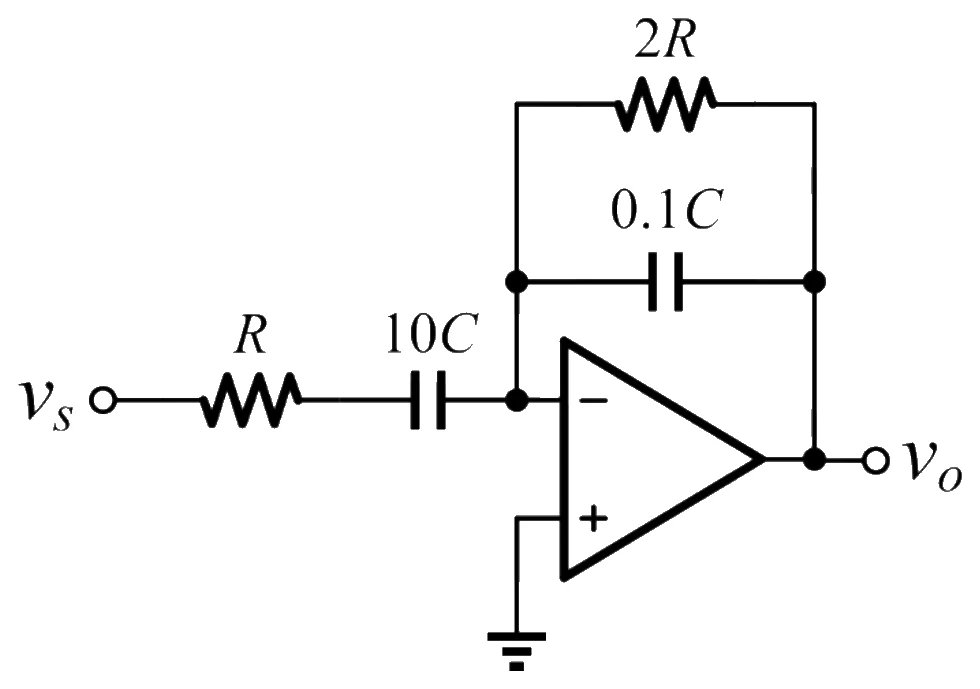
In the ideal inverting filter in the figure, the input is in series with , and the feedback is in parallel with . The lower dB frequency is 1 MHz. What is the upper dB frequency, in MHz?
Answer format: MHz, rounded off to the nearest integer
Full question on page 30 of the official paper (PDF)
Show answerHide answer
Key idea: The input network sets the lower corner and the feedback network the upper one, each through its own time constant.
Official answer: 50
The gain is -Z_f / Z_i, with
\frac{V_o}{V_s} = -\frac{2R}{1 + j\omega(0.2RC)} \cdot \frac{j\omega(10RC)}{1 + j\omega(10RC)}The input network is a high-pass with its corner at 1/(2\pi \cdot 10RC), and the feedback network a low-pass with its corner at 1/(2\pi \cdot 0.2RC). Taking each corner as a -3 dB frequency, their ratio is
Note: The exact -3 dB points come out at about 54 MHz, because the two poles interact (the peak gain is 1.96, not 2). The key uses the standard corner-frequency approximation, which is the method expected in the exam.
Learn the idea:
Q.35
Digital Circuits1 markNAT
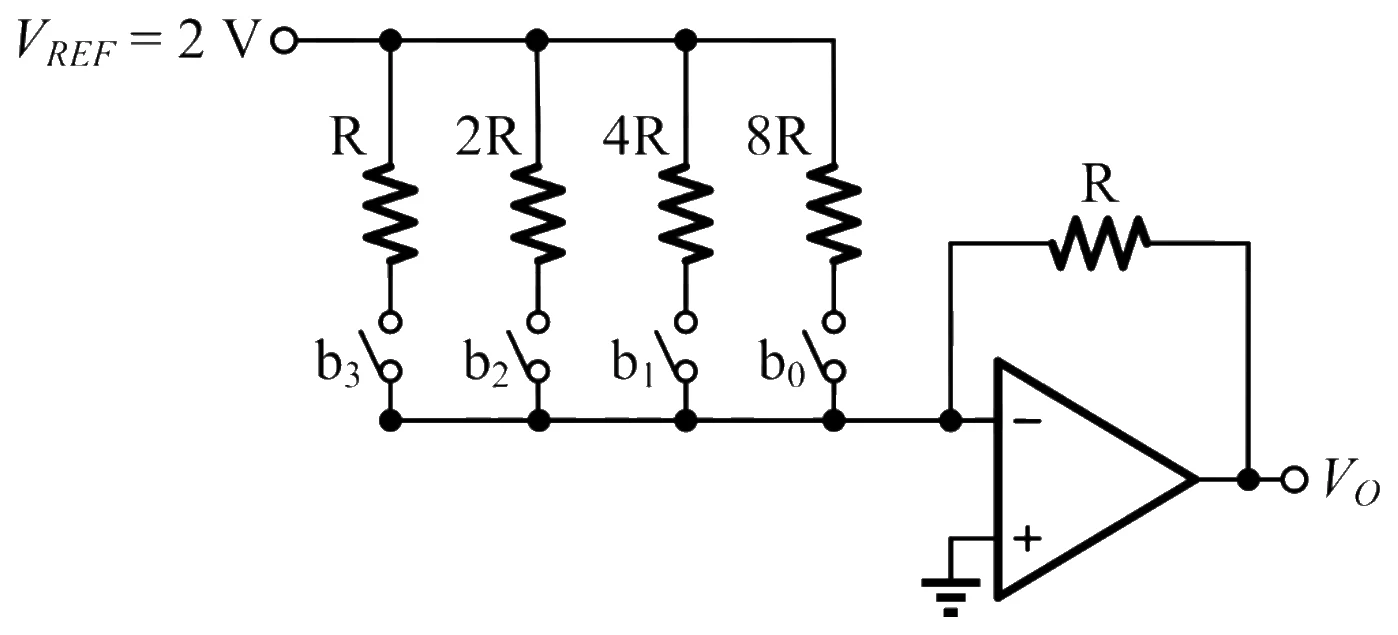
A 4-bit weighted-resistor DAC uses an ideal op-amp with feedback . Bits to (MSB to LSB) switch resistors , , and from V into the inverting input, as in the figure; a switch closes when its bit is 1. By how much does the magnitude of change when the input goes from 1110 to 1101, in mV?
Answer format: mV, rounded off to the nearest integer
Full question on page 30 of the official paper (PDF)
Show answerHide answer
Key idea: Each closed switch adds V_{REF} times the feedback-to-input resistance ratio, so the output is a weighted sum of the bits.
Official answer: 250
V_O = -V_{REF}\left(b_3 + \frac{b_2}{2} + \frac{b_1}{4} + \frac{b_0}{8}\right)- 1110: V_O = -2\,(1 + 0.5 + 0.25) = -3.5 V
- 1101: V_O = -2\,(1 + 0.5 + 0.125) = -3.25 V
The output changes by 0.25 V, that is 250 mV.
Learn the idea:
Q.36
Control Systems2 marksMCQ
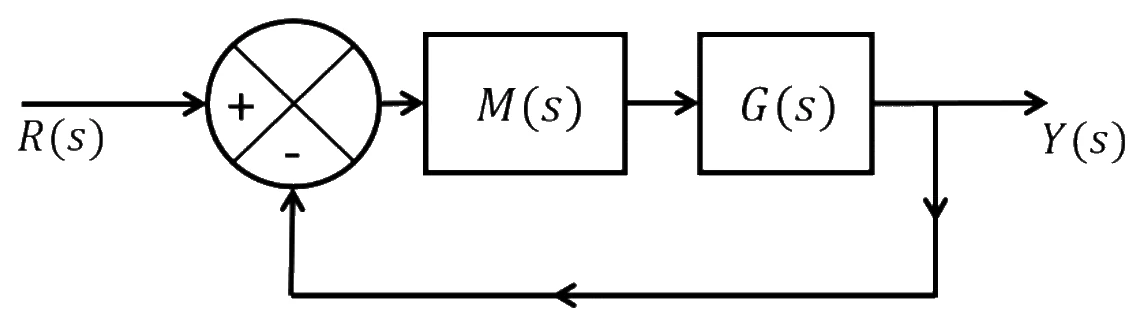
is controlled by in a unity negative-feedback loop, as in the figure. (i) No controller with makes the closed loop stable. (ii) At least one controller with makes it stable. Which is correct?
Full question on page 31 of the official paper (PDF)
Show answerHide answer
Key idea: Write the closed-loop characteristic polynomial: a missing power of s rules out stability.
Official answer: D
The closed-loop poles are the roots of 1 + M(s)G(s) = 0.
- (i) With M = K_I/s: 10s^3 + K_I = 0. The s^2 and s terms are missing, so some root is in the right half-plane (or on the axis) for every K_I > 0. No such controller works: (i) is TRUE.
- (ii) With M = K_P + sK_D: 10s^2 + K_D s + K_P = 0. A second-order polynomial with all coefficients positive has both roots in the left half-plane, so any positive K_P and K_D work: (ii) is TRUE.
Option (D).
Learn the idea:
Q.37
Control Systems2 marksMCQ
For , let , and be the numbers of roots with negative real parts, purely imaginary roots, and roots with positive real parts. Which is correct?
Full question on page 32 of the official paper (PDF)
Show answerHide answer
Key idea: Every option has imaginary roots, so look for a factor s^2 + a and divide it out.
Official answer: A
Try s = j, so s^2 = -1, s^3 = -j, s^4 = 1, s^5 = j:
j + 7 - 3j + 33 + 2j - 40 = 0So s^2 + 1 is a factor, and dividing it out leaves a cubic that factors further:
The roots are \pm j, 2, -4 and -5: L = 2, I = 2, R = 1. Option (A). A Routh array gets the same counts, with a row of zeros at the s^2 + 1 factor.
Learn the idea:
Q.38
Networks, Signals and Systems2 marksMCQ
has finite energy and a Fourier transform that is zero outside . It is sampled as with , where and , and passes through an ideal low-pass filter with cutoff and passband gain . What is the filter's output?
Full question on page 33 of the official paper (PDF)
Show answerHide answer
Key idea: Shifting the sampling instants changes where the samples are taken, not which signal they are samples of.
Official answer: A
The impulses sit at t = \tau + nT_s and carry f's own values there, f(\tau + nT_s). In frequency, the shifted impulse train is
The k = 0 copy is F(\omega)/T_s with no phase factor: the offset only multiplies the other copies by a phase. If the copies don't overlap, \omega_s > 2\omega_c, that is T_s < \pi/\omega_c, the filter keeps just the k = 0 copy and its gain T_s restores F(\omega). The output is f(t). Option (A).
Option (B) is the usual slip: the samples are taken later, but they are still samples of f(t), not of f(t - \tau).
Q.39
Networks, Signals and Systems2 marksMCQ
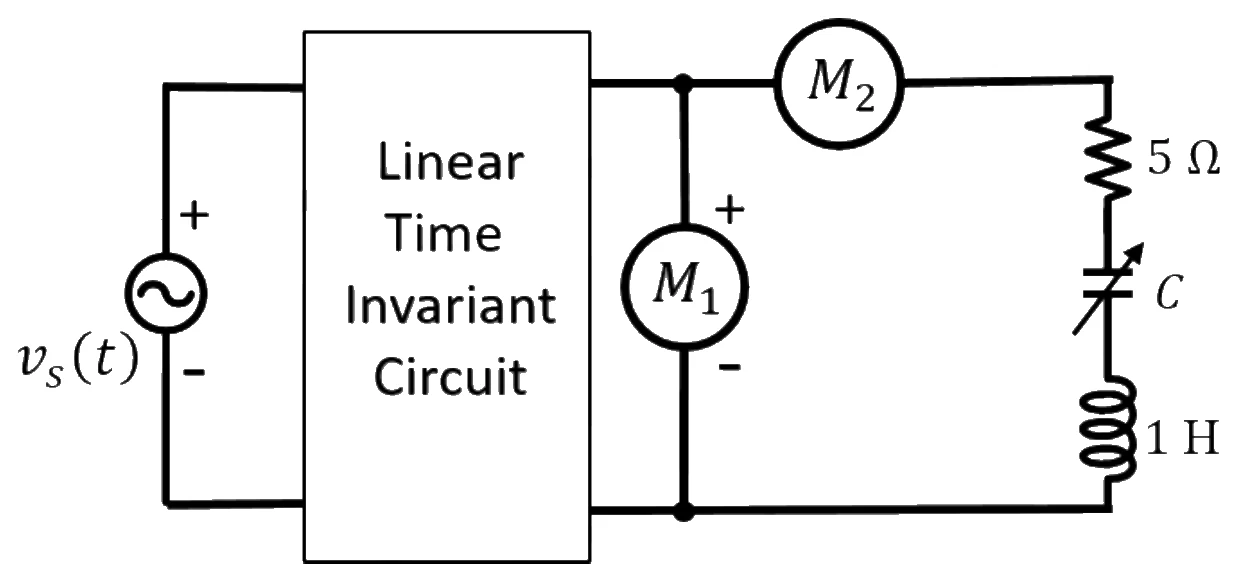
An unknown linear time-invariant circuit, driven by V, feeds a branch of 5 Ω, a variable capacitor and 1 H in series, as in the figure. An ideal AC voltmeter across the branch reads 25 V RMS, and an ideal AC ammeter in it reads 5 A RMS. What should be?
Full question on page 34 of the official paper (PDF)
Show answerHide answer
Key idea: The two meter readings give the branch's impedance magnitude without needing anything about the rest of the circuit.
Official answer: A
The branch has 25 V across it and 5 A through it, so
So the reactance is zero: the branch is at resonance at \omega = 200 rad/s.
Option (A). The unknown circuit doesn't matter, because the meters measure the branch directly.
Learn the idea:
Q.40
Networks, Signals and Systems2 marksMCQ
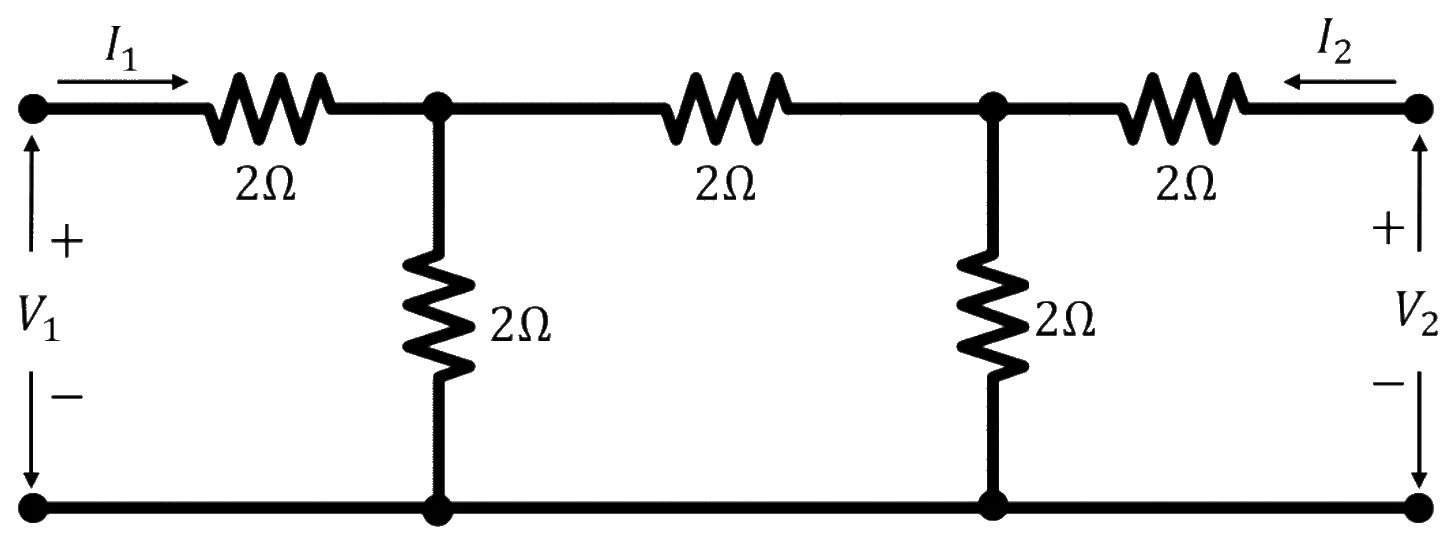
Find the Z-parameter matrix, in ohms, of the two-port in the figure: from port 1, a 2 Ω series resistor, a 2 Ω shunt, a 2 Ω series resistor, a 2 Ω shunt, and a 2 Ω series resistor to port 2.
Full question on page 35 of the official paper (PDF)
Show answerHide answer
Key idea: Each Z-parameter is a ratio measured with the other port open, so the open port's series resistor carries no current.
Official answer: A
Call the two shunt nodes A (near port 1) and B. With port 2 open, the last 2 Ω carries nothing, so V_2 = V_B. From node A the network looks like 2 Ω in parallel with 2 + 2 = 4 Ω:
The current into node A splits so that V_A = \tfrac{4}{3} I_1, and the divider of 2 Ω and 2 Ω gives V_B = \tfrac{1}{2} V_A:
Z_{21} = \frac{V_2}{I_1} = \frac{2}{3}\ \OmegaThe network is symmetric and reciprocal, so Z_{22} = \tfrac{10}{3} and Z_{12} = \tfrac{2}{3}. Option (A).
Learn the idea:
Q.41
Communications2 marksMCQ
A source sends , equally likely to be , or . The receiver gets , where is zero-mean Gaussian noise independent of , and uses a maximum-likelihood decoder. If the probability of a symbol error is , what is ?
Full question on page 36 of the official paper (PDF)
Show answerHide answer
Key idea: With equal priors and Gaussian noise, the ML thresholds sit halfway between neighbouring symbols, and an inner symbol can be pushed out either way.
Official answer: D
The decision thresholds are at -1 and 1. Using the symmetry of N, with P = P(N > 1):
- S = -2 is wrong only if N > 1: probability P.
- S = 0 is wrong if |N| > 1: probability 2P.
- S = 2 is wrong only if N < -1: probability P.
So \alpha = \tfrac{4}{3}. Option (D).
Learn the idea:
Q.42
Communications2 marksMCQ
, with , for and 0 otherwise, and the pairwise independent, zero-mean and unit-variance. (i) The mean of is independent of . (ii) The autocorrelation is independent of for all . Which option is correct?
Full question on page 37 of the official paper (PDF)
Show answerHide answer
Key idea: Zero-mean coefficients make the mean zero everywhere, but the pulses fill only half of each slot, so the power switches on and off with time.
Official answer: A
(i) E[f(t)] = \sum_n E[a_n]\, p(t - nT) = 0 for every t: TRUE.
(ii) Since E[a_n a_m] is 1 for n = m and 0 otherwise,
At \tau = 0 this is 1 when t is in the first half of a slot and 0 in the second half, so it depends on t: FALSE. Option (A).
Learn the idea:
Q.43
Analog Circuits2 marksMCQ
In the differential pair in the figure, the identical ideal MOSFETs and are in saturation with mS. Each drain has 1 kΩ to V, and the tail current is 2 mA. The inputs are and volts. What is , the drain voltage of , in volts?
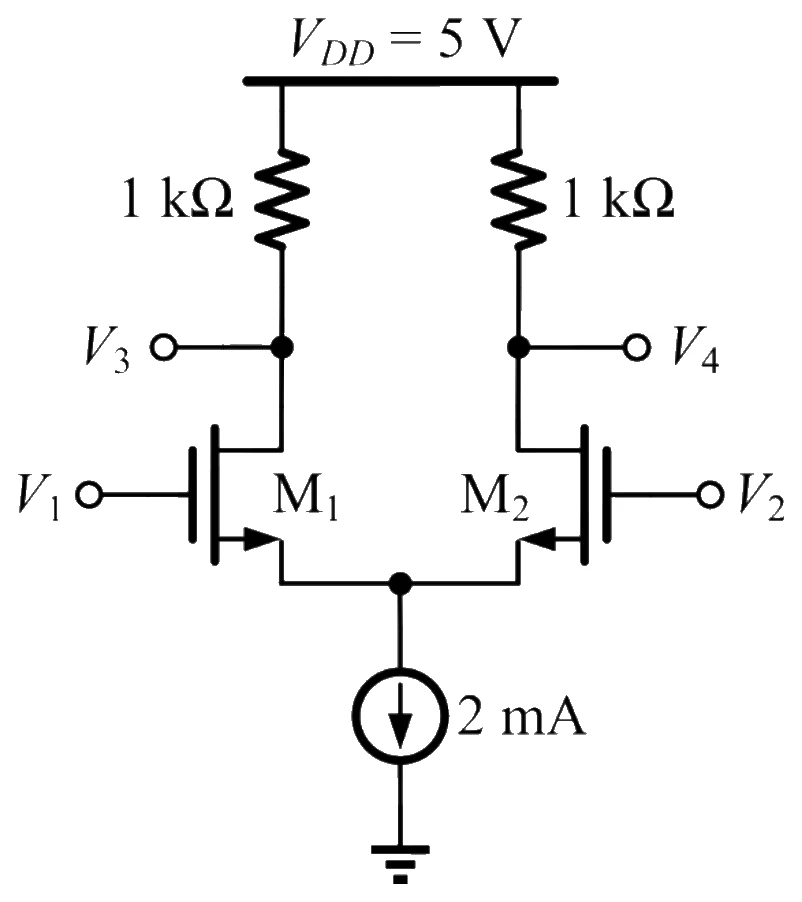
Full question on page 38 of the official paper (PDF)
Show answerHide answer
Key idea: The tail current splits equally at rest, and each transistor's current changes by g_m times half the differential input.
Official answer: D
At rest each transistor carries half of 2 mA, so V_3 = 5 - 1\,\text{k}\Omega \times 1\,\text{mA} = 4 V.
The differential input is V_1 - V_2 = 0.02\sin\omega t. Each transistor sees half of it, so M_1's current rises by
Option (D). The drain falls when the current rises, hence the minus sign; using the whole differential input gives the 0.1 in (B) and (C).
Q.44
Digital Circuits2 marksMCQ
A 10-bit ADC samples at 1 MHz with a full-scale voltage of 3.3 V. For a 500 kHz sinusoidal input, what are the maximum SNR (in dB, to two decimal places) and the output data rate (in Mbps)?
Full question on page 39 of the official paper (PDF)
Show answerHide answer
Key idea: A full-scale sine quantized to N bits has an SNR of 6.02N + 1.76 dB, whatever the full-scale voltage.
Official answer: A
The full-scale voltage cancels out of the ratio. Each of the 10^6 samples per second produces 10 bits, so the data rate is 10 Mbps. Option (A).
5 Mbps would come from using the 500 kHz signal frequency instead of the 1 MHz sampling rate.
Learn the idea:
Q.45
Digital Circuits2 marksMCQ
In the positive-edge-triggered circuit in the figure, the first flip-flop's D comes from a multiplexer choosing (SEL = 1) or (SEL = 0). The second flip-flop's D comes from a multiplexer choosing the first flip-flop's (SEL = 1) or (SEL = 0). is the XOR of the two outputs. With SEL and S as in the timing diagram and no timing violations, what is the sequence of from to ?
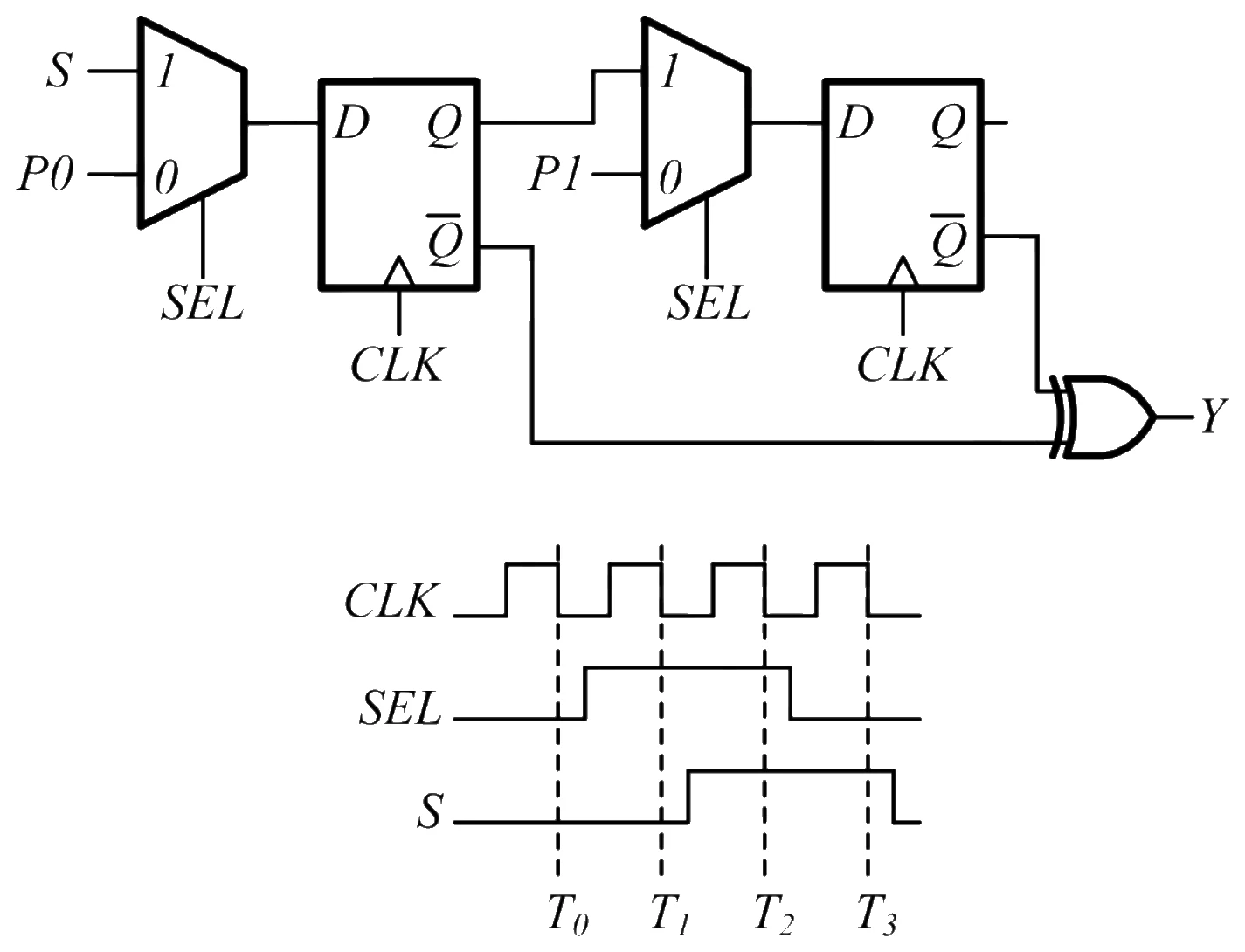
Full question on page 40 of the official paper (PDF)
Show answerHide answer
Key idea: The flip-flops change only on rising clock edges, so read the inputs at each rising edge and the output at the instant after it.
Official answer: A
Y = \overline{Q_1} \oplus \overline{Q_2} = Q_1 \oplus Q_2. The marks T_0 to T_3 are falling edges, so each comes just after a rising edge. At those rising edges:
- Before T_0: SEL = 0, so Q_1 = P_0 = 0 and Q_2 = P_1 = 1. Y = 1.
- Before T_1: SEL = 1, S = 0, so Q_1 = S = 0 and Q_2 takes the old Q_1 = 0. Y = 0.
- Before T_2: SEL = 1, S = 1, so Q_1 = 1 and Q_2 takes the old Q_1 = 0. Y = 1.
- Before T_3: SEL = 0, so Q_1 = 0 and Q_2 = 1. Y = 1.
The sequence is 1011. Option (A). The first edge loads both flip-flops, so their starting state doesn't matter.
Learn the idea:
Q.46
Electronic Devices2 marksMCQ
A semiconductor has intrinsic carrier concentration m⁻³ at 300 K, and electron and hole mobilities of 0.15 and 0.05 m²/Vs. With C, what is its intrinsic resistivity at 300 K, in kΩ·m?
Full question on page 41 of the official paper (PDF)
Show answerHide answer
Key idea: In an intrinsic semiconductor both carriers have concentration n_i, so their mobilities add.
Official answer: B
Option (B).
Q.47
Analog Circuits2 marksMCQ
In the circuit in the figure, identical PNP transistors and are active with , and V. is diode-connected from the 20 V rail into a Zener diode in breakdown ( V, mA), which feeds to ground. That node drives 's base; 's emitter has to 20 V and its collector feeds the load. If mA, what are and in kΩ, to one decimal place?
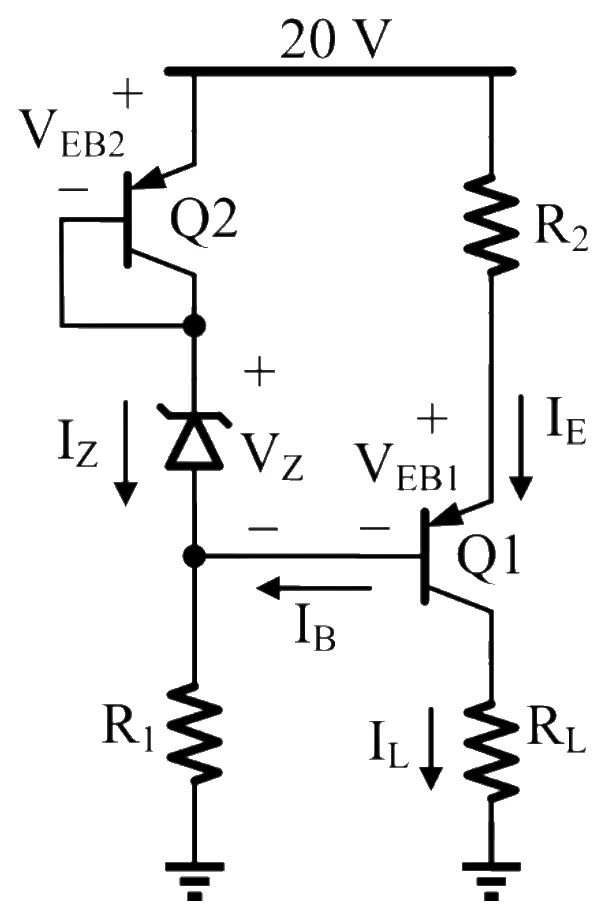
Full question on page 42 of the official paper (PDF)
Show answerHide answer
Key idea: The diode drop and the Zener voltage fix Q_1's base voltage, and the base current adds to the Zener current in R_1.
Official answer: A
Q_2 drops 0.7 V, so the Zener's top is at 19.3 V and its bottom node at 19.3 - 5 = 14.3 V. That node is Q_1's base.
I_L = I_{C1} = 12 mA, so I_B = 12/120 = 0.1 mA and I_E = 12.1 mA. The base current flows out of Q_1's base into the node, joining the Zener current in R_1:
Option (A).
Learn the idea:
Q.48
Electronic Devices2 marksMCQ
The electron mobility in non-degenerate germanium at 300 K is 0.38 m²/Vs. With J/K and C, what is the electron diffusivity at 300 K, in cm²/s, to the nearest integer?
Full question on page 43 of the official paper (PDF)
Show answerHide answer
Key idea: The Einstein relation ties diffusivity to mobility through the thermal voltage kT/e.
Official answer: B
To the nearest integer, 98. Option (B). Forgetting that 1 m² is 10^4 cm² gives 0.0098, and 26 is the thermal voltage in mV.
Learn the idea:
Q.49
Electromagnetics2 marksMCQ
A 4 m × 4 m metal sheet lies in the - plane with corners at , as in the figure. Its surface charge density is µC/m². What is the total charge on the sheet, in µC?
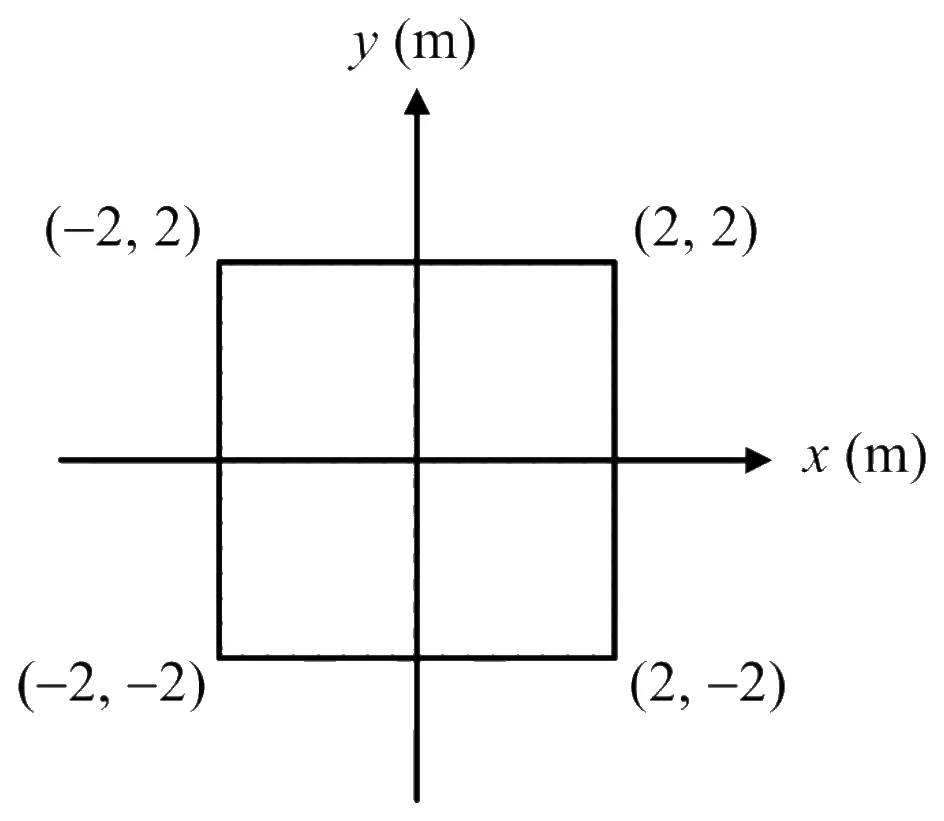
Full question on page 44 of the official paper (PDF)
Show answerHide answer
Key idea: Integrate the density over the area; the absolute value doubles the half where y > 0.
Official answer: C
Option (C). Dropping the absolute value would make the two halves cancel to 0, and 16 is the total without the factor of 4.
Learn the idea:
Q.50
Electromagnetics2 marksMCQ
A field of 0.01 V/m is applied along a copper wire of circular cross-section, 1 mm in diameter. Copper's conductivity is S/m. What current flows, in amperes, to two decimal places?
Full question on page 45 of the official paper (PDF)
Show answerHide answer
Key idea: Ohm's law in point form, J = \sigma E, times the cross-sectional area gives the current.
Official answer: A
To two decimal places, 0.46 A. Option (A). Using the 1 mm diameter as the radius gives 1.82, option (B).
Learn the idea:
Q.51
Engineering Mathematics2 marksMSQ
is non-negative, continuous and bounded on , with maximum and minimum there. For which pairs is guaranteed?
One or more options are correct.
Full question on page 45 of the official paper (PDF)
Show answerHide answer
Key idea: The integral lies between the interval length times the minimum and the interval length times the maximum.
Official answer: A
The interval has length 6, so
6m \le \int_2^8 f(x)\,dx \le 6MA pair is guaranteed to work if \beta \le 6m and \alpha \ge 6M for every such f. Since m, M \ge 0:
- (A) 5m \le 6m and 7M \ge 6M: always holds.
- (B) \alpha = 5M fails for a constant f = 1, whose integral is 6 > 5.
- (C) and (D): \beta = 7m fails for the same constant, since 7 > 6.
Option (A) only.
Learn the idea:
Q.52
Engineering Mathematics2 marksMSQ
Which of these statements about contour integrals, taken counter-clockwise round the unit circle , are TRUE?
One or more options are correct.
Full question on page 46 of the official paper (PDF)
Show answerHide answer
Key idea: By Cauchy's theorem the integral is zero unless the function has a singularity inside the circle with a non-zero residue.
Official answer: A and B
- (A) e^z is analytic everywhere, so the integral is 0: TRUE.
- (B) For n \ge 0, z^n is analytic. For negative even n there is a pole at 0, but \oint_C z^n\,dz is 2\pi j only for n = -1 and 0 for every other integer. TRUE.
- (C) \cos z is analytic, so the integral is 0, and the statement is FALSE.
- (D) \sec z = 1/\cos z has poles at \pm\pi/2, \pm 3\pi/2, \dots, all outside the unit circle, so this integral is 0 too: FALSE.
Options (A) and (B).
Learn the idea:
Q.53
Control Systems2 marksMSQ
A system has states , and and input , with . Which statements are TRUE?
One or more options are correct.
Full question on page 46 of the official paper (PDF)
Show answerHide answer
Key idea: The matrix is diagonal, so each state is a separate first-order system, and each one's pole decides what a bounded input can do to it.
Official answer: B
Each state obeys its own equation (from rest):
- \dot{x}_1 = 2x_1 + u: pole at +2. A constant u = 1 gives x_1 = (e^{2t} - 1)/2, unbounded.
- \dot{x}_2 = -2x_2 + u: pole at -2. For any input with |u| \le U, |x_2| \le U/2, so x_2 is always bounded.
- \dot{x}_3 = u: an integrator. u = 1 gives x_3 = t, unbounded.
So u = 1 makes x_1 unbounded: (B) is TRUE and (A) is FALSE. x_2 can never be unbounded, so (C) is FALSE, and u = 0 keeps everything at zero, so (D) is FALSE. Option (B).
Learn the idea:
Q.54
Communications2 marksMSQ
takes values , 0 and 1 with and , where . Let be the entropy of in bits. Which statements are TRUE?
One or more options are correct.
Full question on page 47 of the official paper (PDF)
Show answerHide answer
Key idea: Entropy is largest when the three outcomes are equally likely, at \alpha = \tfrac{1}{3}, and falls away on either side.
Official answer: B and C
- g(0.25) = 1.5 bits (probabilities 0.25, 0.5, 0.25)
- g(0.3) \approx 1.571 bits (0.3, 0.4, 0.3)
- g(0.4) \approx 1.522 bits (0.4, 0.2, 0.4)
So g(0.3) > g(0.4) and g(0.3) > g(0.25): options (B) and (C). Both make sense: 0.3 is the closest of the three to \tfrac{1}{3}.
Learn the idea:
Q.55
Networks, Signals and Systems2 marksMSQ
is periodic with fundamental period , and with . Their Fourier series are and . Which statements are TRUE?
One or more options are correct.
Full question on page 47 of the official paper (PDF)
Show answerHide answer
Key idea: Compressing a signal in time shrinks its period and raises every harmonic's frequency, but leaves the weight of each harmonic unchanged.
Official answer: A and D
Substitute \alpha t for t in the series for f:
That is exactly the given form for y, so d_k = c_k: (A) is TRUE and (C) is FALSE. y repeats when \alpha t advances by T_0, so its fundamental period is T_0 / \alpha: (D) is TRUE and (B) is FALSE. Options (A) and (D).
Learn the idea:
Q.56
Control Systems2 marksMSQ
Which of the signal flow graphs (A) to (D) in the figure represent the block diagram shown above them? In the block diagram, the error is formed by feeding back only 's output, and .
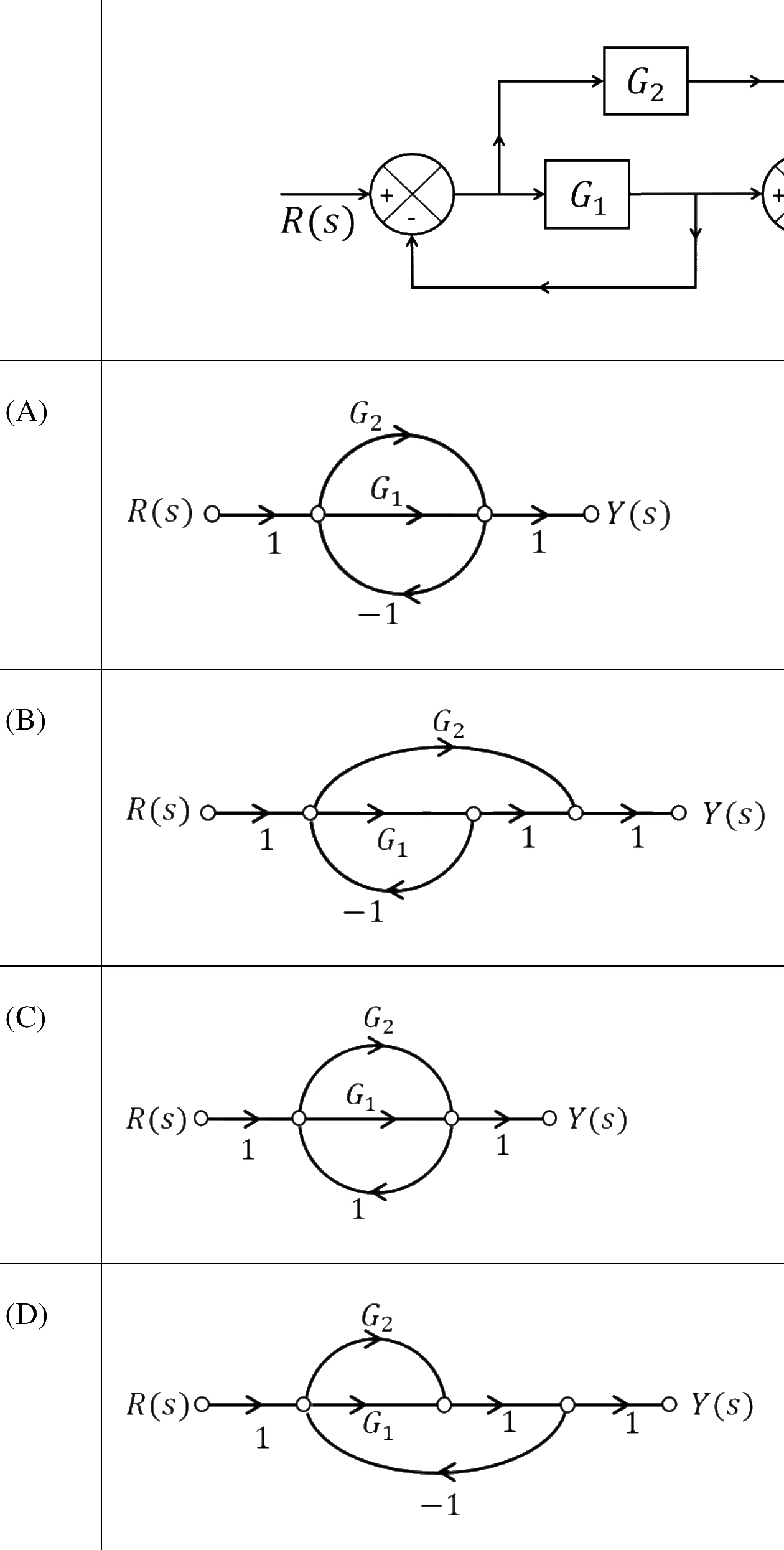
One or more options are correct.
Full question on page 48 of the official paper (PDF)
Show answerHide answer
Key idea: Find where the feedback is taken: here it is after G_1 but before G_2's path joins, so the loop gain is -G_1 alone.
Official answer: B
From the block diagram, E = R - G_1 E, so E = R/(1 + G_1), and
\frac{Y}{R} = \frac{G_1 + G_2}{1 + G_1}Graph (B) has a single loop, G_1 and the -1 branch, with forward paths G_1 and G_2 that both touch it, so Mason's rule gives (G_1 + G_2)/(1 + G_1). It matches.
In (A) and (D) the -1 branch returns from a node where G_2 has already joined, so the loop gain is -(G_1 + G_2) and the result is (G_1 + G_2)/(1 + G_1 + G_2). Graph (C) has positive feedback. Option (B) only.
Q.57
Analog Circuits2 marksMSQ
All diodes in the bridge in the figure are ideal, with across the bridge and across . As is swept from to volts, which of the plots (A) to (D) are correct?
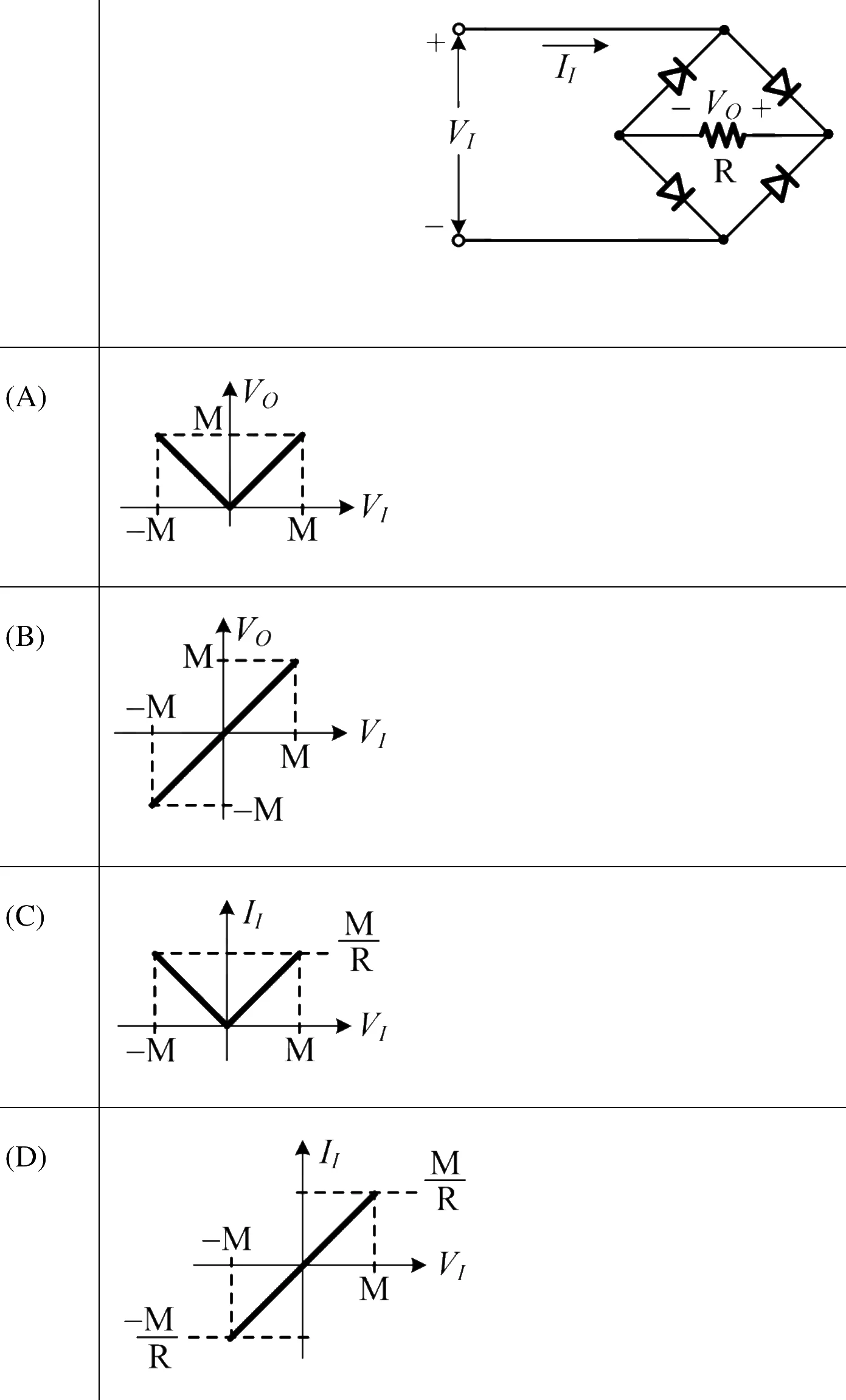
One or more options are correct.
Full question on page 49 of the official paper (PDF)
Show answerHide answer
Key idea: A bridge routes current through the load the same way for either input polarity, but the source current still reverses with the source.
Official answer: A and D
For V_I > 0 one pair of opposite diodes conducts, and for V_I < 0 the other pair does. Either way the current through R flows the same way, so V_O = |V_I|: plot (A), not (B).
The source sees R in either case, but its current reverses with V_I: I_I = V_I / R, a straight line from -M/R to M/R. That is plot (D), not (C). Options (A) and (D).
Learn the idea:
Q.58
Engineering Mathematics2 marksNAT
Two fair six-sided dice are rolled, and is the sum of the outcomes. What is the expectation of ?
Answer format: Rounded off to two decimal places
Full question on page 50 of the official paper (PDF)
Show answerHide answer
Key idea: Expectation is linear: the expected sum is the sum of the expected values.
Official answer: 6.95 to 7.05
So E[X] = 7.00. Listing all 36 outcomes gives the same answer.
Learn the idea:
Q.59
Engineering Mathematics2 marksNAT
With and , what is over real , where is the Euclidean norm?
Answer format: Rounded off to two decimal places
Full question on page 50 of the official paper (PDF)
Show answerHide answer
Key idea: The minimum is the distance from \mathbf{b} to the line through \mathbf{a}: the part of \mathbf{b} perpendicular to \mathbf{a}.
Official answer: 2.95 to 3.05
The best x projects \mathbf{b} onto \mathbf{a}:
The minimum is 3.00.
Learn the idea:
Q.60
Communications2 marksNAT
and take values in with , , and , where . What is the mutual information ?
Answer format: Rounded off to two decimal places
Full question on page 50 of the official paper (PDF)
Show answerHide answer
Key idea: Mutual information is zero exactly when the joint distribution is the product of the marginals.
Official answer: 0
The marginals are P(X = 0) = 0.2, P(X = 1) = 0.8, P(Y = 0) = 0.3 and P(Y = 1) = 0.7. Every joint probability is the product of its marginals:
So X and Y are independent and I(X; Y) = 0.00.
Learn the idea:
Q.61
Analog Circuits2 marksNAT
In the circuit in the figure, V drives , an ideal diode and a 5 V battery in series. The battery's negative terminal is joined to the diode's cathode and its positive terminal to the bottom of the input. For how long in each period of the input is the diode forward biased, in ms?
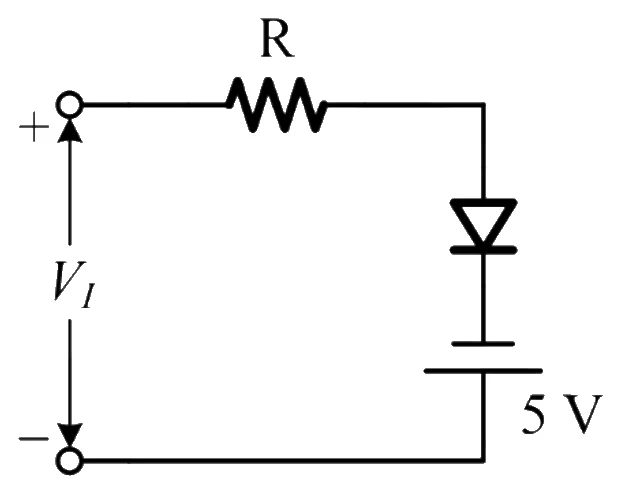
Answer format: ms, rounded off to two decimal places
Full question on page 51 of the official paper (PDF)
Show answerHide answer
Key idea: Read the battery's polarity first: here it pulls the cathode below the input's reference, so the diode conducts for most of the cycle.
Official answer: 13.32 to 13.34
The battery holds the cathode 5 V below the bottom terminal, so the ideal diode conducts whenever V_I > -5 V:
That holds for every \theta except 210° < \theta < 330°: for 240° of each 360°. The period is 2\pi / 100\pi = 20 ms, so
Reading the battery the other way round, with the diode needing V_I > 5 V, gives 6.67 ms.
Learn the idea:
Q.62
Digital Circuits2 marksNAT
In the circuit in the figure, the first flip-flop's Q drives the second's D, and the second's Q and an input go through an AND gate back to the first flip-flop's D. The AND gate's propagation delay is 1 ns, and the flip-flops have a set-up time of 2 ns, a hold time of 0 ns and a clock-to-Q delay of 2 ns. What is the maximum clock frequency with no set-up violations, in MHz?
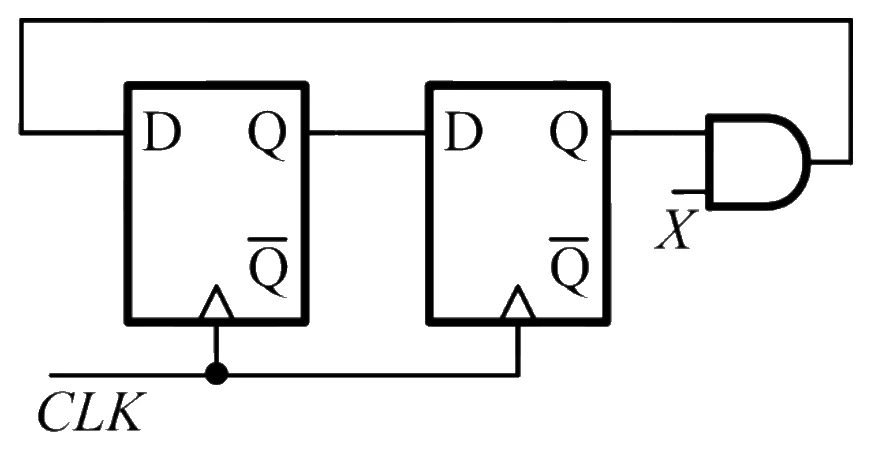
Answer format: MHz, rounded off to the nearest integer
Full question on page 51 of the official paper (PDF)
Show answerHide answer
Key idea: The clock period must cover the slowest register-to-register path: clock-to-Q, then the logic, then set-up.
Official answer: 200
- First flip-flop to second: 2 + 0 + 2 = 4 ns (no logic between them).
- Second flip-flop through the AND gate to the first: 2 + 1 + 2 = 5 ns.
The slower path sets the period, T_{min} = 5 ns, so
Learn the idea:
Q.63
Electronic Devices2 marksNAT
An ideal germanium p-n junction diode has a reverse saturation current of 10 µA at 300 K. With J/K and C, what forward voltage gives a current of 100 mA at 300 K, in volts?
Answer format: Volts, rounded off to two decimal places
Full question on page 52 of the official paper (PDF)
Show answerHide answer
Key idea: Invert the ideal diode equation: the voltage grows with the logarithm of the current ratio.
Official answer: 0.23 to 0.24
To two decimal places, 0.24 V, inside the key's range of 0.23 to 0.24.
Learn the idea:
Q.64
Electromagnetics2 marksNAT
A 50 Ω lossless transmission line is terminated in Ω. If the average incident power is 10 mW, what average power reaches the load, in mW?
Answer format: mW, rounded off to one decimal place
Full question on page 52 of the official paper (PDF)
Show answerHide answer
Key idea: On a lossless line the load gets the incident power minus the reflected power, 1 - |\Gamma|^2 of it.
Official answer: 6.30 to 6.50
Learn the idea:
Q.65
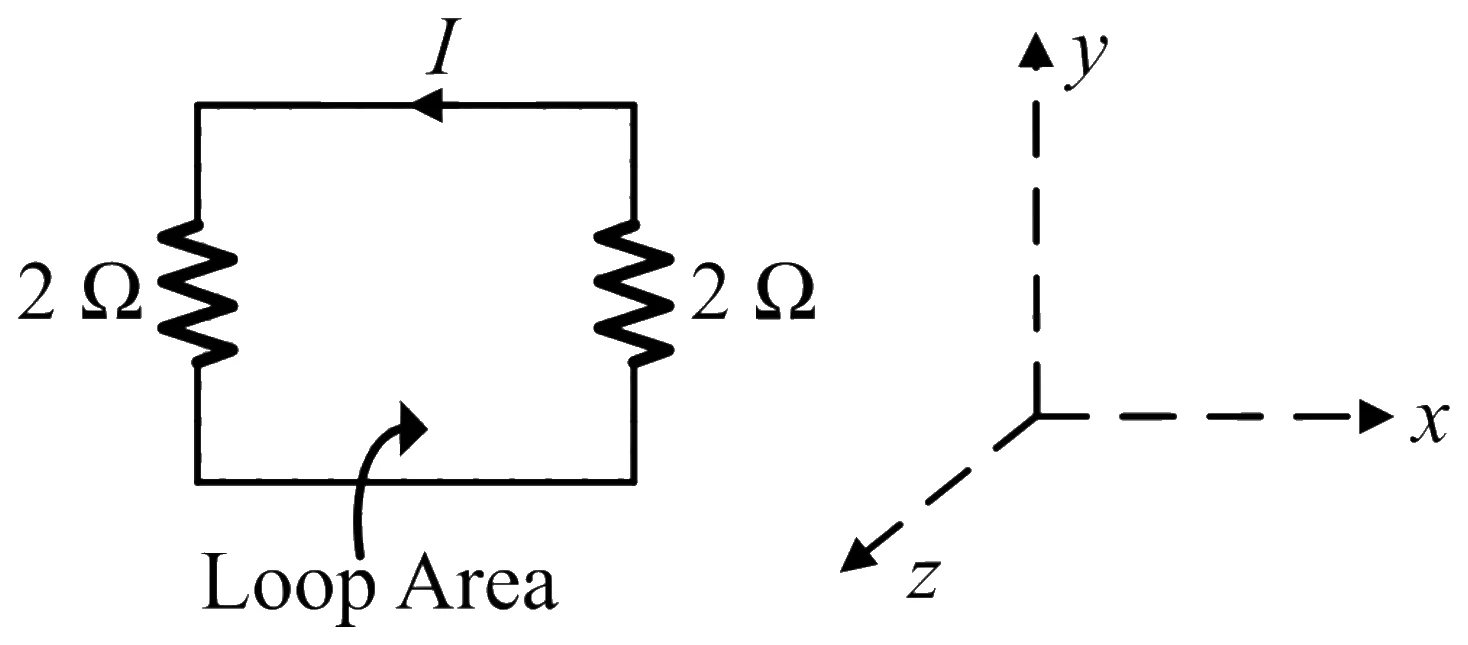
Electromagnetics2 marksNAT
A loop of area 5 m² in the - plane contains two 2 Ω resistors in series, as in the figure. A flux density T is applied along the positive -axis. What is the magnitude of the current in the loop, in amperes?
Answer format: Amperes, rounded off to two decimal places
Full question on page 52 of the official paper (PDF)
Show answerHide answer
Key idea: The induced EMF is the rate of change of flux through the loop, and it drives current through the loop's total resistance.
Official answer: 0.62 to 0.63
The key accepts 0.62 to 0.63, either rounding of 0.625. Using one resistor instead of both gives 1.25 A.
Sources
- GATE 2025 EC question paper (PDF), published by IIT Roorkee. The questions are theirs: we paraphrase each question and its options, and link to the original.
- GATE 2025 EC answer key (PDF). It was published after the challenge window closed. The provisional key is no longer available, so we can't tell which answers, if any, changed between the two. The key gives marks to all for Q8.