GATE EC Communications Previous Year Questions with Solutions
26 Communications questions from the GATE EC 2026 and 2025 and 2024 and 2023 papers, newest first. Try each one, then open its answer: the official answer from that year's key and a worked solution. Each question links to its place in the full paper.
GATE 2026, Q.22
Communications1 markMCQ
A four-level signal (levels ) carries random symbols per second. Find its equivalent Nyquist bandwidth.
Full question on page 22 of the official paper (PDF)
Show answerHide answer
Key idea: Nyquist bandwidth depends on the symbol rate only: half of it.
Official answer: C
With a symbol rate of R_s = 10^4 symbols per second, the number of levels doesn't enter:
B = \frac{R_s}{2} = \frac{10^4}{2} = 5\text{ kHz}Option (C).
GATE 2026, Q.32
Communications1 markNAT
16-QAM carries bit/s over an AWGN channel. Find the minimum transmission bandwidth.
Answer format: MHz, rounded off to two decimal places
Full question on page 31 of the official paper (PDF)
Show answerHide answer
Key idea: Minimum passband bandwidth equals the symbol rate.
Official answer: 0.95 to 1.05
16-QAM carries \log_2 16 = 4 bits per symbol, so the symbol rate is 1 Msymbol/s. A passband signal needs at least the symbol rate in bandwidth (Nyquist pulses, both sidebands):
GATE 2026, Q.44
Communications2 marksMCQ
Coherent QPSK over AWGN is received at dB. Using , find the nearest bit error rate.
Full question on page 41 of the official paper (PDF)
Show answerHide answer
Key idea: QPSK has the same bit error rate as BPSK: \tfrac{1}{2}\mathrm{erfc}\sqrt{E_b/N_0}.
Official answer: B
For Gray-coded coherent QPSK:
P_b = \tfrac{1}{2}\,\mathrm{erfc}\!\left(\sqrt{E_b/N_0}\right)Convert the ratio: E_b/N_0 = 10^{0.84} \approx 6.92, so u = \sqrt{6.92} \approx 2.63. With the given approximation,
The nearest option is 10^{-4}. Option (B).
Learn the idea:
GATE 2026, Q.55
Communications2 marksMSQ
Bandwidth MHz, dBm/Hz and received power dBm over an additive Gaussian channel. What is true of the Shannon capacity ?
One or more options are correct.
Full question on page 52 of the official paper (PDF)
Show answerHide answer
Key idea: Find the SNR in dB, then C = B\log_2(1 + \text{SNR}).
Official answer: C
Noise power in 1 MHz (60 dB-Hz):
So C > 3B is the only true statement. Option (C).
Learn the idea:
GATE 2026, Q.57
Communications2 marksMSQ
A real narrowband signal is , where and vary slowly compared with . Which statements are correct?
One or more options are correct.
Full question on page 54 of the official paper (PDF)
Show answerHide answer
Key idea: Any narrowband signal around a carrier can be written with a slowly varying envelope and phase.
Official answer: A, B and C
Check whether each signal fits the form A(t)\cos[2\pi f_c t + \theta(t)]:
- PSK: constant A(t), and \theta(t) stepping between the symbol phases. True, (A).
- AM: A(t) = A_c[1 + k_a m(t)] and \theta(t) = 0. True, (B).
- Band-limited Gaussian noise around f_c: its envelope (Rayleigh) and phase (uniform) are random processes, but the form is the same. True, (C).
- Narrowband FM: constant A(t) and \theta(t) = 2\pi k_f \int m(\tau)\,d\tau with a small peak deviation. So x(t) can represent it, and (D), which says it never can, is false.
Options (A), (B) and (C).
Learn the idea:
GATE 2026, Q.63
Communications2 marksNAT
A (7, 4) Hamming decoder that corrects one error sees an average bit error rate of 0.10. Find the probability that it decodes a received word wrongly.
Answer format: A probability, rounded off to two decimal places
Full question on page 58 of the official paper (PDF)
Show answerHide answer
Key idea: It fails only when two or more of the seven bits are wrong.
Official answer: 0.10 to 0.20
Subtract the chance of zero or one error in 7 bits from 1:
Learn the idea:
GATE 2025, Q.14
Communications1 markMCQ
An FM signal is , with . What is its peak frequency deviation in Hz?
Full question on page 13 of the official paper (PDF)
Show answerHide answer
Key idea: Frequency deviation is the time derivative of the phase deviation divided by 2\pi, not the sum of the modulation indices.
Official answer: A
The phase deviation is \phi(t) = 3\sin(2\pi f_1 t) + 4\sin(6\pi f_1 t). Differentiating and dividing by 2\pi:
Both cosines equal 1 at t = 0, so the peak is 3f_1 + 12f_1 = 15f_1. Option (A).
The tone at 3f_1 contributes four times its index, 12, because deviation scales with the modulating frequency. Adding the indices, 3 + 4, is the usual slip.
GATE 2025, Q.15
Communications1 markMCQ
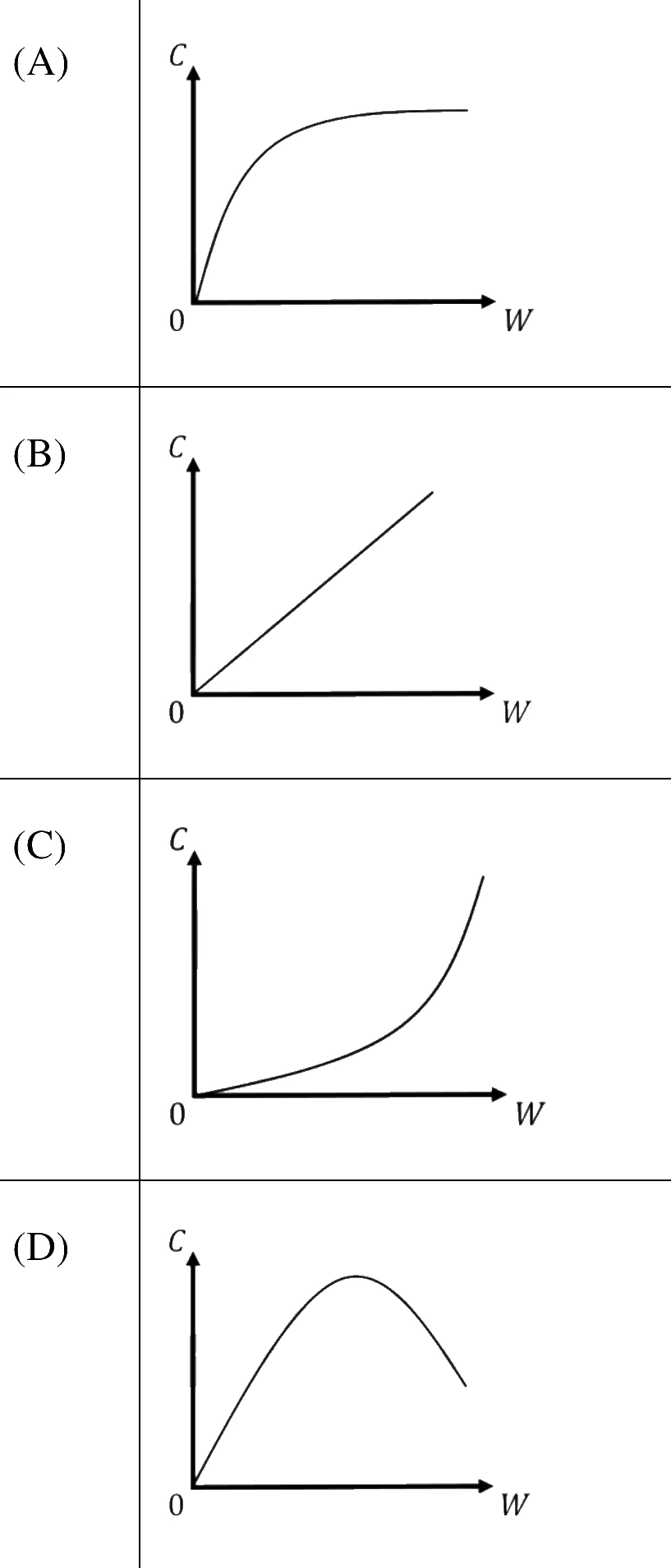
An AWGN channel has bandwidth , noise power spectral density and average power constraint . Which plot in the figure shows how the capacity depends on , with and fixed?
Full question on page 14 of the official paper (PDF)
Show answerHide answer
Key idea: More bandwidth also lets in more noise, so the signal-to-noise ratio falls as W grows.
Official answer: A
By the Shannon-Hartley formula,
C = W \log_2\!\left(1 + \frac{P_{av}}{N_0 W}\right)C is 0 at W = 0 and always increases with W, but ever more slowly. As W \to \infty, using \ln(1 + x) \approx x,
So the curve rises and flattens toward a finite limit: plot (A). It never falls, which rules out (D), and it doesn't grow without limit as (B) and (C) do.
GATE 2025, Q.28
Communications1 markMSQ
is band-limited to Hz. DSB-SC is , and AM is with modulation index . (i) An envelope detector can demodulate DSB-SC if for all . (ii) An envelope detector can demodulate AM only if for all . Which are correct?
One or more options are correct.
Full question on page 27 of the official paper (PDF)
Show answerHide answer
Key idea: An envelope detector recovers whatever multiplies the carrier, provided that factor never goes negative.
Official answer: A and D
The envelope is |A_c\, m(t)| for DSB-SC and |A_c\,(1 + \mu\, m(t))| for AM.
- (i): if m(t) > 0 always, |A_c\, m(t)| = A_c\, m(t), so the envelope is the message. (i) is TRUE.
- (ii): AM needs 1 + \mu\, m(t) > 0, not m(t) > 0. A tone m(t) = \cos(2\pi W t) with \mu = 0.5 goes negative, yet 1 + 0.5\cos(2\pi W t) stays between 0.5 and 1.5, and the envelope detector recovers it. So the "only if" is FALSE.
Options (A) and (D).
Learn the idea:
GATE 2025, Q.33
Communications1 markNAT
A (6,3) binary linear block code has generator matrix . What is the minimum Hamming distance between codewords?
Answer format: An integer
Full question on page 29 of the official paper (PDF)
Show answerHide answer
Key idea: For a linear code, the minimum distance equals the smallest weight of a non-zero codeword.
Official answer: 3
List the 7 non-zero codewords, the sums of the rows of G in every combination, with their weights:
- Single rows: 100101, 010011, 001110 (weight 3 each)
- Two rows: 110110, 101011, 011101 (weight 4 each)
- All three: 111000 (weight 3)
The smallest weight is 3, so d_{min} = 3.
Learn the idea:
GATE 2025, Q.41
Communications2 marksMCQ
A source sends , equally likely to be , or . The receiver gets , where is zero-mean Gaussian noise independent of , and uses a maximum-likelihood decoder. If the probability of a symbol error is , what is ?
Full question on page 36 of the official paper (PDF)
Show answerHide answer
Key idea: With equal priors and Gaussian noise, the ML thresholds sit halfway between neighbouring symbols, and an inner symbol can be pushed out either way.
Official answer: D
The decision thresholds are at -1 and 1. Using the symmetry of N, with P = P(N > 1):
- S = -2 is wrong only if N > 1: probability P.
- S = 0 is wrong if |N| > 1: probability 2P.
- S = 2 is wrong only if N < -1: probability P.
So \alpha = \tfrac{4}{3}. Option (D).
Learn the idea:
GATE 2025, Q.42
Communications2 marksMCQ
, with , for and 0 otherwise, and the pairwise independent, zero-mean and unit-variance. (i) The mean of is independent of . (ii) The autocorrelation is independent of for all . Which option is correct?
Full question on page 37 of the official paper (PDF)
Show answerHide answer
Key idea: Zero-mean coefficients make the mean zero everywhere, but the pulses fill only half of each slot, so the power switches on and off with time.
Official answer: A
(i) E[f(t)] = \sum_n E[a_n]\, p(t - nT) = 0 for every t: TRUE.
(ii) Since E[a_n a_m] is 1 for n = m and 0 otherwise,
At \tau = 0 this is 1 when t is in the first half of a slot and 0 in the second half, so it depends on t: FALSE. Option (A).
Learn the idea:
GATE 2025, Q.54
Communications2 marksMSQ
takes values , 0 and 1 with and , where . Let be the entropy of in bits. Which statements are TRUE?
One or more options are correct.
Full question on page 47 of the official paper (PDF)
Show answerHide answer
Key idea: Entropy is largest when the three outcomes are equally likely, at \alpha = \tfrac{1}{3}, and falls away on either side.
Official answer: B and C
- g(0.25) = 1.5 bits (probabilities 0.25, 0.5, 0.25)
- g(0.3) \approx 1.571 bits (0.3, 0.4, 0.3)
- g(0.4) \approx 1.522 bits (0.4, 0.2, 0.4)
So g(0.3) > g(0.4) and g(0.3) > g(0.25): options (B) and (C). Both make sense: 0.3 is the closest of the three to \tfrac{1}{3}.
Learn the idea:
GATE 2025, Q.60
Communications2 marksNAT
and take values in with , , and , where . What is the mutual information ?
Answer format: Rounded off to two decimal places
Full question on page 50 of the official paper (PDF)
Show answerHide answer
Key idea: Mutual information is zero exactly when the joint distribution is the product of the marginals.
Official answer: 0
The marginals are P(X = 0) = 0.2, P(X = 1) = 0.8, P(Y = 0) = 0.3 and P(Y = 1) = 0.7. Every joint probability is the product of its marginals:
So X and Y are independent and I(X; Y) = 0.00.
Learn the idea:
GATE 2024, Q.14
Communications1 markMCQ
A digital system sends symbols through a noiseless channel band-limited to . The received signal is , where is the overall response to one symbol and has Fourier transform , and it is sampled at . Which Nyquist condition must satisfy for zero intersymbol interference?
Full question on page 12 of the official paper (PDF)
Show answerHide answer
Key idea: A question given marks to all scores full marks for every candidate, whatever they answered.
Official answer: Marks to all
The final key awards marks to all for this question and doesn't say why, so we don't pick an option.
The idea behind it: zero ISI means x(nT) is zero for every n \neq 0. Sampling at 1/T repeats X(f) every 1/T in frequency, so the condition is that the shifted copies add to a constant, \sum_m X(f + m/T) = T\,x(0). One likely reason for the ruling is that the question doesn't say what x(0) is, so the constant on the right isn't fixed.
Ruling in the key: The final key gives marks to all (MTA) for this question: every candidate received its 1 mark.
GATE 2024, Q.20
Communications1 markMCQ
Zero-mean white Gaussian noise with power spectral density passes through a first-order RC low-pass filter, giving . What is the variance of at any time ?
Full question on page 17 of the official paper (PDF)
Show answerHide answer
Key idea: The output variance is the input PSD integrated against |H(f)|^2 over all frequencies.
Official answer: A
|H(f)|^2 = \frac{1}{1 + (2\pi f RC)^2}The output is stationary, so this holds at every t_k. Option (A).
Learn the idea:
GATE 2024, Q.28
Communications1 markNAT
An amplitude modulator's output is V. The carrier power, normalised to 1 Ω, is 50 W, and the total sideband power is of the total power. What is , in volts?
Answer format: Volts, rounded off to two decimal places
Full question on page 24 of the official paper (PDF)
Show answerHide answer
Key idea: Each cosine of amplitude a carries a^2/2 into 1 Ω, so carrier and sidebands can be added as separate powers.
Official answer: 2.49 to 2.51
The carrier power is A^2/2 = 50 W. The two sidebands carry B^2/2 each, B^2 together:
Learn the idea:
GATE 2024, Q.34
Communications1 markNAT
A source sends symbols from an alphabet of 16. What is the maximum achievable entropy, in bits?
Answer format: Bits
Full question on page 26 of the official paper (PDF)
Show answerHide answer
Key idea: Entropy is largest when every symbol is equally likely.
Official answer: 4
H_{max} = \log_2 16 = 4\ \text{bits}Learn the idea:
GATE 2024, Q.45
Communications2 marksMCQ
A source sends from with equal probability over an AWGN channel: , with zero-mean, variance 4 and independent of . With , what is the optimum symbol error probability?
Full question on page 35 of the official paper (PDF)
Show answerHide answer
Key idea: With equal priors the optimum thresholds are midway between symbols, and the middle symbol can be pushed out on either side.
Official answer: B
The thresholds are at \pm 2, a distance 2 from each symbol, and \sigma = 2, so each one-sided error has probability Q(2/2) = Q(1):
- s = -4: Q(1)
- s = 0: 2Q(1)
- s = 4: Q(1)
Option (B). Dividing the distance 2 by the variance 4 instead of \sigma gives Q(0.5), and forgetting the standard deviation altogether gives Q(2).
Learn the idea:
GATE 2024, Q.47
Communications2 marksMCQ
The bits 1 1 1 0 1 0 1 0 1 are encoded with CRC-4, generator . What is the encoded sequence?
Full question on page 36 of the official paper (PDF)
Show answerHide answer
Key idea: Append four zeros, divide by the generator in modulo-2 arithmetic, and append the 4-bit remainder.
Official answer: A
The generator is 10011. Dividing 1110101010000 by it, with XOR in place of subtraction at each step, leaves the remainder 1100.
So the codeword is the message followed by 1100: 1 1 1 0 1 0 1 0 1 1 1 0 0. Option (A). A check: the codeword itself divides by 10011 with no remainder.
Learn the idea:
GATE 2024, Q.57
Communications2 marksNAT
, with uniform on and uniform on , independent. It feeds an 8-bit uniform mid-rise quantiser, and its autocorrelation is . What is the signal-to-quantisation-noise ratio at the output, in dB?
Answer format: dB, rounded off to two decimal places
Full question on page 44 of the official paper (PDF)
Show answerHide answer
Key idea: Signal power is R_X(0), and a uniform quantiser's noise power is \Delta^2/12 with \Delta the full range over 2^n.
Official answer: 45.00 to 45.30
The signal swings over [-2, 2], so with 8 bits \Delta = 4/256 = 1/64 and the noise power is \Delta^2/12 = 1/49152. The signal power is R_X(0) = 2/3:
Learn the idea:
GATE 2023, Q.27
Communications1 markMCQ
Let be a strictly band-limited signal with bandwidth and energy . Assuming , what is the energy in the signal ?
Full question on page 19 of the official paper (PDF)
Show answerHide answer
Key idea: Modulation splits the spectrum into two half-height copies; with \omega_0 > B they don't overlap.
Official answer: B
The Fourier transform of m(t)\cos\omega_0 t is
\tfrac{1}{2}\left[M(\omega - \omega_0) + M(\omega + \omega_0)\right]Each copy has a quarter of the energy density, |M|^2/4, and since \omega_0 = 10B the copies don't overlap, so the energies add: E/4 + E/4 = E/2. Option (B). In the time domain, \cos^2\omega_0 t = \tfrac{1}{2}(1 + \cos 2\omega_0 t), and the \cos 2\omega_0 t part integrates to zero.
Learn the idea:
GATE 2023, Q.30
Communications1 markMSQ
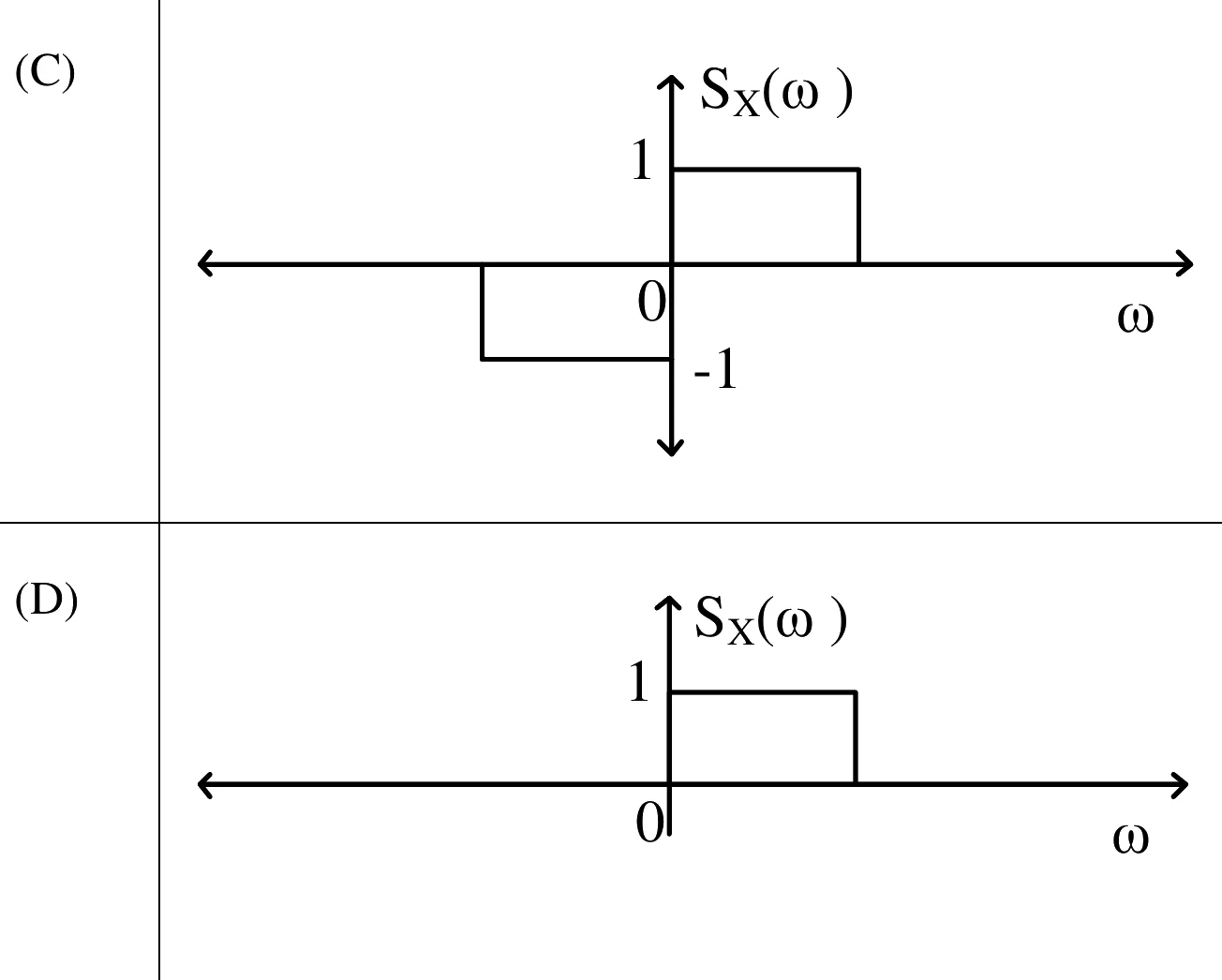
For a real signal, which of the following is/are valid power spectral density/densities? Options (C) and (D) are the plots in the figure.
One or more options are correct.
Full question on page 21 of the official paper (PDF)
Show answerHide answer
Key idea: The PSD of a real signal is real, never negative, and even in \omega.
Official answer: A and B
- (A) 2/(9 + \omega^2) is positive and even: valid. It is the PSD of e^{-3|\tau|}/3.
- (B) e^{-\omega^2}\cos^2\omega is never negative and is even: valid.
- (C) is negative for \omega < 0: not a PSD.
- (D) is not even: for a real signal S_X(-\omega) = S_X(\omega), so a one-sided band isn't valid.
Options (A) and (B).
GATE 2023, Q.45
Communications2 marksMCQ
An FM signal , where has bandwidth , is passed through a non-linear system with output . Let denote the FM bandwidth. What is the minimum value of required to recover from ?
Full question on page 32 of the official paper (PDF)
Show answerHide answer
Key idea: Squaring an FM wave gives a DC term and an FM wave at 2\omega_c with twice the deviation, so twice the bandwidth.
Official answer: B
The term at 2\omega_c occupies 2\omega_c \pm B_T (twice the deviation, so twice the bandwidth), while x(t) occupies \omega_c \pm B_T/2, and the DC term sits at 0. A bandpass filter can keep x(t) alone if the bands don't overlap:
The DC term needs only \omega_c > B_T/2, which this already meets. Option (B).
GATE 2023, Q.59
Communications2 marksNAT
is white Gaussian noise with power spectral density W/Hz. It is input to an LTI system with impulse response . What is the average power of the system output, in W?
Answer format: W, rounded off to two decimal places
Full question on page 42 of the official paper (PDF)
Show answerHide answer
Key idea: For white noise of PSD S_0, the output power is S_0 \int |h(t)|^2 dt, by Parseval.
Official answer: 0.24 to 0.26
In the frequency domain, |H(f)|^2 = 1/(1 + 4\pi^2 f^2), whose integral over all f is also \tfrac{1}{2}. Answer: 0.25.
GATE 2023, Q.65
Communications2 marksNAT
Eight symbols a to h occur with frequencies , , , , , , and . A symbol is chosen, and it is identified by a series of truthfully answered yes/no questions. What is the average number of questions when they are asked in the most efficient sequence?
Answer format: rounded off to two decimal places
Full question on page 44 of the official paper (PDF)
Show answerHide answer
Key idea: The best question sequence is a Huffman code: each question is one bit.
Official answer: 1.97 to 1.99
Ask "is it a?", then "is it b?", and so on: a takes 1 question, b 2, ..., f 6, and g and h 7 each. This is the Huffman code for these probabilities, so no sequence does better on average:
Every probability is a power of \tfrac{1}{2}, so this equals the entropy exactly. Answer: 1.98.